Water carts: common types and configurations in WA
From 15,000 litre truck carts to 120,000 litre rigid builds, a plain guide to the main water cart types and configurations used across WA sites.
 billrayshermac
Western Australia runs more water carts, in more shapes, than almost anywhere in the country. The reason is simple: the state combines enormous mining operations, a busy civil and infrastructure sector, and some of the harshest, dustiest terrain a vehicle can work in. Keeping dust down on a Pilbara haul road and damping a suburban roadworks site are different jobs, and they call for different machines.
That's why "water cart" is a broad term rather than a single product. Before you spec, hire, or buy one, it helps to understand the main types in use across WA and the configurations that separate them. Here's how they break down.
What a water cart actually does
At its core, a water cart is a purpose-built truck that stores and distributes water across a worksite. The main job is dust suppression, laying water on haul roads and work areas to keep airborne dust down, which improves visibility, protects workers' respiratory health, and helps sites meet environmental requirements. Beyond that, water carts handle haul-road conditioning, general road maintenance, and can support fire response and wash-down tasks.
In WA conditions, heat, abrasive dust, corrugated haul roads, and long remote shifts mean that jobs are demanding enough that the build quality of the cart matters as much as the water it carries.
The main types of water cart used in WA
Truck-mounted water carts (6x4, 6x6, 8x4, 8x8)
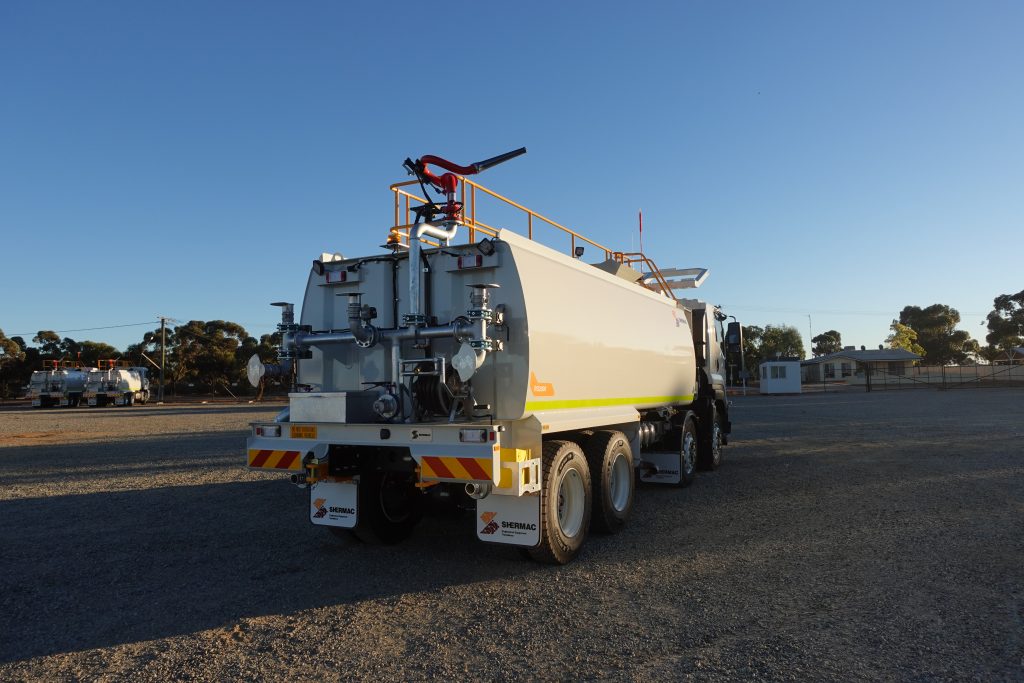
These are water tanks mounted on a rigid truck chassis, and they're the most versatile type. Shermac's Roadserve 1500 Series 6x4 and 6x6 carts carry up to 15,000 litres, while heavier 8x4 and 8x8 builds go up to 40,000 litres. Their compact footprint and manoeuvrability suit civil construction, roadworks, quarries, and smaller mining tasks, anywhere you need dependable dust control without the scale of a haul-truck cart.
Semi off-road water carts
A semi cart pairs a prime mover with a purpose-built water trailer, giving you high-volume capacity for long-haul supply and extended routes. Shermac's Roadserve 3000 Series semi carts run high capacities suited to larger fleet setups, with a curved, low-profile tank for better weight distribution and surge control. They suit contractors and operations covering distance rather than a single tight site.
Rigid off-road water carts
For large-scale mining, rigid carts are built on OEM mining haul-truck chassis and carry the biggest volumes. Shermac's Roadserve 5000 rigid carts can be engineered up to 120,000 litres, built to suit Cat 773, 775, 777, 785, and 789 class trucks and equivalent Komatsu HD chassis. These are the workhorses of sustained, high-production haul-road suppression, where refilling less often and covering more road per pass is what keeps a big operation moving.
Articulated off-road water carts
Where terrain gets tight, steep, or uneven, articulated carts earn their place. Shermac's Roadserve 4000 articulated carts hold up to 50,000 litres and are built on Cat, Komatsu, Bell, and Volvo articulated platforms, including the Cat 740 and 745, Komatsu HM300 and HM400, and Volvo A35 and A40. The articulation point gives a tight turning radius and strong traction, so they navigate ramps, switchbacks, and confined haul roads that a rigid cart would struggle with.
Key configurations to understand
Type sets the scale. Configuration decides how the cart actually performs, and it's where two carts of the same size can be very different machines.
- Capacity. Across the range, tank sizes run from around 6,000 litres up to 120,000 litres, matched to the chassis GVM and the site's water demand and haul distances.
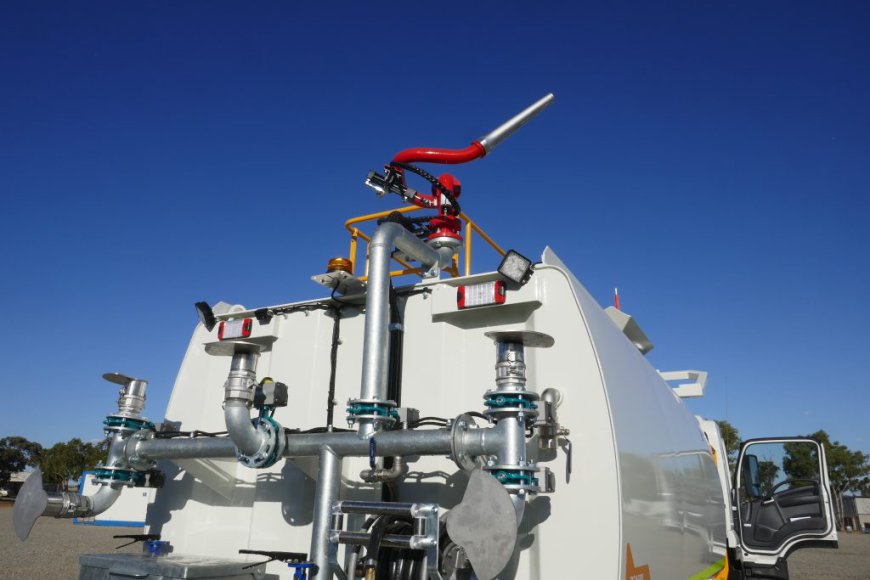
- Spray systems and control. This is the heart of dust suppression. A well-configured cart runs left and right batter sprays, a centre fan spray, a full-width dribble bar, and a hydraulic water cannon, all managed from an ergonomic in-cab panel with joystick control of the cannon. That lets the operator adjust coverage on the move without leaving the cab, which matters for both even watering and operator safety.
- Tank construction. The best tanks are fully baffled steel, with transverse and longitudinal baffling to control surge under braking, and a curved, low centre-of-gravity design for stability on uneven ground. Rigid carts use 10mm floor plates and 8mm wall and baffle plates, and tanks are typically grit-blasted, epoxy-lined internally, and finished with a two-pack external paint system, with extra coatings available for corrosive or high-abrasion sites.
- Mine-spec safety features. For any cart working a mine site, these come as standard on a quality build: ROPS, isolation points, emergency stops, compliant lighting, wheel chocks, wheel nut indicators, flags, high-vis tape, and cabin-mounted strobes, with FOPS available where required.
- Filling and pumps. Hydraulic-driven centrifugal pumps deliver consistent flow, and self-fill options, a three-inch camlock with directional valves, snorkels, and top-fill points, let a cart refill from dams, standpipes, or other sources without extra plant.
Matching the cart to the job in WA
Large mining operations chasing sustained haul-road coverage lean toward high-capacity rigid and articulated carts on haul-truck chassis. Civil, roadworks, and quarry operators, who need manoeuvrability and mid-range volume, are better served by truck-mounted 6x4, 6x6, 8x4, and 8x8 carts or a semi for longer runs. Across all of them, the spray configuration and mine-spec build should follow the actual application rather than a fixed template.
You can see the full spread of types across Shermac's water cart range, which spans the compact truck-mounted builds through to the large off-road platforms.
Frequently asked questions
What size water cart do I need?
Match capacity to your water demand and haul distances rather than buying the biggest tank. Civil and roadworks jobs are often well served by 15,000 litre truck-mounted carts, while large mining operations running continuous suppression benefit from the higher volumes of rigid and articulated builds to cut refill trips.
What chassis can water carts be built on?
It depends on the type. Truck-mounted carts suit standard 6x4, 6x6, 8x4, and 8x8 truck chassis, while rigid and articulated mining carts are built on OEM haul-truck platforms from Cat, Komatsu, Bell, and Volvo. Tank geometry and mounting are matched to the chosen chassis to keep GVM and axle loads compliant.
Are all water carts mine-spec compliant?
No, and it's worth checking. A cart built for a mine site should come with mine-spec safety features as standard, isolation points, emergency stops, compliant lighting, ROPS, and safe access, rather than added later. If a cart can't demonstrate them, it isn't ready for a compliant site.