Turnstile Speed Gates for High-Security Environments in UAE
Turnstile Speed Gates paired with proper Turnstile Access Control now give UAE facilities a full spectrum of options, from cost-effective Tripod Turnstile Gates and elegant Swing Barrier Turnstile Gates to maximum-security Full Height Turnstile Gates and fast Flap Barrier Turnstile Gates.
 tekiftequar
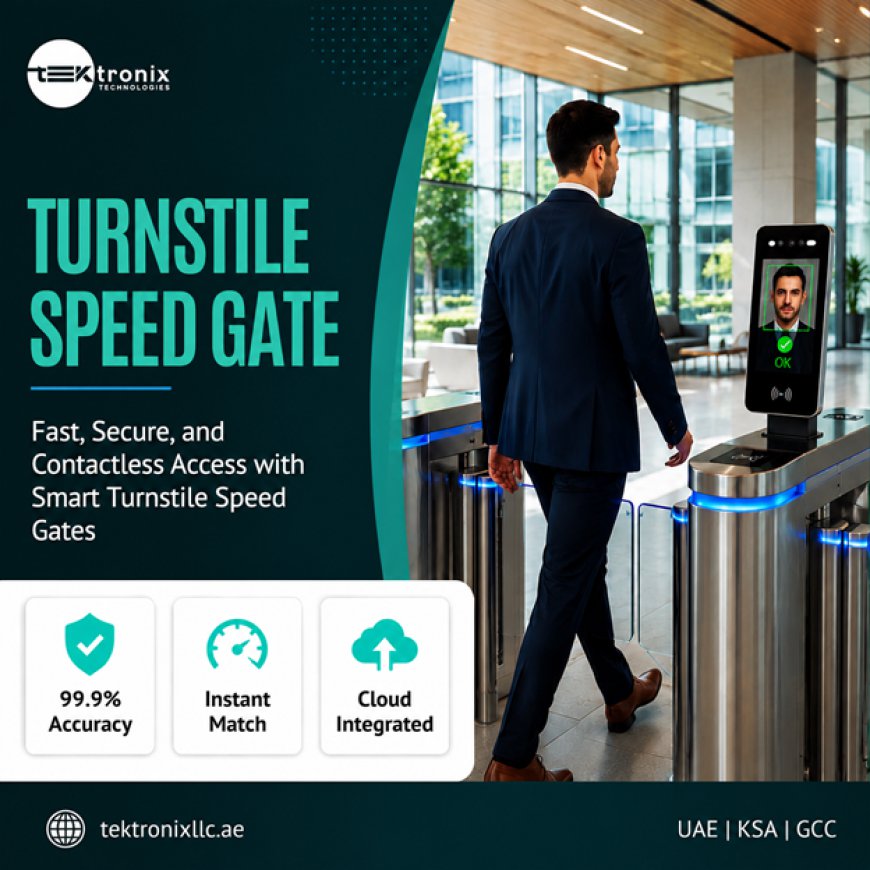
Turnstile Speed Gates are becoming the standard physical barrier for UAE corporate towers, government buildings, and transit facilities that need to combine fast pedestrian throughput with genuine perimeter security. As Dubai and Abu Dhabi continue to add high-density office towers, stadiums, and transport hubs, an unmonitored door or a slow single-lane turnstile can no longer keep pace with the volume of staff and visitors moving through a busy lobby each morning. This guide explains the different gate types available, how they pair with biometric verification, and what to evaluate before specifying one for your facility.
Why UAE Facilities Are Upgrading to Modern Turnstile Systems
The UAE's rapid growth in business towers, transit infrastructure, and large public venues has significantly increased the daily volume of people passing through a single lobby or entrance. A manual guard checkpoint or a slow, single-lane gate cannot verify identity in real time, log every entry event, or keep pace with morning rush-hour arrivals — gaps that become more expensive to ignore as a building's occupancy grows.
Rising Security Demands Across Dubai and Abu Dhabi
Business towers in DIFC, Dubai Internet City, and Abu Dhabi Global Market host dozens of tenant companies under one roof, each contributing to a large daily flow of staff, couriers, and visitors through a shared lobby. Entry systems designed for a smaller, single-tenant building simply cannot keep pace with this density without long queues forming during peak arrival hours.
From Manual Guards to Automated Pedestrian Control
Facilities that once relied entirely on security personnel checking badges by hand are increasingly layering automated gate hardware into their lobbies, producing a timestamped log of every entry event without requiring a guard to manually inspect each credential. This shift reduces dependency on any single guard's vigilance and creates a far more reliable record for post-incident investigations.
Turnstile Access Control: Coordinating Entry Across Every Gate
This layer of technology connects each physical gate to a centralized credential and policy system, so a single access rule — such as restricting a service entrance after hours — applies consistently across every lane in a lobby rather than needing separate configuration at each gate individually. Coordinating multiple lanes this way also allows security teams to monitor entry activity across an entire facility from one dashboard rather than checking each gate's local log separately.
Tripod Turnstile Gates: Cost-Effective Control for Moderate-Security Areas
These compact, waist-height barriers offer a straightforward, budget-friendly option for controlling pedestrian flow in areas where extremely high security is not the primary concern, such as staff cafeterias, gyms, or secondary building entrances. Their smaller footprint makes them easy to install in tighter lobby spaces, though the modest physical barrier they provide is best suited to low-to-moderate risk areas rather than a facility's main high-security entrance.
Swing Barrier Turnstile Gates: Balancing Accessibility and Security
These gates use swinging glass or acrylic panels rather than rotating arms, offering a more premium appearance for corporate lobbies while still physically restricting unauthorized entry. Their wider lane design also makes them more accommodating for wheelchair users, luggage, or trolleys than a narrower tripod-style gate, which is a meaningful consideration for accessibility compliance in modern UAE developments.
Full Height Turnstile Gates: Maximum Security for Perimeter Entry
These floor-to-ceiling rotating barriers provide the strongest physical deterrent against tailgating or forced entry, making them well suited to outdoor perimeter checkpoints, staff-only entrances, and facilities where climbing over or ducking under a barrier must be effectively impossible. Their imposing physical footprint makes them less common in client-facing corporate lobbies, but a natural fit for industrial sites, data centers, and stadium perimeter access.
Flap Barrier Turnstile Gates: Fast, Elegant Throughput for Corporate Lobbies
These gates use retracting flap panels that open and close quickly, offering some of the fastest pedestrian throughput available while still maintaining a physical barrier against unauthorized entry. Their slim profile and quiet operation make them a popular choice for premium corporate lobbies and government buildings where both aesthetics and speed matter alongside security.
Intelligent Facial Recognition Turnstiles: Merging Biometric Verification with Physical Barriers
Pairing a gate directly with a facial verification camera allows a lane to open automatically the instant an enrolled staff member is recognized, removing the need to present a card or badge at all. This combination closes a gap that card-only turnstiles cannot: even if a badge is lost, shared, or cloned, the physical gate itself will not open without a live, matching face at the point of entry. Facilities exploring an intelligent turnstile system for UAE lobbies should confirm the recognition camera and gate mechanism are properly synchronized, since a slow handoff between the two can create the exact queuing problem the upgrade was meant to solve.
Biometric Turnstiles: Extending Verification Beyond the Face
Beyond facial recognition, some deployments pair gates with fingerprint or palm-vein readers for facilities that need an additional or alternative verification method at specific lanes. This flexibility allows a single lobby to offer multiple verification paths — facial recognition for general staff traffic and a secondary biometric method for a smaller group requiring an extra layer of confirmation at a more sensitive internal gate.
Building a Long-Term Gate Upgrade Roadmap
Rather than replacing every lobby entrance at once, many organizations find it more practical to phase a turnstile modernization across one or two budget cycles, prioritizing the highest-traffic or highest-risk entrances first before extending the same platform to secondary doors. This phased approach also makes it easier to secure internal budget approval, since each stage can be justified on its own merits rather than requiring sign-off for an entire building-wide overhaul at once. Organizations that document this roadmap clearly, including target dates for each phase and the specific throughput or security problem each stage solves, tend to maintain stronger executive support throughout the rollout than those treating it as a single undefined project.
Scaling Turnstile Deployment as Your Facility Grows
A gate configuration that works well for a single-lobby office with modest occupancy may behave very differently once a facility expands to additional floors, a second building, or a much larger tenant base. Organizations should evaluate how easily a platform can add new lanes, new gate hardware, and additional credential capacity without requiring a complete system redesign each time occupancy or footprint changes. Vendors with genuine multi-site experience in the region typically have established processes for this kind of scaling, while those without it often struggle when a client's needs outgrow the original single-lobby deployment.
Aligning Turnstile Investment with UAE Smart-Building Standards
The UAE's continued push toward smart-city and smart-building standards across Dubai and Abu Dhabi means new commercial developments increasingly specify biometric-ready gate infrastructure from the earliest design stages rather than retrofitting it after construction. Developers and enterprise tenants alike benefit from aligning their entry specification with these broader smart-building expectations, since doing so both future-proofs the investment and signals a level of operational maturity that increasingly matters to prospective tenants, investors, and regulators evaluating a building's overall quality.
Incident Response: Handling Gate Failures and Suspicious Attempts
Even a well-tuned gate system will occasionally reject a legitimate staff member due to a damaged card, a camera obstruction, or a temporary biometric mismatch, and facilities need a clear fallback procedure for these moments rather than simply leaving a lane propped open. A documented exception process — typically involving a manual verification step by security personnel and a logged override — keeps the audit trail intact even when the automated system cannot make a confident decision. Equally important is a clear escalation path for repeated tailgating attempts at a single lane, so security teams can distinguish a genuine technical glitch from a deliberate attempt to bypass the gate.
Common Deployment Scenarios: Corporate Towers, Stadiums, and Transit Hubs
Corporate towers typically prioritize flap or swing barrier gates in the main lobby for a fast, polished staff experience, often paired with full height gates at secondary or after-hours entrances. Stadiums and large public venues need to process extremely high pedestrian volumes in short windows before an event starts, favouring gate types optimized for raw throughput over premium aesthetics. Transit hubs such as metro stations balance both concerns, needing gates that move large daily commuter volumes quickly while still preventing fare evasion or unauthorized platform access.
Integration with Existing Building and Security Systems
A turnstile upgrade rarely stands alone — most deployments need to integrate with existing access control platforms, visitor management kiosks, and building-wide video surveillance already in place. Organizations should confirm that a prospective gate system can work alongside legacy card readers during a phased rollout, rather than requiring an all-at-once replacement of every lane in the lobby on a single go-live date.
Data Privacy and Governance for Turnstile-Based Verification
Because facial and biometric turnstile deployments capture identity data at every entry event, organizations need clear policies on how this data is encrypted, retained, and who internally can access it. UAE organizations should confirm that enrollment and match logs are stored securely, that departing staff have their credentials properly and promptly revoked, and that the platform's data handling aligns with the organization's own internal privacy commitments to its workforce.
Measuring Return on Investment for Turnstile Upgrades
The cost case for modern gate hardware usually rests on reduced queuing time during peak arrival hours, fewer security incidents tied to tailgating or shared credentials, and a stronger audit trail that simplifies compliance reviews and incident investigations. Organizations that previously staffed a manual checkpoint at every lobby entrance often find that automated gates absorb much of that workload, freeing security personnel for patrols and exception handling rather than routine credential checks.
Staff and Visitor Training for New Gate Systems
Even the most reliable gate hardware depends on staff and frequent visitors understanding how the new process works. A short orientation — explaining how the camera capture works, what to do if a lane rejects a valid credential, and how to report an issue — significantly reduces confusion and help-desk friction in the weeks following a rollout. Organizations that skip this step often see a spike in support requests during the first month, not because the technology is unreliable, but because people were never given a clear explanation of how the new gates differ from the manual checkpoint they replaced.
Multi-Site Deployment: Managing Turnstiles Across Several UAE Locations
Organizations operating more than one office or facility across the UAE benefit significantly from a centralized management platform that oversees credentials, gate status, and access logs across every site from a single dashboard. This is particularly valuable for companies with offices in both Dubai and Abu Dhabi, since security teams can apply consistent policies everywhere rather than managing each location's gates as an isolated system with its own separate database.
Choosing the Right Vendor: Questions to Ask Before You Commit
Organizations evaluating a provider should ask for specific examples of comparable regional deployments at similar throughput volumes, not just generic commercial references from unrelated markets. Useful questions include how the gate mechanism handles a power interruption, whether lanes fail open or fail locked during an outage, and how the vendor has validated throughput speed under actual peak-hour conditions rather than in a quiet demo environment.
Physical Design Considerations for High-Traffic Lobbies
Lane width, the number of gates installed relative to expected peak traffic, and the physical flow of the lobby around the gates all affect real-world throughput just as much as the gate hardware itself. A lobby with too few lanes for its occupancy will create queues regardless of how fast each individual gate operates, while poorly planned approach paths can cause pedestrian bottlenecks before people even reach the gate line.
Business Continuity: What Happens When the Network Goes Down
A gate system that depends entirely on a live network connection to a central server introduces a single point of failure that facility managers need to plan around carefully. Well-designed controller architectures cache recent credential and policy data locally, allowing gates to continue operating on cached rules for a defined period even if connectivity to the central system is temporarily lost. Organizations should ask vendors directly how their gates behave during an outage, since the answer has real operational and safety implications.
Comparing Turnstile Types: Throughput vs. Security Trade-offs
Every gate type sits somewhere on a spectrum between raw pedestrian throughput and physical security strength, and no single option maximizes both simultaneously. Flap and swing barrier gates favor speed and aesthetics for staff-facing lobbies, tripod gates favour cost efficiency for lower-risk areas, and full height gates favor maximum physical deterrence at the expense of both speed and visual appeal. Facilities typically achieve the best overall result by mixing gate types across a single site — fast, elegant lanes for general staff traffic and full height barriers reserved for perimeter or after-hours entrances — rather than forcing one gate type to serve every purpose.
Total Cost of Ownership Beyond Initial Hardware
Organizations comparing providers often focus heavily on the upfront cost of gate hardware, but the total cost of ownership over a multi-year deployment includes software licensing, mechanical maintenance, firmware updates, and the labor required for credential management as staff join and leave. A cheaper initial hardware quote can end up costing more over several years if the vendor's mechanical support response times are slow or if replacement parts are difficult to source locally in the UAE.
Turnstile Speed Gates UAE: Market Overview
Adoption across the country is accelerating fastest in corporate towers, free zones, transit infrastructure, and large public venues, driven by both rising occupancy density and increasing expectations for a professional, secure arrival experience. Facility owners across the Emirates are increasingly specifying automated gate hardware as a standard requirement in new building fit-outs rather than an optional upgrade.
Why Organizations Choose Tektronix LLC
Tektronix LLC has delivered turnstile and pedestrian access projects for corporate, government, and transit clients across the UAE and wider GCC, with engineering teams experienced in matching gate types to throughput requirements and integrating biometric verification directly into gate hardware. Its regional deployment portfolio spans single-lobby corporate towers to multi-gate transit and stadium installations requiring centralized oversight. Organizations evaluating a rollout can review the full Tektronix LLC turnstile speed gates for the UAE to see how these capabilities are applied on real regional projects.
Implementation Checklist for Turnstile Deployment
Before selecting a provider, facility and security managers should confirm the following:
● Gate throughput has been validated under actual peak-hour traffic conditions
● Lane count is sized appropriately for the facility's expected occupancy
● Biometric integration is synchronized properly with gate opening speed
● The platform integrates with existing access control and visitor-management systems
● Fail-open or fail-locked behaviour during a power or network outage is clearly defined
● Replacement parts and mechanical support are readily available in the UAE
● Vendor references include comparable regional deployments, not only international case studies
Conclusion
Turnstile Speed Gates paired with proper Turnstile Access Control now give UAE facilities a full spectrum of options, from cost-effective Tripod Turnstile Gates and elegant Swing Barrier Turnstile Gates to maximum-security Full Height Turnstile Gates and fast Flap Barrier Turnstile Gates. Intelligent Facial Recognition Turnstiles and Biometric Turnstiles add verification directly into the gate itself, closing gaps that card-only lanes cannot. As Turnstile Speed Gates UAE adoption continues to expand across corporate towers and transit hubs, facilities that choose the right mix of gate types now will move people faster while keeping a far stronger audit trail than manual checkpoints ever could.
Frequently Asked Questions
1. Which gate type is best for a corporate office lobby?
Flap or swing barrier gates are typically preferred for staff-facing corporate lobbies since they balance fast throughput with a more premium appearance than tripod or full height options.
2. Can turnstiles be combined with facial recognition?
Yes, many modern deployments pair a gate directly with a facial verification camera so the lane opens automatically for a recognized, enrolled individual without requiring a card or badge.
3. What happens to the gates during a power outage?
This depends on the specific system configuration; organizations should confirm with their vendor whether gates fail open, fail locked, or continue operating on cached credential data during an outage.
4. How many lanes does a lobby actually need?
Lane count should be sized based on expected peak-hour occupancy rather than average daily traffic, since undersized lane counts create queues even when individual gates operate quickly.
5. Are full height turnstiles suitable for a main corporate entrance?
Full height gates are generally better suited to perimeter or after-hours entrances than a client-facing main lobby, since their imposing appearance and slower throughput are better matched to maximum-security areas than general staff traffic.
For more information contact us on:
Tektronix Technology Systems Dubai-Head Office
+971 50 814 4086
+971 55 232 2390
Office No.1E1 | Hamarain Center 132 Abu Baker Al Siddique Rd – Deira – Dubai P.O. Box 85955
Or click on the below link for more information:
https://tektronixllc.ae/turnstile-speed-gates-uae/