What Else Can You Cook in a Shawarma Machine? 20 Delicious Ideas Beyond Shawarma
Most people think a shawarma machine is built for one thing only, but that's far from the truth. After opening my Mediterranean restaurant and later traveling across the Middle East, Turkey, Greece, and beyond, I discovered just how versatile this simple vertical rotisserie really is. From authentic shawarma and Turkish döner to Greek gyros, tacos al pastor, grilled vegetables, and more, here's how one cooking method has inspired some of the world's most iconic dishes—and why it's much more than just a shawarma machine.
 chrissalman
When I first decided to open a Mediterranean restaurant, I made the same mistake that I think many first-time restaurant owners make—I followed the trend.
Everywhere I looked, shawarma was booming. New shops were opening, social media was full of perfectly sliced meat spinning on vertical rotisseries, and long queues outside shawarma restaurants made it look like the safest business anyone could start. I convinced myself that if I served great shawarma, people would come, the restaurant would become popular, and everything else would fall into place.
Reality had other plans.
The food wasn't bad. In fact, many customers complimented it. Some even became regulars. But compliments don't pay the bills. Week after week, sales stayed lower than I had imagined, and I kept wondering what I was missing.
Looking back, I smile at how naïve I was. I thought I understood Middle Eastern food because I knew shawarma. I couldn't have been more wrong.
Instead of changing my menu every other week or chasing another food trend, I decided to do something that had always been on my bucket list. I packed my bags and travelled through parts of the Middle East. I wanted to eat where the locals ate, visit family-owned restaurants that had been around longer than I had been alive, and understand why people spoke about their food with so much pride.
That trip changed everything.
The first thing I noticed wasn't a recipe or a spice blend. It was how every restaurant had its own personality. Two places might both serve shawarma, yet the meat tasted completely different because every family guarded its own marinade like a family heirloom. Some added more garlic, others relied on warming spices, while another chef proudly told me his secret had never been written down—it simply lived in his memory.
Then something else caught my attention.
The same style of vertical rotisserie kept appearing everywhere, but it wasn't always cooking shawarma.
In Turkey, I watched beef slowly roasting for döner. The machine looked familiar, but the seasoning was lighter and the meat itself became the star of the meal.
A few days later in Greece, that same rotating spit was filled with pork for gyros. Served with pita, tomatoes, onions, and tzatziki, it felt completely different despite using almost the same cooking method.
Months later, while reading about Mexican street food, I discovered tacos al pastor and couldn't believe what I was looking at. Once again, there was a vertical rotisserie—this time stacked with marinated pork and topped with pineapple. The technique had travelled across continents and become something entirely new.
That's when I stopped thinking of it as simply a shawarma machine.

It was really a cooking method.
Once I started paying attention, I realized just how versatile it was.
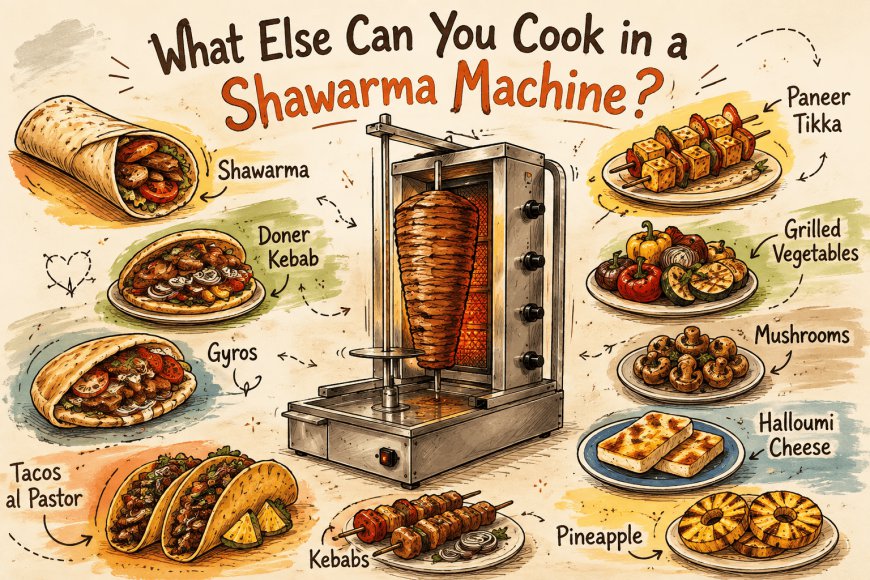
Of course, it still produced incredible chicken, beef, and lamb shawarma. But restaurants were also preparing döner kebab, gyros, tacos al pastor, and even cooking kafta and kebabs on the side skewers while the main spit rotated beside them. Some chefs roasted vegetables, mushrooms, halloumi cheese, or paneer to offer vegetarian options without needing another grill.
It made me wonder why so many people—including me—had placed the machine inside such a small box.
We often do the same thing with Middle Eastern cuisine itself.
Mention it to someone and they'll probably think of shawarma, hummus, or falafel. Those dishes deserve their popularity, but they're only a tiny chapter in a much bigger story. Behind them are regional breads, slow-cooked stews, grilled meats, fresh salads, seafood, desserts, and recipes that have been passed from one generation to the next for hundreds of years.
The more I travelled, the more I realized I wasn't collecting recipes—I was collecting stories.
Every chef I met had a reason for preparing food the way they did. Every spice blend reflected local history. Every restaurant carried traditions that couldn't be copied from a cookbook.
Ironically, if my restaurant had become an overnight success, I probably never would have left to discover any of this.
The slow sales that once frustrated me became the reason I explored an entire cuisine instead of staying comfortable with just one dish.
Today, when someone asks me what else you can cook in a shawarma machine, I usually smile before answering.
The better question is, what can't you cook?
From shawarma and döner to gyros, tacos al pastor, kebabs, grilled vegetables, paneer, halloumi, mushrooms, and countless regional specialties, that simple rotating spit has travelled further than most people realize. It has quietly connected cultures, adapted to local traditions, and helped create some of the world's most loved street foods.
And every time I see one turning slowly in a restaurant window, I'm reminded that the best journeys sometimes begin with a plan that doesn't work out.