Where Football Fans Can Compare Predictions and Odds Online?
Compare football predictions, probability estimates and betting odds with NaijaScore9. Analyse match data, bookmaker prices and useful betting tools before kickoff.
 joyvictor55
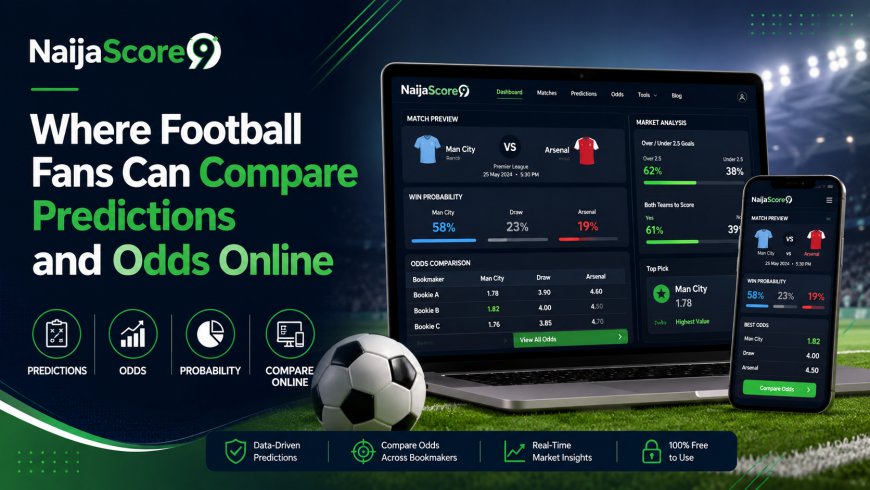
Football fans today have access to more match information than ever before. Before kickoff, it is possible to review predictions, probability estimates, recent team performance and betting odds from multiple sources within minutes.
The challenge is not finding information. It is knowing how to compare it properly.
A football prediction may suggest that the home team is the most likely winner, while the available betting odds tell you how the market is pricing that outcome. Looking at either one in isolation provides only part of the picture.
For fans who want to research matches more carefully, the most useful platforms are those that make it easy to compare football predictions and odds together, while still providing enough context to understand what the numbers mean.
Why Compare Football Predictions With Betting Odds?
Predictions and odds answer different questions.
A football prediction attempts to estimate what is likely to happen in a match.
Betting odds represent the price available for a particular outcome.
Suppose a prediction model estimates the following probabilities:
-
Home win: 55%
-
Draw: 27%
-
Away win: 18%
The model considers the home team the most likely winner.
Now suppose a bookmaker offers decimal odds of 1.60 on the home victory.
Those odds represent an implied probability of:
1 ÷ 1.60 × 100 = 62.5%
The prediction estimates a 55% probability, while the bookmaker's price implies approximately 62.5% before considering the bookmaker's margin.
That comparison provides far more information than simply seeing "Home Win."
It demonstrates why football fans should consider probability and price together.
Use Football Prediction Platforms as a Starting Point
A dedicated football prediction platform can provide an organised starting point for match research.
Instead of searching separately for every team or fixture, users can browse upcoming matches and review available predictions from one place.
A useful prediction platform may include:
-
predicted match outcomes;
-
win, draw and loss probabilities;
-
recent team performance;
-
scoring information;
-
league context;
-
goals markets;
-
other relevant match statistics.
Football fans can use the NaijaScore9 football prediction platform to explore available match predictions and supporting football information before comparing those assessments with market odds.
The important point is to treat a prediction as an estimate rather than a guaranteed result.
Compare Odds Across More Than One Bookmaker
Once you have an opinion about a match, the next step is understanding the available price.
Different betting sites frequently offer different odds for exactly the same outcome.
Consider a hypothetical home-win market:
| Bookmaker | Decimal Odds |
|---|---|
| Bookmaker A | 1.78 |
| Bookmaker B | 1.85 |
| Bookmaker C | 1.93 |
The football outcome is identical, but the potential return is not.
On a ₦10,000 stake:
-
1.78 returns ₦17,800;
-
1.85 returns ₦18,500;
-
1.93 returns ₦19,300.
That is a ₦1,500 difference between the lowest and highest available prices.
Comparing bookmakers therefore matters, especially for users who regularly research football markets.
Turn Odds Into Probability
One of the easiest ways to compare predictions and betting prices is to convert odds into implied probability.
For decimal odds:
Implied Probability = 1 ÷ Decimal Odds × 100
For example:
| Odds | Approx. Implied Probability |
|---|---|
| 1.50 | 66.7% |
| 1.80 | 55.6% |
| 2.00 | 50% |
| 2.50 | 40% |
| 4.00 | 25% |
Once odds are expressed as percentages, they become much easier to compare with a football prediction.
Suppose a prediction gives a team a 60% probability of winning.
If the bookmaker is offering odds of 2.00, the price implies approximately 50%.
That difference may justify further analysis.
It does not mean the bet is guaranteed to provide value. The quality of the original probability estimate still matters.
Look Beyond the Predicted Winner
Football prediction comparison should not focus exclusively on the 1X2 market.
Depending on the match, users may also review predictions and odds for:
-
Both Teams to Score;
-
Over 1.5 Goals;
-
Over 2.5 Goals;
-
Under 2.5 Goals;
-
Double Chance;
-
Draw No Bet;
-
Asian Handicap;
-
correct score;
-
corners;
-
cards.
Different markets can produce very different probability and pricing relationships.
For example, a prediction model might show only a modest advantage for the home team but indicate a stronger probability of Over 2.5 Goals.
That information can help users explore the fixture more broadly rather than assuming that the match winner is always the most relevant market.
Check the Information Behind the Prediction
Not all football predictions deserve equal weight.
Before comparing a prediction with bookmaker odds, consider what information appears to support it.
Useful factors may include:
-
recent team form;
-
quality of recent opponents;
-
home and away performance;
-
goals scored and conceded;
-
injuries and suspensions;
-
expected line-ups;
-
fixture congestion;
-
league position;
-
tactical changes.
A prediction based on outdated information may become less useful even if the mathematical presentation looks impressive.
This is particularly important when teams are playing several matches within a short period or when major squad changes have occurred.
Do Not Ignore Bookmaker Margin
Displayed odds do not usually represent pure probabilities.
Bookmakers incorporate a margin into their prices.
Imagine the following 1X2 market:
-
Home: 2.00
-
Draw: 3.40
-
Away: 4.00
The approximate implied probabilities are:
-
Home: 50%
-
Draw: 29.4%
-
Away: 25%
Together they total approximately 104.4%, rather than 100%.
The additional percentage reflects the bookmaker's margin within the market.
This is why users comparing predictions against odds should understand that the displayed implied probability is not necessarily the same as a theoretical fair probability.
Tools such as implied probability and no-vig calculators can help make these differences easier to understand.
Use Betting Tools to Make Comparisons Easier
Manual calculations are possible, but they can become inconvenient when comparing several matches and bookmakers.
Betting calculators can simplify the process.
For example:
Odds Converter: converts decimal, fractional and American odds.
Implied Probability Calculator: turns a betting price into a percentage.
No-Vig Calculator: helps estimate probabilities after removing bookmaker margin.
Kelly Criterion Calculator: explores theoretical stake sizing based on a user's probability estimate and the available odds.
These tools should be viewed as analytical aids rather than prediction systems.
NaijaScore9 brings together football information and practical betting tools that can help users better understand the relationship between odds and probability.
Compare Information, Not Just Numbers
Two websites can publish different predictions for the same fixture.
That does not necessarily mean one of them is useless.
Suppose:
Platform A: Home win 58%
Platform B: Home win 51%
Market implied probability: 54%
Instead of automatically choosing whichever prediction is highest, investigate why the estimates differ.
One model may place greater weight on recent results.
Another may consider longer-term performance.
The market may have moved after important team news.
Differences between sources can encourage better research.
The objective should not be to find the prediction that confirms what you already believe.
Check Team News Closer to Kickoff
Predictions and odds can change as a match approaches.
Important information may emerge after an initial prediction is published, including:
-
confirmed starting line-ups;
-
late injuries;
-
squad rotation;
-
suspensions;
-
weather conditions;
-
tactical changes.
Betting markets frequently respond to new information.
A team priced at 2.20 earlier in the day might move to 1.95 after favourable team news.
That means users should check whether the assumptions behind an earlier prediction still make sense before relying on it.
Avoid Platforms Promising Guaranteed Predictions
A credible prediction or odds-comparison service should not imply that football outcomes can be guaranteed.
Claims such as:
-
100% winning prediction;
-
guaranteed football bet;
-
fixed match;
-
sure odds;
-
guaranteed daily profit;
should be treated cautiously.
Football contains uncertainty regardless of how much data is available.
Red cards, penalties, injuries and individual mistakes can completely change the outcome of a match.
Responsible platforms should communicate probabilities and analysis without pretending that risk has disappeared.
A Practical Way to Compare Predictions and Odds
Football fans can use a simple process:
-
Choose the fixture you want to analyse.
-
Review the prediction and estimated probabilities.
-
Check recent team information and match context.
-
Convert available odds into implied probability.
-
Compare prices across bookmakers.
-
Consider bookmaker margin.
-
Review important team news closer to kickoff.
-
Make your own decision.
This approach is more useful than simply searching for the highest-confidence prediction and placing a bet immediately.
Final Thoughts
The best place to compare football predictions and odds online is not necessarily the website publishing the largest number of daily picks.
Look for platforms that provide clear predictions, meaningful probability information, current match context and tools that help explain betting prices.
Predictions tell you what an analytical model considers more likely.
Odds tell you how the betting market is pricing that outcome.
Using both together can give football fans a much clearer view of a match than relying on either one alone.
Most importantly, prediction and odds comparison should support independent research—not replace it. Football remains unpredictable, and no platform, model or bookmaker price can guarantee the result of a match.