

3D Printing in Australia: Creating Smarter Solutions for Water and Wastewater Infrastructure
Water and wastewaterinfrastructure operates continuously and depends on a wide range of pumps, valves, pipes, monitoring systems, treatment equipment, control devices, and mechanical components. Many of these systems are built around specific site conditions, meaning standard commercial parts may not always provide the ideal solution.
Introduction
Water and wastewaterinfrastructure operates continuously and depends on a wide range of pumps, valves, pipes, monitoring systems, treatment equipment, control devices, and mechanical components. Many of these systems are built around specific site conditions, meaning standard commercial parts may not always provide the ideal solution.
Maintenance teams can also face challenges when components become obsolete, difficult to source, or expensive to order in small quantities. For organisations responsible for essential infrastructure, finding practical alternatives can be important for maintaining reliable operations.
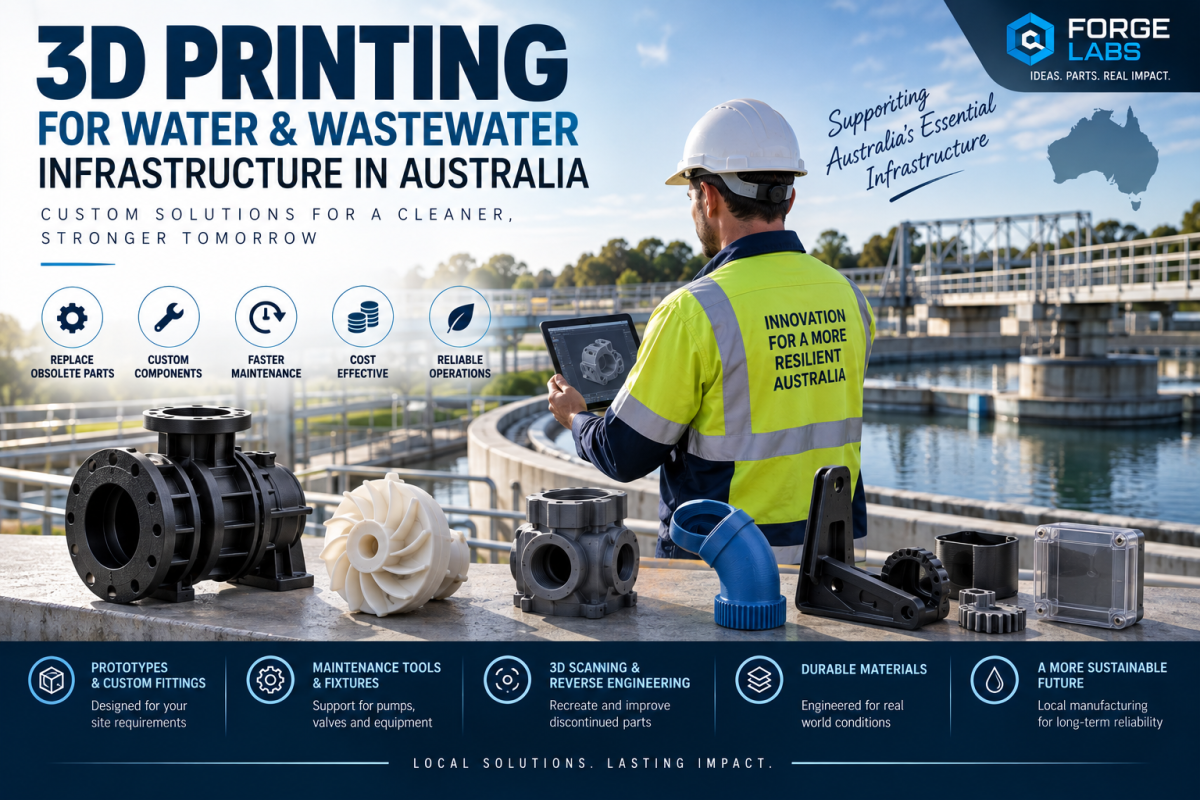
3D printing in Australia is providing another manufacturing option for suitable applications within the water and wastewater sector. Additive manufacturing can be used to develop prototypes, custom fittings, equipment housings, maintenance tools, replacement components, and specialised parts.
By combining 3D printing with CAD development, scanning, reverse engineering, and engineering assessment, organisations can develop solutions specifically around their operational requirements.
Why Water Infrastructure Benefits From Custom Manufacturing
Water treatment facilities and wastewater plants often contain equipment configured for a particular site. Pumps, sensors, pipework, control systems, filtration equipment, and machinery may all require supporting components with specific dimensions.
A commercially available product might be:
- Too large for the available space
- Incorrectly configured
- Difficult to modify
- Available only in large quantities
- No longer manufactured
- Unsuitable for a particular installation
Additive manufacturing allows a component to be designed around the actual environment.
This can be useful for low-volume items where traditional manufacturing tooling would be disproportionate to the required production quantity.
Producing Custom Equipment Components
3D printing can support the production of selected components used around treatment facilities and water infrastructure.
Potential applications include:
- Sensor housings
- Cable-management parts
- Equipment covers
- Mounting brackets
- Protective guards
- Pipework prototypes
- Instrument supports
- Custom adapters
- Equipment labels
- Maintenance fixtures
The suitability of each application depends on factors such as pressure, temperature, chemical exposure, mechanical loading, and required service life.
A detailed engineering assessment should be performed before using a printed part in a critical operating environment.
Supporting Pump and Valve Maintenance
Pumps and valves are essential to water and wastewater operations. Maintenance teams may need specialised tools, covers, brackets, spacers, and fixtures to service this equipment.
3D printing can help create custom maintenance aids around specific equipment.
Examples include:
- Alignment guides
- Positioning fixtures
- Inspection tools
- Protective inserts
- Assembly aids
- Component holders
- Drilling templates
- Equipment organisers
These tools can make repetitive maintenance tasks easier to perform and help improve consistency between servicing operations.
Because a fixture can be redesigned digitally, maintenance teams can improve the tool after observing how it performs in practice.
Managing Discontinued Components
Water infrastructure assets may remain operational for decades. As equipment ages, manufacturers can discontinue older parts or replace product lines with newer designs.
This can make relatively simple replacement components surprisingly difficult to obtain.
Where appropriate, 3D scanning and reverse engineering can provide a route toward recreating selected non-critical parts.
The process may involve:
- Inspecting the existing component
- Measuring or scanning the geometry
- Developing a CAD model
- Reviewing the design
- Selecting a suitable material
- Manufacturing the component
- Inspecting and testing the finished part
The digital model can then be archived for future reference.
This can provide a useful option for components that would otherwise require extensive searching through legacy supply chains.
Using 3D Scanning for Existing Infrastructure
Many water and wastewater facilities contain components that were installed before modern digital design workflows became standard.
Original CAD models may no longer be available. Technical drawings may also be incomplete or difficult to locate.
3D scanning can capture the geometry of existing components and surrounding areas. This information can then help engineers create replacement parts or develop modifications.
Scanning may be useful for:
- Legacy equipment
- Unusual fittings
- Machine interfaces
- Protective housings
- Custom brackets
- Equipment surrounds
- Plant modifications
- Replacement components
The ability to capture real-world geometry can reduce the uncertainty associated with designing around manually estimated dimensions.
Developing Water Treatment Technology
Water technology companies and engineering teams frequently develop new equipment for filtration, monitoring, dosing, sensing, and treatment processes.
Early-stage development requires repeated physical prototypes.
3D printing can accelerate the creation of:
- Sensor housings
- Filter-system components
- Instrument enclosures
- Flow-system prototypes
- Control interfaces
- Mechanical fixtures
- Testing apparatus
- Equipment mounting systems
A prototype can be tested, evaluated, modified, and reproduced without the need to establish production tooling at every stage.
This makes additive manufacturing particularly valuable for research and development.
Creating Prototypes for Fluid Systems
Designing equipment that interacts with water or other fluids often requires physical testing. A digital model may show how a system is expected to work, but a physical prototype can reveal practical issues that are not obvious on a screen.
3D printing can help develop prototypes for:
- Flow-path concepts
- Pipe connections
- Valve arrangements
- Pump interfaces
- Drainage systems
- Filtration concepts
- Fluid-handling equipment
Physical prototypes can be used to examine assembly, accessibility, dimensions, and interaction between components before a final manufacturing approach is selected.
For components exposed to real operating pressure or demanding fluids, the prototype material and manufacturing process must be evaluated carefully.
Designing for Restricted Spaces
Treatment plants and utility facilities often contain crowded mechanical areas where pipes, cables, pumps, instruments, and structural elements must coexist.
Standard components may not always fit efficiently.
3D printing allows engineers to develop custom solutions for restricted areas.
A digital model can be designed around existing infrastructure to create:
- Compact equipment mounts
- Custom cable guides
- Sensor brackets
- Protective covers
- Pipework supports
- Equipment adapters
- Custom access solutions
This can be particularly useful when modifying an existing facility where moving major equipment is impractical.
Material Selection for Water and Wastewater Applications
Material selection is critical because water infrastructure can involve moisture, chemicals, temperature fluctuations, UV exposure, and continuous operation.
Depending on the application, engineers may consider materials such as:
- PETG
- ASA
- Nylon
- TPU
- Engineering resins
- Specialist engineering polymers
- Metal additive manufacturing materials
However, no material should be assumed suitable simply because it is commonly used in 3D printing.
The selection process should consider:
- Chemical compatibility
- Moisture exposure
- Mechanical loads
- Operating temperature
- UV exposure
- Wear
- Expected service life
- Cleaning procedures
For parts exposed to treatment chemicals or demanding mechanical conditions, specialist material evaluation may be necessary.
Custom Enclosures for Monitoring Equipment
Modern water infrastructure relies increasingly on sensors and monitoring systems. Equipment may be installed outdoors, inside plant rooms, near pumps, or in areas exposed to moisture and dust.
A customised enclosure can be designed around the specific device.
3D printing can support development of housings with features such as:
- Cable-entry points
- Mounting brackets
- Display openings
- Fastener locations
- Internal supports
- Ventilation features
- Protective edges
- Equipment-specific dimensions
This makes the technology useful during the development and testing of monitoring systems.
For permanent outdoor deployment, enclosure performance and environmental protection should be properly validated.
Supporting Maintenance Teams With Digital Parts
A key advantage of additive manufacturing is the ability to maintain digital information about a component.
Instead of relying solely on physical storage, an organisation can maintain a controlled digital library containing approved CAD models for selected parts.
A digital record may include:
- CAD geometry
- Material requirements
- Revision history
- Manufacturing instructions
- Inspection requirements
- Application information
When a suitable component is needed, the approved design can be manufactured without recreating the model from the beginning.
This can be particularly useful for low-volume components and ageing infrastructure.
Reducing Waste in Low-Volume Manufacturing
Traditional manufacturing can become inefficient when only a small number of components are needed. Tooling, minimum order quantities, and storage requirements can increase the overall cost.
3D printing produces objects layer by layer and can therefore be useful for selected low-volume applications.
A water utility may need only:
- One custom bracket
- Several equipment covers
- A replacement housing
- A small number of fixtures
- A specialised maintenance tool
Producing only the required quantity can reduce the need to purchase and store surplus components.
Improving Infrastructure Design Through Iteration
Infrastructure projects often evolve as engineering teams receive new information from site inspections and field testing.
3D printing supports an iterative workflow where physical prototypes can be developed before final fabrication.
A typical cycle may look like:
Site Requirement → CAD Design → Prototype → Physical Review → Design Adjustment → New Prototype
This can help identify:
- Clearance problems
- Difficult installation points
- Poor access
- Inaccurate dimensions
- Interference with existing equipment
- Maintenance challenges
Fixing these issues during the development stage can reduce the risk of discovering them after full-scale manufacturing.
Supporting Water Industry Research
Universities, utilities, engineering companies, and technology developers can use additive manufacturing as part of research into water management and treatment.
Possible areas include:
- Water-quality monitoring
- Filtration technology
- Pumping systems
- Fluid dynamics
- Smart infrastructure
- Sensor technology
- Automation
- Water treatment equipment
- Wastewater processes
3D printing allows researchers to produce experimental hardware and modify it quickly as findings develop.
This flexibility can be particularly useful when researchers are testing several competing designs.
When Metal 3D Printing May Be Appropriate
Some water infrastructure components have mechanical or environmental requirements that may exceed the capabilities of standard polymer printing.
Metal additive manufacturing can be considered for specialised applications where factors such as strength, temperature resistance, durability, or complex geometry are important.
The technology may be relevant to certain:
- Engineering components
- High-load fixtures
- Specialist mechanical parts
- Custom industrial components
- Complex replacement items
However, metal printing is not automatically the best solution. Cost, material compatibility, corrosion behaviour, tolerances, finishing requirements, and service conditions should all be evaluated.
Quality Assurance Matters
Water and wastewater systems are critical infrastructure, which means component reliability matters.
A printed component should be evaluated according to how it will be used.
Depending on the application, checks may include:
- Dimensional inspection
- Material verification
- Fit testing
- Functional testing
- Load evaluation
- Environmental assessment
- Surface inspection
- Repeatability testing
Parts used in highly critical or regulated applications may require additional engineering review, certified processes, or established conventional manufacturing methods.
3D printing should therefore be incorporated into a controlled technical workflow rather than used without appropriate assessment.
Working With Professional 3D Printing Services
Professional additive manufacturing providers can help water utilities, engineering firms, manufacturers, and technology companies access capabilities that go beyond basic desktop printing.
Services may include:
- Industrial FDM printing
- SLS manufacturing
- Metal 3D printing
- 3D scanning
- Reverse engineering
- CAD modelling
- Rapid prototyping
- Low-volume manufacturing
- Material consultation
- Post-processing
- Engineering support
Forge Labs provides Australian businesses with industrial 3D printing, rapid prototyping, scanning, reverse engineering, and customised manufacturing services.
For water infrastructure projects, this combination can help organisations move from an identified engineering challenge to a physical prototype or suitable manufactured component.
Conclusion
3D printing in Australia is creating useful opportunities for the water and wastewater sector by enabling customised manufacturing, rapid prototyping, reverse engineering, and low-volume production.
Whether an organisation needs a replacement component for ageing equipment, a custom housing for a monitoring system, a maintenance fixture, or a prototype for new treatment technology, additive manufacturing can provide a flexible development pathway.
The key is choosing applications carefully. Material compatibility, environmental exposure, mechanical loading, safety, and quality requirements must all be considered before a printed component is introduced into service.
When combined with 3D scanning, CAD development, engineering assessment, and professional manufacturing, 3D printing can become a valuable tool for maintaining infrastructure and developing the next generation of Australian water technology.
At forgelabs, we provide professional 3D printing services in Australia for businesses, startups, engineers, and creators. We help turn ideas into real products with clean, accurate, and reliable results. We offer FDM 3D printing, resin printing, nylon parts, metal 3D printing, and full support services like CAD design, 3D scanning, and reverse engineering. From rapid prototyping to custom parts and small batch production, we handle every project with care and attention to detail. forgelabs proudly serves Melbourne, Sydney, and all of Australia. Our clients trust us for fast turnaround, strong materials, fair pricing, and clear communication. If you are looking for the best 3D printing services in Australia, then you are at right place



Comments (0)