3D Printing Services in Australia: Transforming Ideas into Precision Products
 forgelabs
Introduction
Australian businesses are increasingly searching for manufacturing solutions that combine precision, speed, and flexibility. 3D printing services in Australia are helping companies achieve these goals by providing an efficient way to turn digital designs into physical products. From early prototypes and engineering models to functional components and customised production parts, additive manufacturing can support different stages of product development. It also allows businesses to experiment with complex designs and specialised components without always requiring traditional tooling. As industries continue adopting digital manufacturing, professional 3D printing is becoming a valuable resource for businesses across Australia.
Faster Prototyping and Design Testing
Product development often involves repeated testing and design improvements. Traditional manufacturing methods can make this process expensive when every new design requires additional tooling or setup. Professional 3D printing services in Australia provide a more flexible approach by allowing engineers to manufacture prototypes directly from CAD files. These physical prototypes can be evaluated for dimensions, fit, appearance, and functionality. Design changes can then be made digitally before another version is produced. This process helps businesses improve products while reducing development delays and unnecessary manufacturing expenses.
Custom Manufacturing for Different Industries
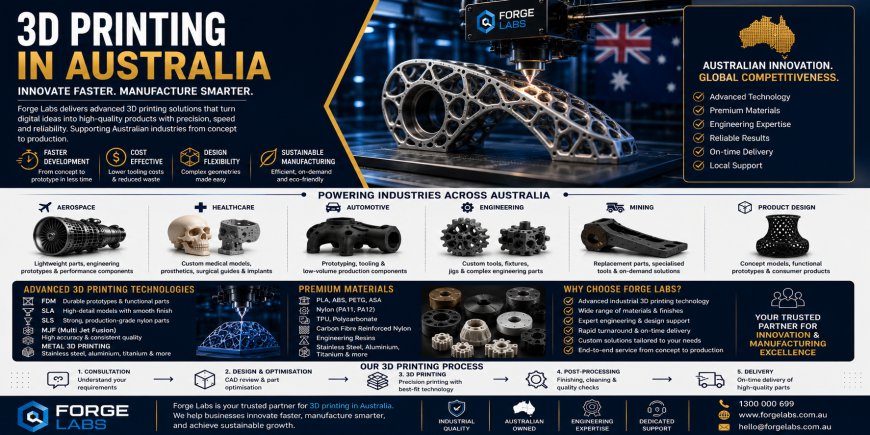
One of the strongest advantages of 3D printing services in Australia is their ability to support customised manufacturing. Businesses can create specialised brackets, housings, machine components, jigs, fixtures, tools, and replacement parts based on individual requirements. Manufacturing companies can use additive technology for production aids, while automotive businesses can develop custom components and prototypes. Healthcare, mining, aerospace, education, and product design organisations can also use 3D printing for specialised applications that require flexibility and precise digital control.
Advanced Technologies and Materials
Professional 3D printing involves several technologies, each suited to different applications. FDM is commonly used for functional prototypes, engineering parts, and durable tooling. SLA produces detailed components with smooth surfaces, making it suitable for applications where appearance and precision matter. SLS can manufacture strong polymer components for functional applications and low-volume production, while metal 3D printing supports demanding industrial requirements. Material selection should consider strength, flexibility, temperature resistance, durability, dimensional accuracy, and the intended environment of the final component.
Forge Labs for Professional Manufacturing
Forge Labs provides professional 3D printing services in Australia for businesses seeking reliable additive manufacturing and engineering expertise. Its capabilities include industrial 3D printing, rapid prototyping, 3D scanning, reverse engineering, CAD optimisation, functional prototype development, and low-volume manufacturing. By combining advanced technology with technical knowledge, Forge Labs helps businesses move from digital concepts to accurately manufactured components. This integrated approach can improve product development, simplify custom manufacturing, and provide businesses with greater flexibility throughout the production process.
Conclusion
The growing adoption of 3D printing services in Australia demonstrates how additive manufacturing is changing the way businesses approach product development and production. Companies can use professional 3D printing to create prototypes faster, manufacture customised components, reduce tooling requirements, and explore innovative designs. Forge Labs provides the technology and engineering support needed to make these capabilities practical for Australian businesses. As manufacturing continues moving toward digital and flexible production, 3D printing will remain an important technology for companies seeking greater efficiency, precision, and innovation.