Bottom Seal Bag Maker With Flying Knife: Complete Guide to Features, Applications & Production
A Bottom Seal Bag Maker With Flying Knife is an industrial bag-making machine designed to form, seal, and cut plastic film into finished bags using a continuous production process. Unlike conventional stop-and-cut systems, its flying knife mechanism synchronizes with the moving film web, allowing cutting without repeatedly stopping the material.
 Ramcko Machinery Private Limited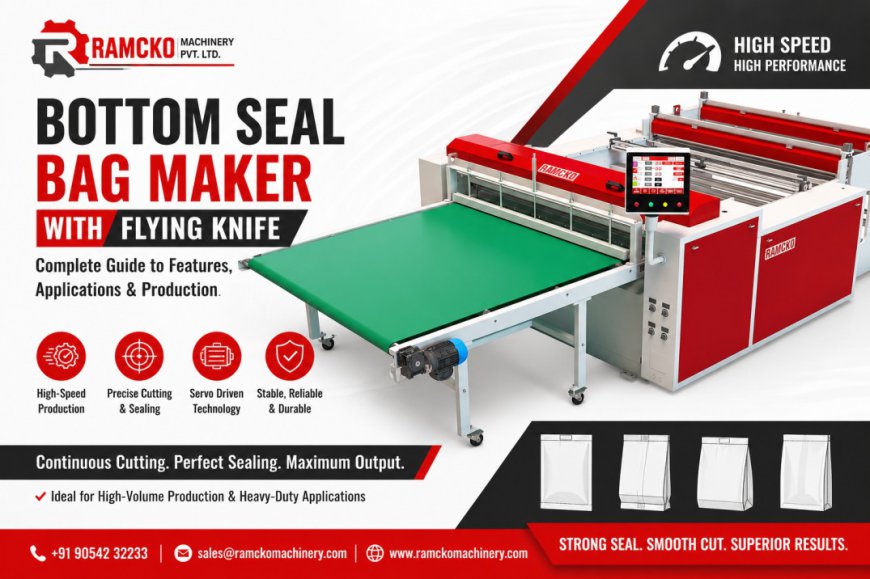
Executive Summary / Quick Answer
A Bottom Seal Bag Maker With Flying Knife is an industrial bag-making machine designed to form, seal, and cut plastic film into finished bags using a continuous production process. Unlike conventional stop-and-cut systems, its flying knife mechanism synchronizes with the moving film web, allowing cutting without repeatedly stopping the material.
This technology is particularly suitable for high-volume production, heavy-duty bags, garbage liners, agricultural packaging, and other applications where consistent bottom sealing, accurate dimensions, and high output are important.
What Is a Bottom Seal Bag Maker With Flying Knife?
A Bottom Seal Bag Maker With Flying Knife combines three important production functions:
-
Film feeding and forming
-
Bottom sealing
-
High-speed flying-knife cutting
The machine takes a continuous roll of plastic film and converts it into individual bags according to programmed bag length and width.
The bottom seal is created by applying controlled heat and pressure to the film. After the required bag length is established, the flying knife cuts the material while the film continues moving through the production line.
This combination makes the machine suitable for manufacturers looking for high-speed bag making equipment with consistent sealing and cutting accuracy.
How Does a Bottom Seal Bag Machine Work?
The production process generally follows these stages:
1. Film Unwinding
A roll of plastic film is mounted on the unwinding section. The film is released at a controlled rate and guided toward the forming and sealing area.
Depending on the machine configuration, tension-control systems and guide rollers help maintain stable film movement.
2. Film Feeding
The feeding system moves the film through the machine at a controlled speed.
Modern machines commonly use servo-driven feeding systems to control:
-
Bag length
-
Feeding speed
-
Registration accuracy
-
Cutting position
-
Production synchronization
3. Bottom Sealing
The film reaches the sealing section, where heated sealing components apply controlled temperature and pressure.
The bottom seal creates the closed base of the bag. For applications involving heavier loads, appropriate seal design and process control are important because the bottom seam experiences significant stress during filling, handling, and transportation.
4. Flying Knife Cutting
After the required bag length is reached, the flying knife travels in synchronization with the moving film.
Instead of stopping the entire film web before every cut, the cutting mechanism matches the web movement and performs the cut during production.
5. Bag Collection
Finished bags can be collected individually, stacked, counted, or directed toward downstream packaging equipment depending on the machine configuration.
What Is Flying Knife Technology?
The flying knife bag machine uses a moving cutting mechanism that synchronizes with the film rather than relying on a completely stationary cutting cycle.
A conventional guillotine system may require the film to stop or significantly slow down before cutting. At high production speeds, these repeated acceleration and deceleration cycles can limit throughput.
A flying knife system is designed to reduce this interruption.
Flying Knife vs. Standard Guillotine Cut
|
Feature |
Flying Knife System |
Standard Guillotine Cut |
|
Film movement during cutting |
Continuous or synchronized movement |
Often requires stopping/slowing |
|
High-speed production |
Highly suitable |
More speed limitations |
|
Cutting synchronization |
Servo/control-system based |
Mechanical or programmed cycle |
|
Production interruptions |
Lower |
Higher at increased speeds |
|
Bag length control |
High precision when properly calibrated |
Good, depending on system |
|
Mechanical movement |
Synchronized cutting motion |
Stop-and-cut movement |
|
High-volume applications |
Well suited |
Better for lower/moderate output |
|
Production efficiency |
High |
Depends on machine design |
The actual performance depends on machine configuration, film characteristics, bag dimensions, sealing method, and operating conditions.
How Servo Technology Improves Flying Knife Performance
Servo motors are an important part of modern continuous cut bag machines.
A servo-controlled system can coordinate:
-
Film feeding
-
Cutting position
-
Bag length
-
Knife movement
-
Sealing timing
-
Film registration
The control system receives position and speed information and adjusts the cutting movement accordingly.
For example, if the film speed changes, the flying knife can adjust its movement to maintain synchronization with the moving web.
This is particularly valuable when producing bags at high speeds where even small timing errors can create dimensional inconsistencies.
Key Features and Technical Capabilities
1. High-Speed Continuous Operation
One of the primary reasons manufacturers select a flying knife system is its ability to support continuous production.
Output may be specified in bags per minute (BPM) or cycles per minute (CPM) depending on the machine design.
Actual production output depends on:
-
Bag dimensions
-
Film thickness
-
Number of lanes
-
Film material
-
Seal temperature
-
Cutting requirements
-
Machine configuration
Therefore, buyers should compare rated speed with actual expected production conditions, rather than relying only on the maximum advertised speed.
2. Precision Temperature and Sealing Control
Plastic films require appropriate heat, pressure, and dwell conditions to produce reliable seals.
Common materials may include:
-
LDPE
-
HDPE
-
LLDPE
-
Recycled polyethylene films
-
Film blends designed for specific packaging applications
Different film structures can have different sealing characteristics.
A good bottom seal bag machine should provide appropriate temperature control and allow operators to adjust sealing parameters according to film specifications.
3. Servo Motor Integration
Servo technology can provide precise control over film feeding and cutting synchronization.
Benefits may include:
-
Accurate bag length
-
Repeatable production
-
Controlled acceleration and deceleration
-
Better registration
-
Faster parameter adjustment
Servo systems are particularly valuable for manufacturers producing multiple bag sizes on the same machine.
4. PLC and Touchscreen Control
A PLC-based control system allows operators to manage machine parameters through a touchscreen interface.
Typical settings can include:
-
Bag length
-
Production quantity
-
Film speed
-
Sealing temperature
-
Cutting timing
-
Machine alarms
-
Production counters
A well-designed HMI also makes troubleshooting easier by displaying operating status and alarm information.
5. Waste Reduction
Material waste directly affects manufacturing costs.
Accurate feeding, sealing, and cutting can reduce unnecessary film loss caused by:
-
Incorrect bag length
-
Poor cutting alignment
-
Excessive trim
-
Improper sealing
-
Rejected bags
Edge-trim handling systems can further assist where the application generates continuous trim material.
6. Heavy-Duty Sealing Jaw Design
For industrial applications, the sealing section must withstand continuous operation.
A heavy-duty sealing arrangement can help maintain:
-
Consistent sealing pressure
-
Stable heat transfer
-
Repeatable seam quality
-
Long operating cycles
However, seal strength is not determined by the machine alone. Film composition, thickness, temperature, pressure, dwell time, and cooling conditions all influence the final seam.
Primary Applications
Garbage Bags and Trash Can Liners
Garbage bags require reliable seams because they can experience concentrated loads during collection and transportation.
Flying-knife technology can support high-volume production of:
-
Garbage bags
-
Trash can liners
-
Bin liners
-
Waste collection bags
-
Industrial waste sacks
Machines may be configured for roll-to-roll or stacked-bag production depending on the product requirements.
Heavy-Duty Industrial Sacks
Industrial packaging often requires stronger bags capable of handling substantial loads.
Potential applications include packaging for:
-
Fertilizers
-
Industrial powders
-
Construction materials
-
Chemicals
-
Raw materials
-
Manufacturing components
For such products, heavy-duty bottom seal plastic bags need appropriate film selection and seam design in addition to reliable machine operation.
Agricultural and Produce Bags
Agricultural packaging can include bags used for:
-
Seeds
-
Animal feed
-
Agricultural materials
-
Produce
-
Soil-related products
-
Farm supplies
The ability to adjust bag dimensions allows manufacturers to produce different sizes for different products.
Commercial and Retail Packaging
Bottom-seal technology can also be used for commercial packaging applications where consistent dimensions and clean sealing are important.
Depending on machine configuration, manufacturers may process printed or unprinted films.
Production Advantages
Higher Throughput
Continuous cutting can reduce the production interruptions associated with repeated stop-and-cut cycles.
For high-volume manufacturers, this can translate into greater production capacity within the same operating period.
The actual throughput should always be evaluated using the required bag size and film specification rather than machine speed alone.
Consistent Bag Dimensions
Servo-controlled feeding and synchronized cutting help maintain consistent bag length.
Dimensional consistency is important when bags are:
-
Automatically filled
-
Packed into bundles
-
Counted mechanically
-
Supplied to large-volume customers
-
Integrated into automated packaging lines
Reliable Bottom Sealing
A properly configured bottom seal provides a strong closed seam suitable for many industrial packaging applications.
However, manufacturers should conduct seal-strength testing using their actual film and product load because different materials behave differently during heat sealing.
Production Flexibility
A modern machine may be configured to produce different bag formats by adjusting parameters such as:
-
Bag length
-
Bag width
-
Film thickness
-
Production speed
-
Seal temperature
-
Cutting settings
This flexibility can allow manufacturers to serve multiple product categories without maintaining separate production lines for every bag size.
ROI and Manufacturing Efficiency
The economic value of a flying knife system should be evaluated through several factors rather than purchase price alone.
Important ROI factors include:
-
Production output
-
Film waste
-
Energy consumption
-
Labor requirements
-
Machine downtime
-
Maintenance costs
-
Rejected bag percentage
-
Machine utilization
-
Product changeover time
Continuous motion can reduce unnecessary start-stop cycles in appropriately designed machines. This may contribute to lower mechanical stress and improved production efficiency.
However, energy consumption depends on the complete machine design, heater system, motor technology, operating speed, and production conditions.
Important Factors Before Buying
Choosing the right high-speed bag making equipment requires more than checking the maximum machine speed.
1. Film Thickness Range
Confirm that the machine supports the thickness range you intend to process.
Ask the manufacturer for tested operating ranges for your specific film structure.
2. Maximum Bag Width
Check the maximum film width and finished bag width.
If you plan to produce multiple sizes, consider the full range rather than purchasing based on one current product.
3. Bag Length Range
Verify minimum and maximum bag lengths and the accuracy achievable at your desired production speed.
4. Speed Rating
Ask for practical output data based on your actual:
-
Bag dimensions
-
Film thickness
-
Film material
-
Number of lanes
-
Cutting requirements
5. Blade Durability
The flying knife is a critical wear component.
Consider:
-
Blade material
-
Replacement frequency
-
Sharpening requirements
-
Replacement cost
-
Availability of spare blades
6. Control System
Check whether the machine includes:
-
PLC control
-
Touchscreen HMI
-
Servo drives
-
Production counter
-
Alarm diagnostics
-
Recipe storage
7. After-Sales Support
Industrial machinery is a long-term investment. Technical support, spare-parts availability, operator training, and service response can have a major impact on total ownership cost.
Maintenance Guide
Regular maintenance is essential for stable performance and consistent bag quality.
Flying Knife Maintenance
Inspect the cutting blade regularly for:
-
Dull edges
-
Damage
-
Uneven cutting
-
Film buildup
-
Incorrect alignment
Sharpen or replace the blade according to the manufacturer's maintenance recommendations.
Sealing Bar Maintenance
Keep sealing surfaces clean and inspect them for:
-
Plastic residue
-
Uneven heating
-
Surface damage
-
Excessive wear
Accumulated film residue can affect heat transfer and seal quality.
Lubrication
Follow the machine manufacturer's lubrication schedule for bearings, moving assemblies, and other specified components.
Over-lubrication can be just as problematic as insufficient lubrication, so use the recommended lubricant and quantity.
Electrical and Control-System Checks
Periodically inspect:
-
Servo connections
-
Sensors
-
Wiring
-
PLC signals
-
Emergency-stop circuits
-
HMI alarms
-
Temperature controllers
Preventive inspection can help identify problems before they cause extended downtime.
Common Production Problems and Possible Causes
|
Problem |
Possible Causes |
|
Uneven bottom seal |
Incorrect temperature, pressure, or film alignment |
|
Bag length variation |
Feeding calibration or servo synchronization issue |
|
Poor cutting quality |
Dull/damaged blade or incorrect knife alignment |
|
Film wrinkles |
Incorrect tension or guiding |
|
Seal leakage |
Incorrect sealing parameters or unsuitable film conditions |
|
Excessive waste |
Incorrect cutting setup or film tracking |
|
Machine vibration |
Mechanical wear, imbalance, or incorrect adjustment |
These are general troubleshooting possibilities. Operators should always follow the machine manufacturer's service procedures before making mechanical or electrical adjustments.
Why Choose a Flying Knife Bag Machine for High-Volume Production?
For manufacturers producing large quantities of plastic bags, production speed is only one part of the equation.
A well-designed Bottom Seal Bag Maker With Flying Knife can bring together:
-
Continuous film movement
-
Synchronized cutting
-
Controlled bottom sealing
-
Servo-based positioning
-
PLC automation
-
Flexible production settings
-
Reduced production interruptions
-
Consistent bag dimensions
This combination makes flying knife technology particularly relevant to modern plastic bag manufacturing operations where output and repeatability are major priorities.
Conclusion
A Bottom Seal Bag Maker With Flying Knife is designed for manufacturers that need a combination of high production speed, accurate cutting, reliable bottom sealing, and automated process control.
Its synchronized flying-knife system allows the cutting process to operate with the moving film web, reducing the need for repeated stop-and-cut cycles. When combined with servo feeding, PLC controls, precision temperature management, and a robust sealing system, the technology can support demanding applications ranging from garbage liners to heavy-duty industrial bags.
For manufacturers evaluating new bottom seal bag machine technology, the most important factors are not simply maximum speed or machine price. Film compatibility, bag dimensions, actual production output, seal quality, maintenance requirements, automation, spare-parts support, and long-term operating costs should all be considered.
Ramcko Machinery can be positioned as a machinery partner for manufacturers evaluating modern bag-making solutions and seeking equipment suited to their specific production requirements.