Expert Crankshaft Journal Repair Services by MPA Power Project
Learn how crankshaft journal repair works, common damage signs, repair methods, in-situ grinding, and ways to prevent costly engine downtime.
 MPA Power Project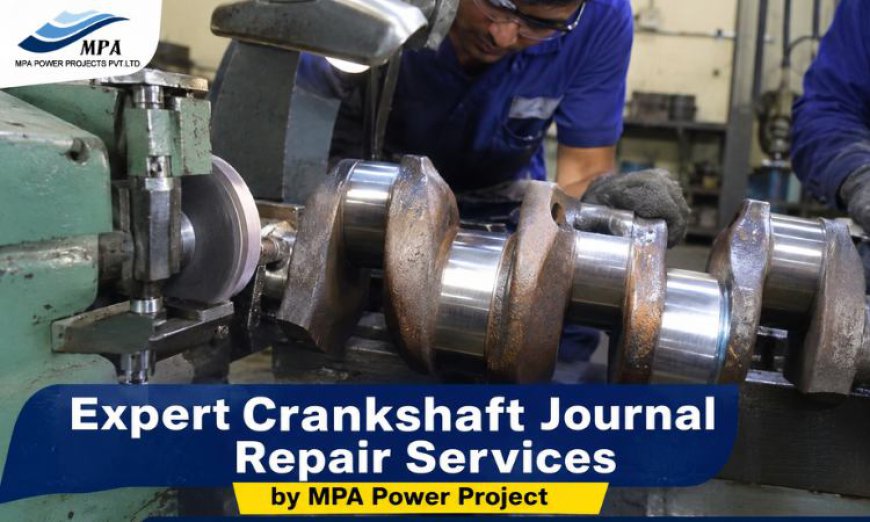
A worn crankshaft journal can create problems far beyond the crankshaft itself. Excessive clearance, bearing damage, vibration, overheating, and poor engine performance may all develop when the journal surface is no longer within the required dimensions. In large marine and industrial engines, replacing an entire crankshaft is often expensive and can lead to extended downtime.
The good news is that many journal-related problems can be professionally assessed and repaired without automatically replacing the complete crankshaft. The right approach depends on the amount and type of damage, journal dimensions, bearing condition, alignment, and the manufacturer’s specifications.
What Is a Crankshaft Journal?
A crankshaft journal is a precisely machined surface on which an engine bearing supports and allows the crankshaft to rotate. Main journals are supported by the main bearings, while crankpin journals work with connecting-rod bearings.
These surfaces must maintain the correct diameter, roundness, smoothness, and alignment. Even a relatively small change can affect the oil film between the journal and bearing.
This is why journal repair is not simply a matter of removing visible scratches. The finished surface must meet the required dimensional and surface-finish tolerances.
Why Do Crankshaft Journals Wear or Get Damaged?
Journal damage usually develops gradually, although sudden failures can also occur. Common causes include:
-
Inadequate or contaminated lubrication
-
Bearing failure or incorrect bearing clearance
-
Excessive engine loading
-
Dirt or metallic particles in the lubricating oil
-
Overheating
-
Misalignment
-
Poor maintenance practices
-
Long operating periods under demanding conditions
Common forms of damage include scoring, scratches, uneven wear, ovality, taper, corrosion marks, and localized surface damage.
One important point that is sometimes overlooked is why the journal was damaged in the first place. Grinding the journal without correcting a lubrication, bearing, or alignment problem may only treat the symptom. A reliable repair should therefore include an investigation of the underlying cause.
What Are the Signs of a Damaged Crankshaft Journal?
Not every crankshaft journal problem produces an obvious warning. However, several signs deserve immediate investigation.
1. Low or Unstable Lubricating Oil Pressure
A damaged journal or incorrect bearing clearance can contribute to excessive oil leakage through the bearing area. If oil pressure changes unexpectedly, the complete lubrication system should be checked rather than assuming the crankshaft is the only cause.
2. Unusual Engine Vibration
Changes in crankshaft geometry, bearing condition, or alignment can contribute to abnormal vibration. Vibration should be investigated using operating data rather than relying only on visual inspection.
3. Bearing Overheating
A damaged journal can interfere with the proper oil film between the journal and bearing. Increased friction may then generate additional heat.
4. Metal Particles in Lubricating Oil
Metallic particles found during oil inspection can indicate wear somewhere inside the engine. They do not automatically prove journal damage, but they are an important reason to inspect bearings and crankshaft surfaces.
5. Visible Scoring or Surface Damage
During inspection, grooves, scoring, discoloration, pitting, or uneven wear on a journal should be measured carefully before deciding on a repair method.
How Is Crankshaft Journal Repair Performed?
Professional journal repair starts with measurement and diagnosis rather than immediate machining.
Step 1: Inspection and Measurement
The damaged area is inspected to determine the extent of wear or surface damage. Measurements may include journal diameter, ovality, taper, and other relevant dimensional checks.
The results should be compared with the engine manufacturer’s specifications or approved repair limits.
Step 2: Determine the Repairable Condition
Not every damaged journal should automatically be ground. The technician must determine whether enough material remains for machining while maintaining the required crankshaft dimensions.
The condition of the bearing, crankshaft alignment, adjacent journals, fillets, and other related components should also be considered.
Step 3: Precision Grinding
Where grinding is appropriate, controlled machining removes the damaged surface and restores the journal to a suitable diameter and finish.
For large engines, In-Situ Grinding of Crankshaft can be particularly useful because specialized equipment can be installed around the crankshaft while it remains in the engine. This can reduce the need for complete crankshaft removal, but its suitability depends on the engine design, accessibility, damage, and required repair tolerances.
Step 4: Surface Finishing
After grinding, the journal needs the appropriate surface finish for reliable bearing operation. The goal is not simply to make the journal look smooth. Its final geometry and finish must support proper lubrication and bearing contact.
Step 5: Final Verification
The repaired journal should be measured again. Depending on the repair and engine requirements, checks may include diameter, taper, ovality, surface condition, alignment, and other relevant inspection criteria.
The bearing clearance should also be considered before the engine is returned to service.
What Is the Difference Between Journal Grinding and Complete Crankshaft Replacement?
Repair is generally considered when the journal damage can be safely removed while keeping the crankshaft within acceptable repair limits.
Replacement may become necessary when damage is beyond allowable machining limits, when significant cracks or structural defects are present, or when the crankshaft cannot be restored reliably to the required specifications.
A useful decision rule is simple:
Repair when the crankshaft can be restored to an approved condition. Replace when safe restoration is no longer technically or economically justified.
Cost alone should not determine the decision. The consequences of another failure, equipment availability, downtime, and the remaining service life of the engine also matter.
Why Can In-Situ Journal Repair Reduce Downtime?
Traditional crankshaft repair may involve extensive dismantling, removal of the crankshaft, transportation to a workshop, machining, and reinstallation. For large marine and industrial equipment, each additional step can increase downtime and logistical complexity.
In-situ machining approaches can remove some of these requirements by bringing specialized equipment to the machine.
However, “in-situ” does not mean that every repair is automatically faster or better. Adequate working space, shaft accessibility, machine condition, accurate measurements, suitable tooling, and proper quality control are still essential.
The real advantage comes when on-site machining is technically suitable and eliminates unnecessary dismantling without compromising repair quality.
What Should You Check Before Hiring a Crankshaft Repair Specialist?
Choosing a repair provider should involve more than comparing prices. Ask practical questions before work begins:
Does the provider understand large industrial or marine engines?
Crankshaft repair on heavy equipment requires different planning from repairing a small automotive component. Experience with the specific type of machinery can be important.
How will the damage be measured?
A professional repair should be based on measurements and specifications rather than visual judgment alone.
What inspection methods will be used?
Depending on the suspected problem, appropriate non-destructive testing and dimensional inspection may be required to identify cracks or other defects.
Will the root cause be investigated?
Ask whether bearing condition, lubrication, alignment, and related components will be checked. Repairing only the visible journal damage may not prevent recurrence.
How will the final repair be verified?
A good repair process should include documented measurements and appropriate final checks before the equipment returns to operation.
How Can Crankshaft Journal Damage Be Prevented?
Preventive maintenance is often less disruptive than emergency crankshaft repair. Operators can reduce risk by following the engine manufacturer’s maintenance schedule and paying close attention to lubrication and bearing condition.
Regular oil analysis can help identify abnormal wear before serious damage develops. Monitoring oil pressure, bearing temperatures, vibration, and unusual operating sounds can also provide early warning.
During scheduled maintenance, inspect bearings and measure critical components according to the manufacturer’s requirements. Correct lubrication problems promptly, and investigate repeated bearing failures instead of treating each failure as an isolated event.
Another important practice is maintaining accurate maintenance records. Comparing measurements over time can reveal gradual wear that may not be obvious from a single inspection.
Frequently Asked Questions
Can a worn crankshaft journal be repaired?
Yes, some worn journals can be repaired through controlled machining or other approved repair methods. The decision depends on the depth of damage and the remaining material, dimensions, alignment, and manufacturer’s repair limits.
Can crankshaft journal repair be done without removing the crankshaft?
In suitable large engines, on-site or in-situ machining can allow journal repair while the crankshaft remains installed. Whether this is possible depends on accessibility, equipment design, damage, and technical requirements.
Is grinding enough to repair every damaged journal?
No. Grinding is appropriate for certain types and levels of damage. Cracks, severe deformation, excessive material loss, or other structural problems may require a different solution or complete replacement.
How do I know if the crankshaft needs repair?
Warning signs can include abnormal vibration, bearing overheating, lubrication problems, metallic particles in oil, and visible journal damage. Proper measurement and inspection are needed to confirm the actual condition.
Is crankshaft repair better than replacement?
Neither option is universally better. Repair can be practical when the crankshaft remains within approved repair limits. Replacement may be safer when the damage is too severe or reliable restoration is not possible.
Conclusion
Crankshaft journal repair is a precision job where diagnosis is just as important as machining. A successful repair should identify the reason for damage, measure the affected journal accurately, select an appropriate repair method, restore the required geometry and surface condition, and verify the result before the engine returns to service.
For marine and industrial equipment, on-site machining can be a valuable option when removing the crankshaft would create unnecessary downtime. Ultimately, the best repair is not simply the quickest or cheapest one—it is the solution that restores the crankshaft safely, meets the required specifications, and helps prevent the same failure from returning.
For companies evaluating this type of work, MPA Power Project can be considered as part of the technical assessment when professional crankshaft journal repair and related in-situ machining expertise are required.