Everyone’s Using AI. Almost Nobody’s Winning with It.
 theleadershipchronicle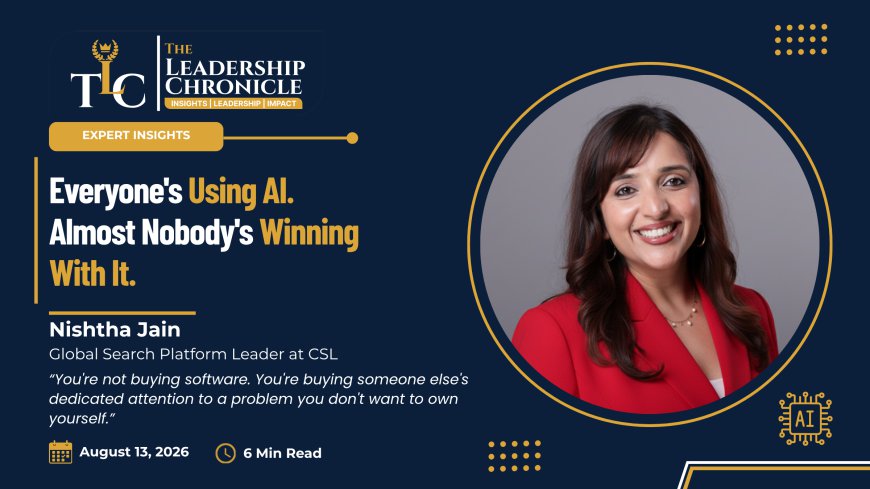
Nearly 9 in 10 companies now use AI somewhere in the business.
Say that number in a board meeting and people nod like the hard part is over.
It isn’t. Because right behind it sits a far less flattering one. In McKinsey’s 2025 State of AI survey, 88% of organizations reported using AI in at least one business function — up from 78% the year before. But only about a third have begun scaling it across the enterprise, just 7% have it fully scaled, and only around 6% qualify as genuine “high performers” seeing meaningful bottom-line impact.
“Everyone’s in the pool. Almost nobody’s swimming.”
The “AI-powered” label stopped meaning anything
Customers figured this out before most executives did.
Slap “AI-powered” on a product in 2023 and it turned heads. Do it now and you get a shrug. Customers don’t care whether something is AI-powered. They care whether it works — whether the bot actually solves the problem, whether the “smart” recommendation is useful, whether the thing that promised to save them time didn’t just make them repeat themselves to a human ten minutes later.
That gap between the label and the lived experience isn’t a marketing problem. It’s almost always a build-versus-buy decision that got made for the wrong reasons.
Two ways to get it wrong
Most companies fail this decision in one of two opposite directions.
They build because it feels ambitious. A VP sponsors an internal team to build a custom tool instead of buying one, because “our use case is different.” Six months later the team is still cleaning up three years of messy data because the model was never the hard part; the data was. A year in, the “custom” build does maybe 70% of what an off-the-shelf product did on day one, except now it also needs someone on call when it breaks. Nobody announces this failure. It just shows up eighteen months later as a line item no one wants to explain.
Or they buy because it feels safe. And for the routine 80% of a workflow, it is. But buying the intelligence isn’t the same as buying the judgment. The tool handles volume beautifully right up until it meets the furious customer, or the edge case that’s technically against policy but obviously the right call. Those aren’t rare. They’re the 20% that was always going to take 80% of the actual skill, and they’re exactly what the customer remembers.
“Buying the intelligence isn’t the same as buying the judgment.”
Both failures come from treating build-versus-buy as one big decision, made once, for the whole company.
It isn’t. It’s a series of small decisions, made honestly, one workflow at a time.
A few thoughts before you pick a side
Before anyone argues for a side, it’s worth naming the honest costs. Not the brochure costs — the ones that show up quietly, a year later, when the excitement’s worn off. Six of them come up every single time.
The roadmap won’t be yours. Buy something, and you inherit a stranger’s priorities. Vendors build for the middle of their customer base, which means the feature that matters most to you may simply never get built — not because they’re difficult, but because you’re not the majority. Build it yourself and the roadmap is entirely yours. That’s the upside. The cost is that you now own a roadmap, forever.
Fast and yours are usually different things. Buying gets you live in weeks; building takes quarters. But speed is bought with fit — you’re moving fast toward someone else’s definition of the problem. Half the time that’s fine. The other half, you discover the mismatch only after you’ve reshaped your process around a tool that never quite fit.
“Cheaper” is a claim, not a fact. Somewhere along the way “buy is cheaper than build” hardened into gospel. It isn’t. I’ve watched a tidy per-seat price quietly balloon into a renewal number nobody wanted to say in the room right as usage scaled the way the business needed it to. Run the real math, at the scale you’ll reach, before you treat cost as the settled part.
One company can’t outspend a thousand. A vendor spreads the cost of every feature across its entire customer base. When you build, that math has a denominator of one. Every enhancement, every fix, every “can it also do this” — you fund all of it, alone, indefinitely.
One company can’t out-see the market either. A vendor watching hundreds of customers can see where the whole category is drifting. A tool built in-house sees only your own four walls, which is how you end up with something that nails this year’s requirement and gets blindsided by next year’s.
The mature answer is almost always “both.” Nobody serious builds their own payroll system. Plenty of serious companies build their own pricing engine, their own underwriting logic, their own core model because that’s the part competitors can’t hand them. Splitting the decision isn’t a failure to decide. It’s the decision, made well.
So how do you decide?
Two questions settle most of it.
Buy when it’s core and covered
Buy when the technology is genuinely load-bearing — the problem doesn’t get solved without it — and a mature vendor already covers 80–90% of the business-critical workflow around it.
- Spend discipline: Rationalize the cost against what the alternative costs you, not against zero.
- Vendor selection: Pick a partner whose full-time job is that specific technology, not a feature bolted onto a broader platform, and who brings a robust support model with them.
“You’re not buying software. You’re buying someone else’s dedicated attention to a problem you don’t want to own yourself.”
Build when the fit breaks or the ground is still moving
Build when either of these is true:
- The best tool on the market is genuinely great but doesn’t cover 80% of your core workflow and doesn’t integrate cleanly. A brilliant tool that solves the wrong 40% of your problem is worse than no tool, because now your process bends around it. Building the missing layer beats forcing that fit.
- The workflow itself isn’t settled yet. If the steps keep changing and the team is still arguing about who owns what, buying locks you into a vendor’s assumptions about a process that hasn’t stabilized. Build something rough, learn the real shape of the problem, and buy later once you actually know what you’re buying for.
And there’s a third answer people skip: Partner
Sometimes a capability is strategic enough to want, but the foundation underneath it is moving faster than any one team can keep pace with.
That’s not build. That’s not buy. That’s partner: license the fast-moving foundation someone else is racing to improve, and keep the part that’s genuinely yours (your data, your context, your judgment) as the layer you own and control.
The one thing all three answers share
Whether you build, buy, or partner, none of it solves the question customers feel: What happens when the AI hits its limit?
A build with no human handoff frustrates people exactly as fast as a bought bot with no handoff. The choice between full autonomy and empowering a real person isn’t decided by who wrote the code — it’s decided by whether anyone designed, on purpose, the moment the system has to let go.
Skip that step, and the most sophisticated build in the world produces the same complaint as the cheapest chatbot.
“It sounded smart, and then it wouldn’t help me.”
The bottom line
The pitch that should worry you isn’t the one promising too little.
It’s the one promising everything with no mention of who keeps it running a year from now, or what the customer experiences the day it breaks.
The 88% of companies “using AI” mostly aren’t lying about that number. They’re just learning, one project at a time, that using AI and winning with it are two very different jobs, and the gap between them is almost never a model problem.
It’s a decision problem. Made early, made once, and rarely revisited until something breaks.
The “AI-powered” label was never going to win anyone over. Closing the value gap will. Keeping a human in the loop when it counts will. Building something resilient enough that none of it hinges on next quarter’s vendor renewal will.
That’s not a labeling exercise. It’s build-versus-buy, made honestly, showing up in the one place your customers actually notice.
If this resonated, I’d love to hear how your team draws the line between build, buy, and partner. That’s the conversation worth having.
For more details, visit: https://theleadershipchronicle.com/
If you would like to get featured or want to know more, connect with us at contact@theleadershipchronicle.com
LinkedInn : https://www.linkedin.com/company/the-leadership-chronicle/
Twitter : @TLChronicle