Facial Recognition System for Corporate Security Across UAE
 TekYousuf26
A modern Facial Recognition System is fast becoming the backbone of corporate security across the UAE, replacing badge-swipe habits and shared PINs with fast, contactless identity verification at every entry point. As Dubai, Abu Dhabi, and Sharjah businesses scale their offices, warehouses, and data centres, security leaders are under pressure to stop tailgating, credential sharing, and unauthorised access without slowing down the workday.
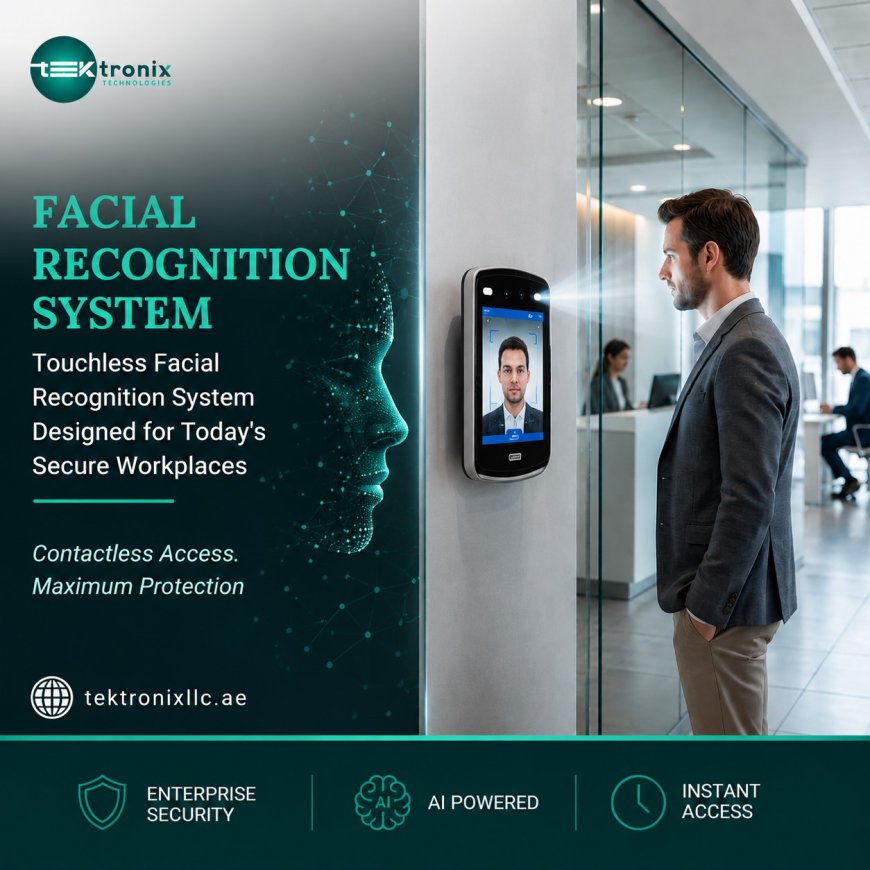
This guide walks through how facial recognition technology actually works inside a corporate environment, what to look for in a device or software platform, and why enterprises across the Emirates are standardising on it as their primary access-control layer for 2026 and beyond.
Why Corporate UAE Is Moving to Facial Recognition Access Control
The UAE's push toward smart-city governance, from Dubai's paperless-office mandates to Abu Dhabi's smart-security frameworks, has made biometric verification a natural next step for private enterprise. Boards and facility managers are adopting Facial Recognition Access Control for three practical reasons: it removes the operational cost of managing lost cards and forgotten PINs, it creates an audit-ready log of exactly who entered a space and when, and it closes the tailgating gap that keycard turnstiles routinely miss.
Insurance underwriters and corporate auditors in the region increasingly ask for verifiable, timestamped access records during compliance reviews. A biometric access log satisfies that requirement in a way that a shared keycard simply cannot, since a card can be handed to anyone but a face cannot.
How Face Detection Technology Works in Modern Offices
Before a system can verify anyone, it first has to find them in the frame. Face Detection is the initial computer-vision step: the camera locates a human face within its field of view, isolates it from the background, and passes that region forward for analysis. This happens in real time, even in crowded lobbies, varied lighting, or when someone is wearing a mask, cap, or spectacles.
Enterprise-grade detection engines used across UAE office towers are trained to handle the region's specific conditions, strong daylight glare through glass facades, mixed-nationality workforces, and high foot-traffic reception areas, so accuracy does not degrade during the morning rush.
Detection Versus Recognition: A Quick Distinction
Detection answers the question, is there a face here? Recognition and identification, covered next, answer the harder question, whose face is it? Both stages have to run in well under a second for the system to feel invisible to employees walking through a turnstile or glass door.
Facial Identification vs Traditional ID Cards: What Changes for Security Teams
Once a face is detected, the platform performs Facial Identification, matching the captured face against an enrolled database of employees, contractors, and approved visitors. Unlike a keycard, which only proves someone is holding a valid credential, identification proves who the person actually is, closing the single biggest loophole in traditional physical access control.
For UAE facility and HR teams, this shift changes daily operations in tangible ways:
- Offboarding is instant, since removing a profile revokes access everywhere at once, unlike collecting a physical card from a departing employee.
- Visitor and contractor logs are self-documenting, with entry photos and timestamps stored automatically for later audit.
- Shift-based access, such as warehouse staff rotating in and out of a facility, no longer depends on card handovers between crews.
The Role of Facial Authentication in Multi-Layered Corporate Security
Where identification answers who is this person, Facial Authentication answers is this person who they claim to be, typically at a specific checkpoint such as a server room, executive floor, or finance department. It is commonly paired with a second factor, a PIN, an employee badge, or UAE Pass digital ID, to create true multi-factor security for the most sensitive zones inside a building.
Layering authentication this way lets a single organisation apply different levels of scrutiny across one campus: a light-touch face scan at the main lobby, and a stricter, dual-factor face-plus-PIN check at the data centre door.
Choosing the Right Facial Recognition Device for Your Facility
Hardware selection determines how well the system performs under real UAE conditions. A reliable Facial Recognition Device should combine an infrared or dual-lens camera for accuracy in low light and direct sun, liveness detection to prevent spoofing with a photo or video, and a fast-local processor so verification does not depend on network latency.
Key Hardware Considerations for UAE Buildings
- IP65-rated housing for outdoor gates, loading bays, and rooftop plant-room entrances exposed to heat and dust.
- Sub-second matching speed to keep queues moving during peak entry hours in high-rise office towers.
- Integration-ready hardware that speaks standard protocols such as Wiegand or TCP/IP with existing turnstiles and door controllers.
- Anti-spoofing sensors capable of rejecting printed photos, screen replays, and 3D masks.
Facial Recognition Software: Features That Matter for UAE Enterprises
The device is only half the equation. The Facial Recognition Software running behind it is what turns raw camera feeds into a usable security platform, handling enrolment, watchlists, reporting, and integration with HR and building-management systems.
For a multi-site UAE enterprise, the software layer should offer a centralised dashboard covering every branch from one console, role-based permissions so HR, security, and IT each see only what they need, exportable audit trails formatted for compliance and insurance reviews, and open APIs that connect cleanly to existing time-and-attendance or ERP systems.
Implementing a Facial Recognition Solution Across UAE Offices: Compliance and Data Privacy
Rolling out biometric access is not purely a technical project; it is also a governance one. A well-planned Facial Recognition Solution for a UAE enterprise accounts for the country's Federal Data Protection Law and any free-zone-specific data rules from bodies such as the DIFC or ADGM, since biometric data is classified as sensitive personal data and requires clear employee consent, defined retention periods, and encrypted storage.
Best practice for a compliant rollout includes obtaining documented employee consent before enrolment, storing facial templates as encrypted mathematical representations rather than raw photographs, setting a defined data-retention and deletion policy, and appointing an internal data-protection point of contact for the deployment.
Why Tektronix Leads Facial Recognition System UAE Deployments
Tektronix Technologies has spent years deploying enterprise security infrastructure across the UAE and Saudi Arabia, working directly with facility managers, IT security leads, and compliance teams to design biometric access programmes that hold up under real audit scrutiny, not just product demos.
That hands-on experience across banking, logistics, healthcare, and government-adjacent facilities is what separates a genuinely reliable Facial Recognition System UAE rollout from an off-the-shelf camera installation. Every deployment is engineered around the client's actual floor plan, workforce size, and compliance obligations rather than a generic template.
Organisations evaluating vendors for this category can review Tektronix's dedicated facial recognition access control system in Dubai, which outlines device options, software capabilities, and integration support for UAE-based facilities.
Dubai's Corporate Landscape and the Facial Recognition System Dubai Advantage
Dubai's free zones, from DIFC and Dubai Internet City to Dubai Silicon Oasis and JAFZA, host a dense concentration of finance, tech, and logistics companies that each carry distinct access-control demands, from executive-floor confidentiality to warehouse shift management. A Facial Recognition System Dubai business can trust needs to scale across that variety without a separate configuration for every building.
For organisations comparing providers, the deciding factors are usually the same: proven installations inside comparable UAE facilities, local support and maintenance rather than remote-only service, and software built to satisfy the country's data-protection expectations from day one. Teams ready to move forward can consult Tektronix's Dubai facial recognition solution page for site-assessment and deployment details.
Conclusion
Corporate security across the UAE is shifting decisively toward biometrics, and a well-implemented Facial Recognition System is now the clearest way to close tailgating gaps, retire vulnerable keycards, and produce audit-ready access logs. From accurate Face Detection at the door to layered Facial Authentication at sensitive zones, the right combination of device and Facial Recognition Software turns everyday entry points into a controlled, evidence-backed security layer. UAE enterprises that plan for compliance from the outset, choose proven hardware, and partner with an experienced local provider position themselves ahead of both security incidents and regulatory scrutiny.
FAQs
1. How is a facial recognition system different from a fingerprint scanner for office access?
A Facial Recognition System verifies identity from a distance without physical contact, which makes entry faster and more hygienic than fingerprint scanners, especially at high-traffic lobbies where dozens of employees enter within a few minutes each morning.
2. Can facial recognition access control integrate with our existing turnstiles and door locks?
Yes. Most enterprise-grade Facial Recognition Access Control platforms connect to standard turnstile and electronic-lock hardware through Wiegand or TCP/IP interfaces, so an existing UAE office fit-out rarely needs to be replaced, only upgraded.
3. Is facial recognition data legally compliant with UAE data protection rules?
It can be, provided the deployment follows the UAE's Federal Data Protection Law: obtaining employee consent, encrypting stored templates, and defining a clear retention policy. A properly configured Facial Recognition Solution builds these safeguards in from the start rather than as an afterthought.
4. What happens if the facial recognition device fails to identify someone, such as with a mask or sunglasses?
Quality Facial Recognition Device hardware uses infrared sensors and multi-point mapping that can still complete Facial Identification through minor obstructions, and most systems fall back to a PIN or badge as a secondary verification method when a match cannot be confirmed.
5. How long does it take to deploy a facial recognition system across a UAE office building?
A single-entrance deployment typically takes a few days from site survey to go-live, while a multi-floor or multi-branch Facial Recognition System Dubai rollout, complete with software integration and staff enrolment, generally takes two to four weeks depending on building size and the number of access points.