Gate Barrier System Solutions for Saudi Government and Institutional Facilities
 TekYousuf26
Gate Barrier System deployments have become a core requirement for government ministries, municipalities, universities, hospitals, and other institutional facilities across the Kingdom of Saudi Arabia. As perimeter security and traffic discipline become non-negotiable at sensitive sites, decision-makers are turning to automated barrier technology that can verify, log, and control every vehicle movement at the gate, without slowing down daily operations.
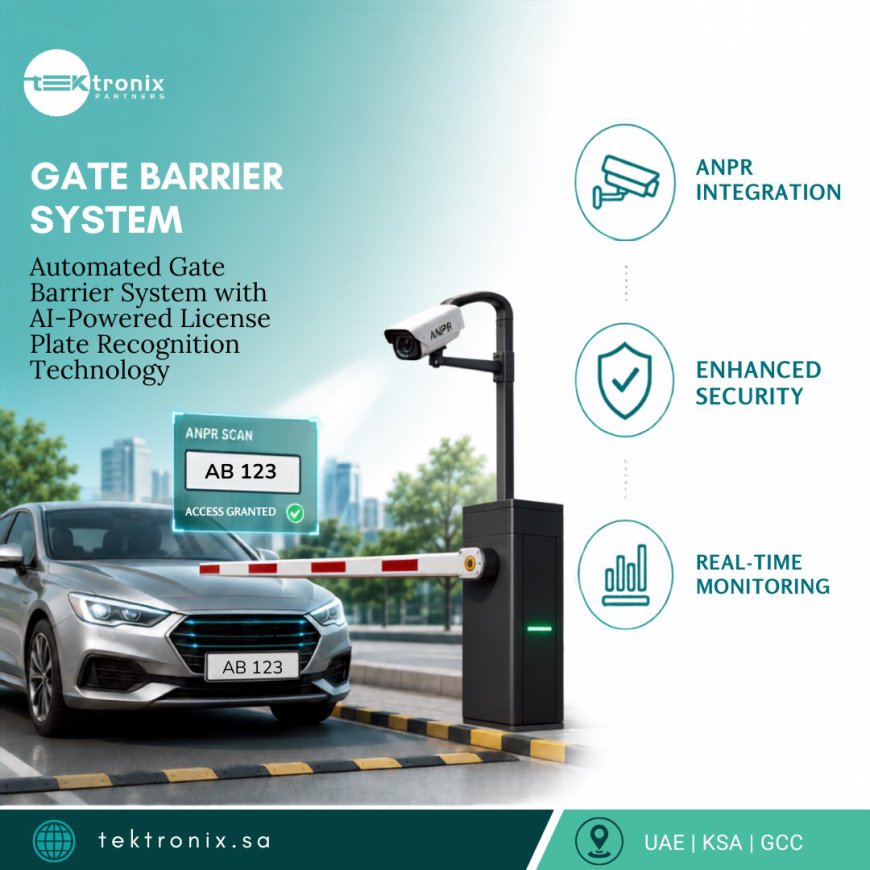
This guide explains how a modern gate barrier system works, why it matters specifically for public-sector and institutional environments, and how facilities across Riyadh and the wider Kingdom are selecting, deploying, and maintaining these systems as part of a broader Vehicle Access Control strategy.
Understanding Gate Barrier Systems in Saudi Arabia's Security Landscape
Saudi Arabia's Vision 2030 agenda has accelerated investment in smart infrastructure, and physical perimeter security sits at the centre of that transformation. Government compounds, ministries, industrial zones, and educational campuses are expected to demonstrate not just visible security, but auditable, technology-driven control over who and what enters a site.
A Boom Barrier System is the most recognizable form this takes: a motorized arm that rises and lowers to permit or deny vehicle passage. Unlike a manned checkpoint alone, a barrier arm paired with sensors, credential readers, and a control panel creates a repeatable, logged process for every single entry and exit, which is exactly what institutional compliance frameworks increasingly require.
For facilities operating around the clock, reliability matters as much as function. Barrier arms rated for high-cycle commercial use, weatherproof housings suited to the Saudi climate, and integration with existing guard-force workflows are now baseline expectations rather than premium add-ons.
Why Government and Institutional Facilities Need Vehicle Access Control
Public buildings, embassies, court complexes, utility plants, and university campuses share a common challenge: large volumes of vehicle traffic that must be screened without creating bottlenecks. A well-designed Vehicle Access Control framework addresses three priorities at once — safety, operational efficiency, and accountability.
Safety and Threat Deterrence
A visible, physically robust barrier at every vehicle entrance discourages unauthorized approach and gives security personnel a controlled point at which to intervene before a vehicle reaches sensitive areas.
Operational Efficiency
Manual checks slow down staff, contractors, and visitors during peak hours. Automated credential recognition lets authorized vehicles pass in seconds while flagging anything unrecognized for manual review.
Accountability and Audit Trails
Every barrier cycle can be logged with a timestamp, credential ID, and, where cameras are integrated, a vehicle image — producing the kind of audit trail that government facility audits and insurance reviews frequently request.
Types of Barrier Hardware: Boom Barriers, Automatic Road Barriers, and More
Not every entry point needs the same hardware. Facility planners typically select from a small family of barrier types, each suited to a different traffic profile.
- Boom Barrier System – the standard motorized arm barrier used at staff and visitor entrances, parking structures, and single-lane checkpoints.
- Automatic Road Barrier – a heavier-duty version engineered for higher-speed approach roads and multi-lane government or industrial complexes, where longer arms and faster cycle times are required.
- Swing and sliding gate barriers – used at facilities that prefer a full physical gate rather than an arm, often paired with the barrier for a layered entrance.
- Rising bollards and crash-rated barriers – deployed at the highest-security government sites where vehicle-borne threats must be physically stopped, not just discouraged.
Choosing between these options depends on approach speed, traffic volume, and the facility's designated threat level, which is why institutional buyers typically request a site survey before finalizing hardware.
RFID Barrier System and LPR Boom Barrier: Smart Access Technologies
Hardware alone does not create a security system — the credentialing layer does. Two technologies dominate institutional deployments in the Kingdom today.
RFID Barrier System
An RFID Barrier System reads a tag mounted on staff and fleet vehicles as they approach, opening the arm automatically for pre-registered credentials. This is the standard approach for employee parking, government vehicle fleets, and recurring supplier deliveries, since it removes the need for a guard to manually verify every regular vehicle.
LPR Boom Barrier
An LPR Boom Barrier uses license plate recognition cameras instead of, or alongside, physical tags. The camera reads the plate, checks it against an authorized list, and triggers the barrier — useful for visitor management, contractor tracking, and facilities where issuing physical tags to every vehicle is impractical.
Many institutional sites in Saudi Arabia now combine both: RFID for known fleet and staff vehicles, and plate recognition as a secondary verification layer or for visitor lanes. Integrating either technology with an advanced gate barrier platform also opens the door to biometric readers and mobile-credential apps for facilities that need a further layer of identity verification.
Entry Point Barriers and Parking Access Barriers for Institutional Campuses
Large institutional campuses rarely have a single gate. Ministries, hospitals, and universities typically manage several categories of controlled access simultaneously, and each benefit from purpose-fit hardware.
Entry Point Barriers at Perimeter Checkpoints
At the outer perimeter, Entry Point Barriers form the first line of vehicle screening — typically an automatic road barrier paired with credential readers, intercoms for visitor communication, and CCTV coverage of the approach lane.
Parking Access Barriers Inside the Campus
Once inside the perimeter, Parking Access Barriers manage internal traffic — separating staff parking from visitor bays, reserving space for official vehicles, and preventing overflow parking in restricted zones near sensitive buildings.
Segmenting a campus this way lets facility managers apply different access rules at each layer: broader access at the perimeter for anyone with a valid reason to be on-site, and tighter, role-based access at internal parking and building entrances.
Security Gate Barrier System: Compliance and Regulatory Considerations in KSA
Government and institutional procurement in Saudi Arabia increasingly tie physical security investment to compliance expectations. A Security Gate Barrier System specified for a ministry building, embassy compound, or critical-infrastructure site must generally account for a few recurring requirements.
- Integration with an existing or planned CCTV and access-control network, rather than operating as an isolated device.
- Fail-safe or fail-secure operation during power interruption, matched to the facility's emergency-egress plan.
- Logged, exportable access records that can be produced for internal audit or regulatory review.
- Weatherproof, high-cycle-rated construction suited to sustained daily use in Saudi Arabia's climate.
Working with an installer familiar with these expectations from prior government and institutional projects reduces the risk of specifying hardware that later fails an audit or requires costly retrofitting.
Choosing the Right Gate Barrier System KSA Provider
Sourcing a Gate Barrier System KSA facilities can rely on long-term comes down to more than hardware price. Institutional buyers are generally better served evaluating vendors against experience, local support, and integration capability.
Track Record with Institutional Clients
A vendor that has previously delivered barrier systems for government buildings, industrial parks, and educational campuses understands compliance documentation, procurement cycles, and the operational realities of a live, occupied site — not just a hardware specification sheet.
Local Engineering and After-Sales Support
Because barrier arms are mechanical systems operating thousands of cycles per month, downtime at a government facility is not acceptable for long. A provider with technicians based in the Kingdom, rather than relying solely on remote support, shortens repair turnaround significantly.
Ability to Integrate, Not Just Install
The strongest vendors treat the barrier as one component of a wider security gate barrier system — able to connect RFID readers, plate-recognition cameras, intercoms, and building-management software into a single operational view for the security control room.
Gate Barrier System Riyadh: Localized Deployment for Government Facilities
Demand for a Gate Barrier System Riyadh facilities can deploy quickly has grown alongside the capital's expansion of government districts, business towers, and gated institutional compounds. Riyadh-based projects bring their own practical considerations.
- Higher daily traffic volumes at ministry and business-district entrances, which favour faster-cycling automatic road barriers over lighter residential-grade arms.
- Proximity to multiple government stakeholders, which often means access logs must be shareable across departments or with a central security authority.
- Extreme summer heat, which makes IP-rated, weatherproof housings and heat-tolerant motor components essential rather than optional.
A locally coordinated rollout — site survey, civil works, hardware installation, credential enrolment, and staff training — typically completes faster in Riyadh than a remotely managed project, since technicians can be on-site for commissioning and any early-stage adjustments without long lead times.
Installation, Maintenance, and Long-Term Reliability
A barrier system is only as reliable as the maintenance program behind it. Institutional facilities should expect, and request, a structured support plan alongside installation.
- A pre-installation site survey covering approach-road width, traffic speed, power supply, and existing security infrastructure.
- Professional installation and commissioning, including credential enrolment for RFID tags or plate-recognition databases.
- Scheduled preventive maintenance visits to inspect motors, sensors, and mechanical arms before wear causes downtime.
- A defined warranty period and a clear escalation path for emergency repairs at government or critical-infrastructure sites.
Facilities that budget for ongoing maintenance, rather than treating installation as a one-time purchase, consistently report longer hardware lifespans and fewer unplanned outages at the gate.
Conclusion
A well-planned Gate Barrier System gives Saudi government and institutional facilities a dependable, auditable way to manage vehicle movement at every entrance. Combining a rugged Boom Barrier System or Automatic Road Barrier with an RFID Barrier System or LPR Boom Barrier turns the gate into a credentialed checkpoint rather than a manual bottleneck. Layered Entry Point Barriers and Parking Access Barriers then extend that same Vehicle Access Control discipline across the whole campus. For facilities evaluating a Security Gate Barrier System, partnering with an experienced Gate Barrier System KSA provider — with proven Gate Barrier System Riyadh deployment experience — is the surest path to a secure, compliant, and low-maintenance entrance.
FAQs
1. What is a Gate Barrier System, and why do government facilities need one?
A Gate Barrier System is an automated boom or road barrier that restricts vehicle access to a site, opening only for authorized entry. Government and institutional facilities rely on it to control who enters, log every movement, and reduce dependence on manual checkpoint staffing.
2. What is the difference between an RFID Barrier System and an LPR Boom Barrier?
An RFID Barrier System identifies vehicles through a physical tag, ideal for staff and fleet vehicles. An LPR Boom Barrier identifies vehicles by reading the license plate through a camera, which suits visitor lanes or sites where issuing tags to every vehicle is impractical. Many facilities use both together.
3. Can a Boom Barrier System integrate with our existing security infrastructure?
Yes. A modern Boom Barrier System is designed to integrate with existing CCTV, access-control platforms, intercoms, and building-management software, so it becomes part of a unified security setup rather than a standalone device.
4. How do Entry Point Barriers differ from Parking Access Barriers?
Entry Point Barriers sit at the outer perimeter and handle the first layer of vehicle screening, while Parking Access Barriers manage traffic once inside the campus, separating staff, visitor, and restricted parking zones.
5. How do we find a reliable Gate Barrier System KSA or Gate Barrier System Riyadh provider?
Look for a vendor with a documented track record on government and institutional projects, technicians based locally for fast response, and the ability to integrate RFID, LPR, and biometric credentialing into one platform rather than supplying hardware alone.