How a STEM Space Kit Teaches Moon Soil
Simulated moon soil bridges the gap between reading about space exploration and actually experiencing it.
 sanober123
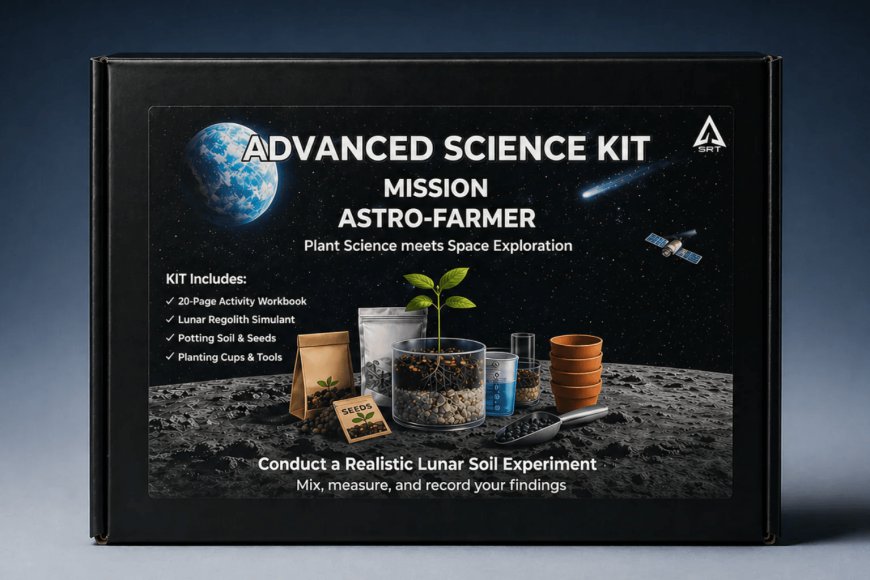
If you've ever wondered what the lunar surface actually feels like, a STEM Space kit is the closest most of us will ever get without leaving Earth. These kits include simulated moon soil, also known as lunar regolith simulant, which is engineered to closely mimic the physical and mineral properties of real samples collected during the Apollo missions.
The Science Behind Lunar Regolith
Real lunar regolith is the layer of loose, fragmented material covering the Moon's bedrock. It forms over billions of years as micrometeorite impacts pulverize surface rock into fine particles. Because the Moon has no atmosphere or water to smooth these particles down, real regolith grains are sharp, jagged, and abrasive — very different from the rounded sand grains found on Earth's beaches or riverbeds.
How Simulants Are Made
Scientists can't simply mine the Moon for classroom supplies, so companies and universities develop regolith simulants using volcanic ash, basalt, and other minerals found on Earth that closely match the chemical composition of actual lunar samples. NASA has even developed standardized simulants like JSC-1A specifically for research and educational purposes, and many STEM kits base their materials on similar formulations.
Why Simulants Matter for Education
Without simulants, students would have no safe or affordable way to study lunar material firsthand. A well-designed STEM Science kit gives classrooms and families access to a scientifically accurate substitute, allowing genuine hands-on experiments rather than just reading about the Moon's surface in a textbook.
Key Physical Properties Kids Can Test
● Particle Size – Real regolith contains a wide range of particle sizes, from fine dust to small pebbles, which can be tested using sieves included in most kits.
● Density – Because of its irregular shape and lack of erosion, regolith often has different packing density compared to Earth soil.
● Reflectivity – The Moon's surface reflects only about 12 percent of sunlight, and simulants allow students to test light reflection with simple tools.
● Water Retention – Real lunar soil contains almost no water, and comparing simulant absorption to Earth soil highlights this dramatic difference.
Mineral Composition and Why It Matters
Lunar regolith contains oxides of silicon, aluminum, calcium, iron, and magnesium, similar to volcanic rock on Earth. Scientists are especially interested in extracting oxygen and metals from this material for future lunar bases, since shipping resources from Earth is extraordinarily expensive. Understanding mineral composition through hands-on testing gives students insight into why in-situ resource utilization, or ISRU, is such an important area of aerospace research today.
Comparing Moon Soil to Mars Soil
Many advanced STEM kits include both lunar and Martian regolith simulants, allowing for direct comparison experiments. Mars soil generally contains more iron oxide, giving it a reddish color, along with traces of perchlorate salts not found in lunar samples. Comparing the two side by side teaches students that not all "space soil" is the same, and each planet presents unique engineering challenges for future exploration.
Classroom Applications Beyond Science Fairs
Teachers can use moon soil simulant for broader lessons connecting geology, chemistry, and even history through the story of the Apollo program. Cross-curricular projects, such as writing a persuasive essay on why lunar resource extraction matters or calculating cost comparisons for shipping versus in-situ resource use, help extend the material beyond a single science class.
Safety Considerations When Handling Simulant
While non-toxic, simulated regolith should still be handled with basic precautions. Fine dust particles can be irritating if inhaled repeatedly, so working in a ventilated space and avoiding excessive agitation of dry material is recommended. Most kits include simple safety notes appropriate for classroom or home use.
How Simulant Quality Varies Between Products
Not every product labeled as "moon soil" undergoes the same rigorous development process. Some low-cost novelty items are little more than dyed sand with no real connection to lunar mineral composition, while scientifically developed simulants are formulated in laboratories using specific ratios of volcanic materials to match published regolith data. Understanding this distinction helps buyers recognize why price and marketing claims alone shouldn't be the only factors considered when selecting a kit for genuine educational use.
The Role of Simulants in Professional Research
Beyond classrooms and homes, regolith simulants play a serious role in professional aerospace research. Engineers use these materials to test how rover wheels perform on loose, granular terrain, how construction equipment might behave when building lunar habitats, and how well certain 3D-printing techniques could work using local lunar material instead of imported concrete or metal. Knowing that the same category of material used by professional engineers is available in an educational kit adds real credibility to classroom experiments.
Common Questions Students Ask About Simulants
Students often want to know whether the simulant in their kit contains any actual lunar material. The honest answer is no — genuine lunar samples are extraordinarily rare, tightly controlled, and reserved almost exclusively for professional scientific research. Explaining this distinction openly, rather than letting misconceptions persist, actually strengthens a student's understanding of how simulants work as scientifically validated stand-ins rather than the real thing.
Final Thoughts
Simulated moon soil bridges the gap between reading about space exploration and actually experiencing it. By understanding how these materials are created and what properties they replicate, students gain a deeper appreciation for the engineering challenges scientists face when planning future missions to the lunar surface.