Reliable Gate Barrier Systems Built for Saudi Security Needs
 TekYousuf26
Every controlled facility in the Kingdom — from residential compounds to government campuses — depends on a dependable Gate Barrier System to manage who and what moves through its perimeter. As Saudi Arabia's cities expand under Vision 2030, facility managers, developers, and security consultants are under growing pressure to install access control that is fast, tamper-resistant, and built for the region's climate and traffic patterns.
This guide walks through the technology, the use cases, and the buying considerations that matter most for organizations across the Kingdom.
What Is a Gate Barrier System and Why It Matters in Saudi Arabia?
A gate barrier is a mechanical or motorized arm, spike plate, or sliding panel that physically blocks a vehicle lane until access is authorized. Paired with sensors, credentials, or number-plate recognition, it becomes a complete access-control layer rather than a simple obstacle. In the Saudi context — where heat, sand, and high vehicle throughput are daily realities — the equipment has to be engineered for durability as much as for speed. Facilities in Riyadh, Jeddah, Dammam, and the Eastern Province increasingly specify barriers that combine mechanical strength with smart connectivity, so a single Gate Barrier System can serve residential towers, logistics yards, and government buildings alike.
Tektronix has supplied and installed perimeter access hardware for commercial, industrial, and government sites across the Kingdom, giving the company direct, field-tested experience with local conditions, procurement requirements, and integration standards. You can review the full barrier and turnstile product range to see the models currently deployed in Saudi facilities.
Beyond the physical arm or spike plate, a complete system also includes the control logic that decides who is allowed through. This is where sensors, credential readers, and software integration turn a simple mechanical gate into a genuine security asset. Facility owners evaluating new equipment should think in terms of the full stack — hardware, credentials, monitoring, and maintenance — rather than treating the barrier arm as a standalone purchase.
The Rise of Boom Barrier System Technology Across the Kingdom
A Boom Barrier System is the most widely recognized form of vehicle gate control — a pivoting arm that raises and lowers to permit or deny passage. Modern units use brushless motors, hydraulic dampers, and reinforced booms rated for continuous-duty cycles, which matters at sites with hundreds of daily vehicle movements such as malls, industrial parks, and mixed-use developments.
Key advantages driving adoption in Saudi projects include:
- Fast-cycle operation, typically opening in under two seconds for high-traffic lanes
- Weather-sealed housings rated for extreme heat, dust, and humidity near the coast
- Compatibility with loop detectors, photocells, and traffic lights for pedestrian safety
- Battery backup so the arm keeps functioning during power interruptions
Maintenance cost is another deciding factor for facility owners. Because a boom arm cycles hundred or thousands of times per month at busy sites, the gearbox, springs, and control board need to be rated for that duty cycle from day one. Selecting undersized equipment to save on upfront cost typically results in premature failure and higher lifetime maintenance spend — a trade-off that experienced integrators help clients avoid during the specification stage.
Entry Point Barriers – First Line of Defense for Any Facility
Entry Point Barriers are the physical and procedural checkpoints where a site's security policy actually gets enforced. Whether it is a single boom arm at a staff entrance or a multi-lane checkpoint at an industrial complex, the entry point is where credential checks, visitor screening, and vehicle inspection converge. Designing this zone correctly — with adequate queuing length, clear sightlines for guards, and barriers rated for anti-ram or standard traffic — is often the difference between a smooth commute and daily congestion at the gate.
A well-planned checkpoint also reduces liability: barriers with obstruction sensors and safety edges prevent damage to vehicles and protect pedestrians, which is now a standard specification in Saudi facility tenders.
Signage, lane markings, and lighting around the checkpoint matter just as much as the barrier itself. Poorly lit entry lanes or unclear queuing paths lead to near-misses and driver frustration, regardless of how capable the underlying equipment is. A thorough site survey before installation should account for approach speed, sightlines, and the number of lanes needed at peak arrival times, particularly for schools, hospitals, and office towers with concentrated shift changes.
Parking Access Barriers for Malls, Offices, and Residential Communities
In mixed-use towers, shopping centers, and gated communities, Parking Access Barriers manage the constant flow of residents, employees, and visitors without creating bottlenecks at peak hours. Ticketless entry, pay-on-foot integration, and app-based resident credentials are becoming the norm in newer Riyadh and Jeddah developments, replacing older token-and-ticket systems that slow traffic and frustrate drivers.
Property managers evaluating parking control equipment typically look for: compact footprint for tight parking ramps, quiet operation for residential buildings, and remote monitoring so a single security desk can oversee multiple entrances. Explore the parking barrier and turnstile solutions built for Saudi developments to compare models suited to different building types.
Integration with payment and validation systems is another growing requirement. Malls and mixed-use developments increasingly link their barrier arms to point-of-sale validation, so a customer's parking fee is automatically discounted or waived after a qualifying purchase — a feature that depends on the barrier's software being open enough to connect with third-party retail systems rather than operating as a closed, standalone unit.
Vehicle Access Control – Building a Smarter Perimeter Strategy
Beyond a single barrier arm, complete Vehicle Access Control involves the credentials, software, and rules that decide who gets through a gate and when. A mature strategy layers multiple technology — RFID tags for staff vehicles, camera-based recognition for guests, and manual override for security personnel — so the system degrades gracefully if any one component fails.
For facilities with multiple entrances, centralizing vehicle access rules in one management platform allows administrators to issue, suspend, or audit credentials from a single dashboard, which is particularly valuable for logistics hubs and multi-tenant business parks operating around the clock.
A strong access-control policy also plans for exceptions: contractor vehicles, delivery trucks, and emergency responders all need a defined process that does not depend on a single guard's judgment at the gate. Time-limited digital passes, pre-approved visitor lists, and clear escalation procedures keep the checkpoint moving even when an unusual vehicle arrives outside normal traffic patterns.
Automatic Road Barrier Solutions for High-Traffic Locations
An Automatic Road Barrier removes the need for a guard to manually raise or lower the arm for every vehicle, instead responding to loop detectors, remote controls, or connected credential readers. This automation is essential wherever traffic volume is high — toll points, warehouse yards, and government campuses — because it keeps queues moving while still enforcing a controlled stop before entry.
Reliability under continuous cycling is the main engineering concern here. Facilities should specify barriers rated for their expected daily cycle count, along with surge protection suited to the local power grid, to avoid downtime during the hottest months of the year when equipment stress is highest.
Remote diagnostics are becoming a standard feature on newer models, letting a maintenance provider check motor temperature, cycle counts, and fault codes without a technician traveling to the site first. For facilities spread across multiple cities, this significantly reduces the time between a fault being detected and a technician arriving with the correct replacement part, cutting downtime at the gate.
RFID Barrier System – Contactless, Fast, and Reliable Entry
An RFID Barrier System reads a windshield tag or vehicle sticker from several meters away, opening the arm automatically without the driver stopping to present a card or wait for a guard. This contactless approach is now standard for staff parking, gated residential compounds, and industrial sites where reducing dwell time at the gate directly improves traffic flow.
Because RFID credentials can be tied to individual vehicles or drivers, the system also produces a reliable audit trail — useful for compliance reporting and incident investigation, both of which are increasingly requested by facility owners and insurers operating in the Kingdom.
Tag range and read reliability vary between suppliers, so facilities with wider approach lanes or higher vehicle speeds should confirm the read distance under real conditions rather than relying on catalogue figures alone. Dual-frequency readers, which combine long-range and close-range detection, are often specified for sites that need both fast-moving staff lanes and slower visitor lanes on the same system.
LPR Boom Barrier – AI-Powered Number Plate Recognition
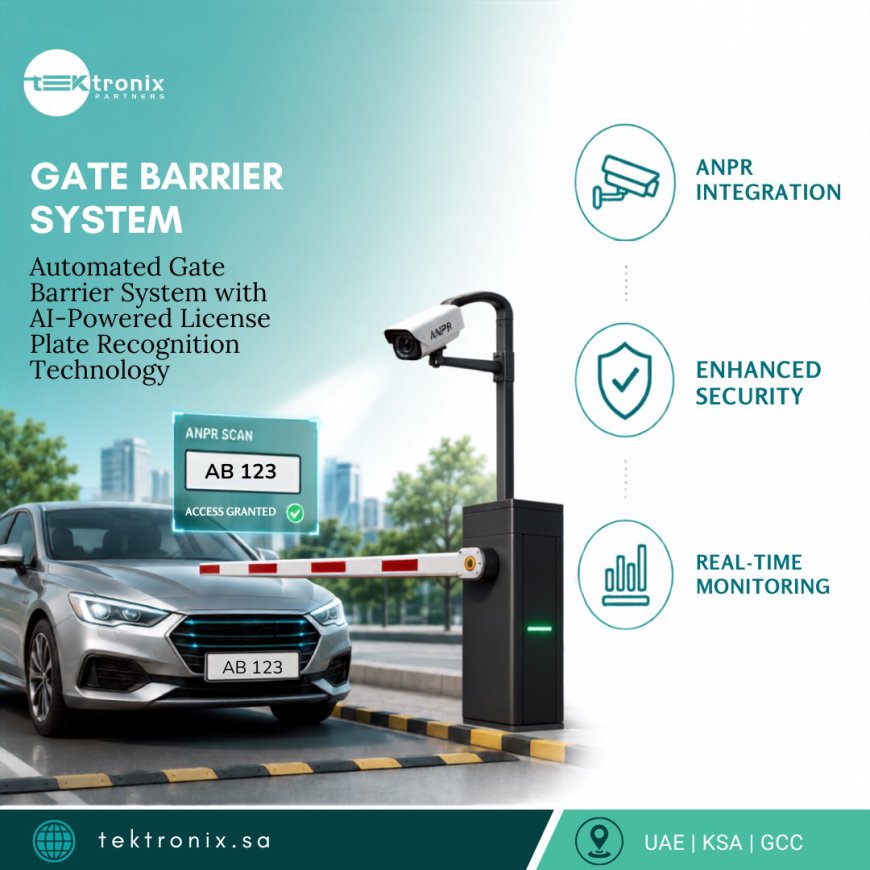
An LPR Boom Barrier pairs a license-plate recognition camera with a boom arm, granting access based on a vehicle's registered number plate rather than a physical card or tag. This is particularly effective for fleet management, visitor pre-registration, and blacklist enforcement, since the camera can flag or deny entry to specific plates automatically, without staff intervention.
LPR-based entry also works well as a redundant layer alongside RFID or card readers — if a driver forgets a tag, the plate camera can still authenticate the vehicle, which keeps the lane moving instead of forcing a manual override.
Recognition accuracy depends heavily on camera placement, lighting, and lens selection, especially at night or during sandstorms, which are common in several Saudi regions. Sites should insist on infrared-capable cameras and a recognition engine tuned for regional plate formats, since generic software trained on other markets often produces higher error rates on local plates until it is properly calibrated.
Security Gate Barrier System – Layers of Protection for Critical Sites
For embassies, data centers, refineries, and other high-sensitivity locations, a single boom arm is rarely enough. A layered Security Gate Barrier System typically combines a crash-rated barrier or bollard, an automated boom arm for routine traffic, credential verification, and CCTV coverage of the entire approach lane. Each layer is designed to slow or stop a threat at a different distance from the protected asset, giving guards time to respond.
Choosing the right combination depends on a formal risk assessment: vehicle speed at approach, asset value behind the perimeter, and the site's regulatory classification all influence whether a project needs standard-duty equipment or crash-rated hardware certified to recognized impact standards.
Documentation matters as much as the hardware itself for regulated sites. Impact ratings, maintenance logs, and installation certificates are frequently requested during security audits, so facilities should keep this paperwork on file from the day the equipment is commissioned rather than trying to reconstruct it years later when an inspector requests it.
Gate Barrier System KSA – Compliance with Local Security Standards
Sourcing a Gate Barrier System KSA projects can rely on means working with equipment that suits the Kingdom's climate, power infrastructure, and regulatory expectations. Government and semi-government tenders in Saudi Arabia frequently require local support, spare-parts availability, and installation teams familiar with civil defense and municipal approval processes — factors that imported, unsupported equipment often cannot satisfy.
Working with a locally established integrator also shortens project timelines, since site surveys, civil works coordination, and after-sales maintenance can be scheduled without the delays of cross-border logistics.
Power supply consistency, ambient temperature ratings, and dust ingress protection (IP rating) are three specifications worth double-checking against Saudi conditions specifically, rather than assuming a barrier certified for a temperate climate will perform the same way after a full summer of continuous outdoor operation. Reputable suppliers will provide test data or reference sites within the Kingdom to support their durability claims.
Gate Barrier System Riyadh – Local Expertise, Nationwide Support
Demand for a dependable Gate Barrier System Riyadh facility require has grown alongside the capital's rapid commercial and residential expansion. New business districts, mixed-use towers, and logistics corridors around Riyadh all need perimeter equipment installed and commissioned quickly, with technicians available for maintenance without long wait times.
Beyond the capital, the same installation and service network extends to other major Saudi cities, so multi-site organizations can standardize on one barrier platform and one support contract rather than managing separate vendors per region.
Response time for repairs is often the single biggest complaint facility managers raise about their existing barrier vendor. A guard desk with a broken arm blocking the only entrance is not a minor inconvenience — it can halt deliveries, delay staff, and create a security gap if the barrier is manually propped open as a workaround. Choosing a Riyadh-based provider with stocked spare parts and same-day dispatch materially reduces this risk compared with vendors who ship parts from abroad.
Planning a Gate Barrier Installation – What Facility Managers Should Check
Before signing off on any barrier system, it helps to walk through a short checklist that covers both the technical and operational sides of the project:
- Expected daily traffic volume per lane and peak-hour queuing requirements
- Power availability at the gate, including backup during outages
- Credential type — RFID tag, LPR camera, mobile app, or a combination
- Integration needs with existing CCTV, visitor management, or payment systems
- Civil defense and municipal approval requirements for the specific site type
- Warranty terms and the location of the nearest authorized service center
Working through this list early in the project — ideally during the design stage rather than after construction is complete — avoids costly rework such as re-routing cabling or resizing the civil foundation once equipment has already been ordered.
Why Tektronix Is the Trusted Choice for Gate Barrier Systems in Saudi Arabia
Tektronix designs, supplies, and maintains perimeter security equipment for commercial, industrial, and government clients across Saudi Arabia. The company's engineering and installation teams work directly on-site, which means product recommendations are grounded in real deployment experience rather than catalogue specifications alone. Every project includes site assessment, civil works coordination, commissioning, and after-sales support, so clients are not left managing multiple vendors for a single checkpoint.
This hands-on approach — combined with a documented track record of installations across Riyadh, Jeddah, and the Eastern Province — is why architects, facility managers, and security consultants specify Tektronix equipment when planning new perimeter security projects. To see technical specifications and configuration options, visit the Tektronix gate barrier and turnstile catalogue.
Clients also benefit from a single point of accountability across the project lifecycle — from the initial site survey and equipment selection through installation, commissioning, and scheduled maintenance visits. This reduces the coordination burden on facility teams who would otherwise need to manage separate contractors for civil works, electrical connections, and equipment servicing.
Conclusion
Choosing the right Gate Barrier System is ultimately about matching real traffic patterns, security risk, and climate conditions to the correct combination of hardware and credentials. Boom Barrier System and Automatic Road Barrier technology now work alongside RFID Barrier System and LPR Boom Barrier recognition to remove friction from daily entry while keeping unauthorized vehicles out. Whether the requirement is Parking Access Barriers for a residential tower or a full Security Gate Barrier System for a critical site, Saudi facilities are best served by locally supported, field-tested equipment. Organizations searching for a Gate Barrier System KSA or Gate Barrier System Riyadh provider should prioritize vendors offering installation, maintenance, and genuine Vehicle Access Control expertise. Reliable Entry Point Barriers protect people, assets, and continuity of operations for years to come.
FAQs
1. What is the difference between a boom barrier and a road blocker?
A Boom Barrier System uses a pivoting arm suited to routine traffic control, while a road blocker is a crash-rated plate that rises from the ground to stop forced-entry attempts. Many high-security sites use both together as part of a layered approach.
2. How does an RFID barrier system work at a residential compound?
An RFID Barrier System reads a windshield tag as the vehicle approaches and automatically raises the arm for registered residents, while visitors are directed to a separate lane for manual verification or intercom access.
3. Can an LPR boom barrier work without RFID tags?
Yes. An LPR Boom Barrier identifies vehicles purely by their license plate, so it can operate as a standalone system or as a backup layer alongside RFID and card-based credentials.
4. What should a facility in Riyadh look for when choosing a supplier?
Facilities sourcing a Gate Barrier System Riyadh project should prioritize suppliers with local installation teams, spare-parts stock, and after-sales service contracts, since imported equipment without regional support can lead to long repair delays.
5. Are gate barriers alone enough for high-security government sites?
Not usually. Government and critical-infrastructure sites typically require a layered Security Gate Barrier System combining crash-rated barriers, credential verification, and surveillance, rather than a single boom arm.