Smart Locker Systems for Schools in Saudi Arabia
 TekYousuf26
Saudi Arabia's schools are undergoing a technology-led transformation that is reshaping every dimension of the learning environment — and the humble school locker is no exception. A modern Smart Locker System replaces the padlock-and-key or combination-dial models that have defined school storage for generations with an intelligent, digitally governed, audit-ready solution that improves student experience, reduces administrative burden, eliminates the theft and lost-key costs that mechanical lockers impose, and provides school security teams with a documented record of every locker access event across the entire campus.
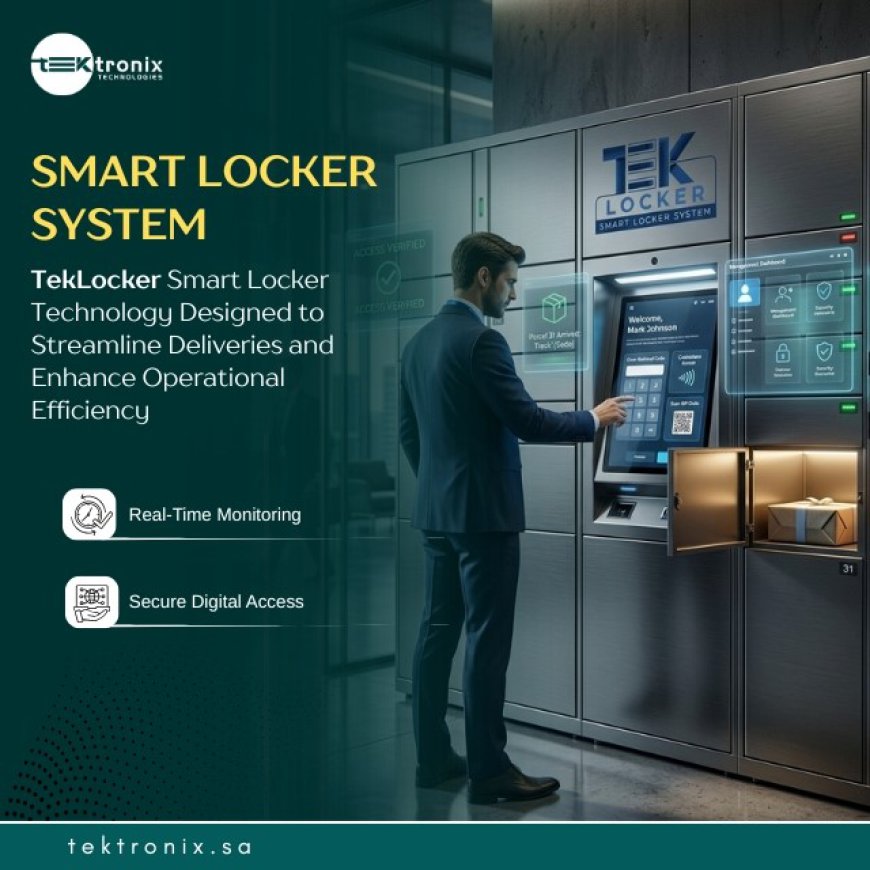
As Saudi Arabia's Ministry of Education drives the modernisation of school infrastructure under Vision 2030's human capital development agenda — and as the Kingdom's private school sector raises its operational standards to attract and retain families seeking premium educational environments — Tektronix KSA delivers the smart locker technology that leading Saudi schools are choosing. Explore our smart locker system for Saudi Arabia schools and discover how intelligent storage transforms campus operations, security, and student experience simultaneously.
Why Saudi Schools Are Replacing Mechanical Lockers with Smart Technology
The limitations of mechanical locker systems are well understood by every school facilities manager in Saudi Arabia, but they have historically been accepted as the cost of providing storage at scale: forgotten combinations that require administrator intervention to reset, lost padlock keys that generate replacement costs and service calls, lockers left open or unsecured because students forget to lock them, and the complete absence of any usage record that would allow a school to investigate a theft, identify a disused locker for reassignment, or confirm which student accessed a specific unit at a specific time. For a Ministry of Education-inspected public school or a COBIS, CIS, or NEASC-accredited private school in Saudi Arabia, these are not trivial operational inconveniences — they are governance gaps that reflect on the institution's facility management standards during inspection and accreditation review visits.
Beyond the administrative burden, mechanical lockers create two security vulnerabilities that digital systems eliminate structurally. First, a combination or key can be shared, enabling unauthorised individuals to access any locker whose credentials they have obtained — creating theft opportunities and compromising the privacy of the assigned student's stored possessions. Second, there is no record of when a locker was opened, by whom, or how many times — making theft investigation dependent entirely on eyewitness accounts or CCTV footage that may not cover the specific locker bank in question at the relevant time. A Smart Lockers for Schools platform addresses both vulnerabilities simultaneously: credential verification confirms the identity of every person who opens a locker, and a timestamped digital log records every access event for security review, parent communication, and Ministry of Education governance documentation purposes.
The Technology Architecture of Tektronix KSA's Smart Locker Platform
Electronic Locker System: The Hardware Foundation
The physical foundation of Tektronix KSA's offering is a premium Electronic Locker System engineered for the operational demands of the Saudi school environment — high daily usage cycles across large student populations, the thermal stress of Saudi Arabia's extreme summer temperatures in non-air-conditioned or partially conditioned locker corridors, and the physical wear of continuous student interaction across an academic year. Each locker unit incorporates an electronic locking mechanism rated for a minimum of one hundred thousand lock-unlock cycles without mechanical degradation — a specification that ensures the system remains reliable across multiple academic years without the replacement costs that inferior hardware imposes on the school's facilities maintenance budget. The locking mechanism operates on a fail-secure default, ensuring that a power interruption does not leave lockers unintentionally open, while an integrated backup battery maintains full locking function during building power failures of up to twenty-four hours — protecting students' stored property during the infrastructure events that Saudi schools occasionally face during peak summer demand on the national grid.
Digital Locker System: Intelligent Control from a Central Platform
Coordinating the entire locker estate from assignment through daily access to decommissioning is Tektronix KSA's Digital Locker System management platform — a cloud-hosted or on-premise software environment that gives school administrators complete visibility and control over every locker unit across the campus from a single browser-accessible console. Administrators assign lockers to students with a few clicks, set access permissions specifying which credential methods are valid for each locker, configure access time windows that restrict locker opening to school hours only, and receive real-time alerts when a locker is accessed outside its configured window, left open beyond a defined threshold, or shows a hardware fault condition. Locker reassignment between academic years — one of the most administratively burdensome tasks in facilities management at large Saudi schools — is completed across the entire estate in minutes rather than days, with the platform automatically clearing previous student credentials and generating new assignment notifications to incoming students via the school's communication channel.
Face Recognition Locker Access: Identity-Verified Storage for Premium Campuses
For Saudi schools seeking the highest level of security and the most frictionless student experience simultaneously, Tektronix KSA's Face Recognition Locker Access module delivers touchless locker opening through biometric facial verification that confirms the identity of the accessing student before the lock releases. A student approaches their locker, the integrated camera terminal captures and matches their facial geometry against the enrolled template in under one second, and the locker opens — no card to locate, no code to remember, and no physical contact with any reader surface. For Saudi schools managing infectious disease control measures, hygienic facility requirements, or student population disabilities that make physical credential interaction challenging, the touchless nature of facial verification addresses all of these considerations simultaneously. All biometric templates are encrypted at AES-256 standard and stored within Tektronix KSA's secured local server, managed under Saudi Arabia's Personal Data Protection Law (PDPL) administered by SDAIA with explicit student and guardian consent workflows built into the enrolment process.
QR Code Smart Locker Access: Instant Credential from the School App
For schools preferring a credential approach that does not involve biometric data capture, Tektronix KSA's QR Code Smart Locker Access module delivers a fast, secure, and visually verifiable entry method through a time-limited QR code displayed on the student's smartphone or printed on a student ID card. The locker's integrated scanner reads the QR code, verifies its validity against the central management platform in real time, and opens the lock — completing the full access sequence in under five seconds. QR codes are generated with a time-to-live parameter configurable by the school administrator, preventing a shared or photographed QR code from providing ongoing unauthorised access beyond the expiry window. For younger students who do not carry smartphones, the QR code can be printed on the student's ID card or term planner, maintaining the same access method while removing the smartphone dependency that may not be appropriate for primary school age groups in Saudi Arabia's educational context.
App-based Locker Access: Student Experience on a Smartphone
For Saudi secondary and higher secondary schools where students routinely carry smartphones, Tektronix KSA's App-based Locker Access module delivers locker opening via Bluetooth Low Energy or NFC from the school's mobile application — enabling students to open their locker by simply approaching it with their phone in their pocket, without any screen interaction or credential presentation. The app also provides students with their locker assignment details, access history, and any outstanding notifications from the school's facilities team — creating a communication channel between the school and the student that supplements the parent-facing communication tools already deployed. For schools conducting equipment lending programmes — where students borrow tablets, scientific calculators, or PE equipment from smart locker banks — the app-based access module manages the borrow-and-return workflow, recording the lending event, the borrowing student's identity, and the return event in a complete asset tracking log that eliminates the paper-based borrowing registers that create administrative overhead and lost-item disputes at Saudi school libraries and resource centres.
Locker Management Software: The Intelligence Behind Campus Storage Operations
The full operational value of a smart locker deployment is realised through Tektronix KSA's Locker Management Software, which transforms raw locker hardware into an intelligent, data-driven campus storage management capability. The software's assignment management module maintains a complete database of every locker unit across the campus — its current assignment status, the assigned student's grade, section, and contact details, the credential type configured, and the full access history from first assignment. During academic year transitions, the bulk reassignment workflow clears and reassigns the entire locker estate in a single operation, generating parent and student notifications through the school's communication platform simultaneously — a process that previously required a dedicated week of administrative effort at large Saudi campuses is compressed into a few hours of supervised system operation.
The software's security and compliance reporting module generate exportable audit logs in PDF, Excel, and CSV formats covering every access event across every locker unit — timestamped, credential-type identified, and user-attributed — providing school security coordinators with the documented evidence required for theft investigations, bullying incident reviews, and Ministry of Education governance documentation submissions. For Saudi schools maintaining or pursuing accreditation under COBIS, CIS, or NEASC frameworks, the locker management audit trail forms part of the documented student wellbeing and facility governance evidence that accreditation review teams examine during site visits. Real-time dashboard views show facilities managers the current open-closed status of every locker across the campus, the units that have been accessed most frequently in the past twenty-four hours, and any hardware fault alerts requiring maintenance attention — replacing the reactive, walk-the-corridor facilities management model with a proactive, data-informed approach that reduces maintenance response times and unplanned disruption to the school day.
Applications Across Saudi School Environments
Tektronix KSA's smart locker platform serves the full range of Saudi school facility types and use cases that the Kingdom's diverse educational sector presents. For Ministry of Education public schools across Riyadh, Jeddah, Makkah, Madinah, and the Kingdom's thirteen administrative regions, the platform provides an affordable, scalable, Arabic-language managed solution that integrates with school management systems and aligns with the Ministry of Education's school digital infrastructure guidelines under Vision 2030's education modernisation agenda. The platform's cloud-hosted management option allows the Ministry of Education's regional education directorates to monitor locker infrastructure deployment and usage across multiple schools from a centralised dashboard — supporting the standardised facility management governance that inspectors expect during scheduled school visits.
For Saudi Arabia's private school sector — spanning premium international curriculum schools in Riyadh's Diplomatic Quarter and Jeddah's Al Rawdah district through to the expanding network of elite Arabic-medium private academies operated by Saudi education groups such as Dar Al Fikr, Manarat, and Rowad Al Khaleej — the platform's premium credential options including facial recognition and app-based access position smart lockers as a visible differentiator in the competitive Saudi private school market, where families compare facility technology standards alongside academic outcomes when selecting schools for their children. For university campuses and technical colleges operating under the Ministry of Education's higher education framework — King Saud University, Princess Nourah University, and the Saudi Technical and Vocational Training Corporation's (TVTC) expanding campus network — the platform's equipment lending management capability addresses the significant asset tracking challenge of managing tablets, laboratory equipment, and technical tools across large student populations at multi-building campuses.
Implementation, Integration, and Deployment Across Saudi Campuses
Tektronix KSA's smart locker deployments integrate natively with the leading school management systems used across Saudi Arabia's public and private school sectors, including Oracle Student Cloud, Alnafithah (Ministry of Education's school management portal), and the SMS platforms deployed across Saudi private international schools. Student enrollment data — including grade, section, gender, and contact details — synchronises automatically from the school management system to the locker management platform, eliminating duplicate data entry and ensuring that locker assignment databases always reflect current enrollment without manual reconciliation. At the end of each academic year, graduation and departure events in the school management system automatically trigger locker decommissioning workflows, clearing the departing student's credentials and flagging the unit for reassignment to the incoming cohort.
Physical installation of Tektronix KSA's locker hardware is managed by a Saudi-based engineering team with experience across school building types common across the Kingdom — from the purpose-built campuses of Riyadh's international school cluster through to the adapted government building footprints of public schools in the Kingdom's more remote governorates. Standard locker bank configurations — free-standing columns, wall-mounted units, and corridor-integrated configurations — accommodate the full range of Saudi school corridor widths and locker bay dimensions without structural modification in most cases. Typical single-school deployments covering all locker banks across the campus are completed within five to ten school days, with installation scheduled during academic year transitions or school holidays to minimise disruption. Ongoing remote monitoring of every locker unit's hardware health, connectivity status, and battery level is provided through Tektronix KSA's service platform, with on-site maintenance dispatched proactively when the remote monitoring system identifies a developing hardware issue before it causes a student-facing failure. Our Saudi Arabia smart locker system for schools deployment team provides a campus assessment, locker count survey, and formal deployment proposal tailored to your school's specific building layout, student population, and curriculum requirements.
Smart Locker System KSA: Compliance, Data Governance, and Arabic Platform Support
Deploying a fully compliant Smart Locker System KSA across Saudi schools requires a platform and deployment methodology calibrated for Saudi Arabia's specific regulatory environment, cultural context, and educational governance structure. Tektronix KSA's platform ships with a full Arabic-language management interface across all administrator, facilities manager, and student-facing touchpoints — ensuring that the system is operationally accessible to the Arabic-speaking school management and security staff who will administer it daily, and that student and parent communications generated by the platform are delivered in Arabic as the primary language. Hijri calendar integration ensures that academic year transition dates, term schedules, and audit log reporting are presented in the calendar format used by Saudi school administrative systems and Ministry of Education documentation requirements.
For Saudi schools choosing the facial recognition credential option, PDPL compliance is built into the student biometric enrolment workflow — with explicit guardian consent capture for students under eighteen years of age, AES-256 biometric template encryption, local server storage within the school's own Saudi-based IT infrastructure, and configurable template retention schedules that automatically purge biometric records when a student departs the school. The platform's data governance module generates the consent records, retention documentation, and data subject access request logs that SDAIA's PDPL enforcement framework requires, providing school administrators with the evidence needed to demonstrate compliance during Ministry of Education or SDAIA regulatory reviews without manual record compilation. Contact Tektronix KSA through our KSA school smart locker solutions and deployment consultation page to schedule a campus visit and receive a tailored smart locker implementation proposal for your Saudi school or educational campus.
Conclusion
Saudi schools that deploy Tektronix KSA's Smart Locker System are investing in campus infrastructure that simultaneously elevates student experience, strengthens security governance, and reduces administrative overhead — with Smart Lockers for Schools built on a robust Electronic Locker System hardware foundation and managed through an intelligent Digital Locker System platform. Whether students access their lockers via Face Recognition Locker Access, QR Code Smart Locker Access, or App-based Locker Access, every event is verified, logged, and governed through powerful Locker Management Software.
FAQs
FAQ 1: What makes a Smart Locker System better than traditional mechanical lockers for Saudi schools?
A Smart Locker System eliminates every structural limitation of mechanical lockers: lost keys, forgotten combinations, shared credentials enabling unauthorised access, and the complete absence of any usage audit trail. Every access event is verified against the assigned student's credential and logged with a timestamp — providing school security coordinators with the documented evidence needed for theft investigations and Ministry of Education governance submissions, while eliminating the administrative overhead of combination resets and key replacements that consume facilities management time at Saudi schools every week of the academic year.
FAQ 2: How do Smart Lockers for Schools handle the transition between academic years in Saudi Arabia?
Tektronix KSA's Smart Lockers for Schools management platform includes a bulk academic year transition workflow that clears all departing student credentials, reassigns locker units to incoming students based on the new enrollment data synchronised from the school management system, and generates Arabic-language notification messages to students and parents confirming their new locker assignment — all in a single supervised operation that can be completed in a few hours rather than the days of manual effort that mechanical locker reassignment requires at large Saudi schools. The workflow also identifies any locker units that have been unassigned, damaged, or flagged for maintenance during the outgoing year, prioritising them for service before the new academic year begins.
FAQ 3: How does Face Recognition Locker Access comply with Saudi Arabia's PDPL for student biometric data?
Tektronix KSA's Face Recognition Locker Access module processes student facial biometric templates with explicit guardian consent capture built into the enrolment workflow for all students under eighteen — a requirement of Saudi Arabia's PDPL administered by SDAIA. All biometric templates are encrypted at AES-256 standard and stored exclusively on the school's local Saudi-based server infrastructure, with no transmission to external cloud environments. Configurable retention schedules automatically purge templates when a student departs the school, and the platform generates data subject access and deletion records required for SDAIA regulatory compliance demonstration, ensuring that the school's biometric data governance documentation is always audit-ready.
FAQ 4: Can QR Code Smart Locker Access work for younger Saudi students who do not carry smartphones?
Yes. Tektronix KSA's QR Code Smart Locker Access module supports QR code delivery on the student's physical ID card or term planner as well as on a smartphone app, making the access method appropriate for primary school age students who do not carry personal devices under the school's technology policy. Printed QR codes on ID cards are generated with configurable validity periods and can be renewed termly as part of the school's standard ID card reissuance process, ensuring that the access credential remains current and that expired or lost ID cards cannot be used to access the assigned locker beyond their intended validity window.
FAQ 5: How does the Locker Management Software generate compliance reports for Ministry of Education inspections?
Tektronix KSA's Locker Management Software generates exportable compliance reports in PDF, Excel, and Arabic or English bilingual formats covering all locker access events, assignment histories, hardware fault records, and maintenance action logs for any specified date range. These reports provide Ministry of Education inspectors and COBIS, CIS, or NEASC accreditation reviewers with structured, auditable evidence of professional locker estate management — demonstrating that the school maintains documented governance of its storage infrastructure, investigates security incidents with digital evidence rather than paper records, and manages student data in compliance with PDPL requirements. Reports are available on demand from the management console without any manual data extraction or formatting required from the school's administration team.