Why the companies winning with AI are redesigning the work around it
 theleadershipchronicle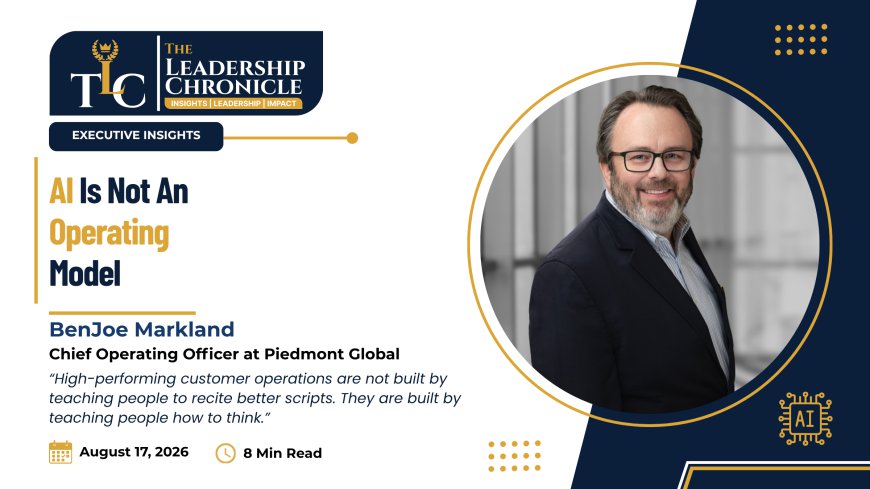
AI has produced one of the most interesting contradictions I have witnessed in the past two decades of building and leading operations.
Organizations now have access to more technology, more data, and more automation than at any point in my career. We have the ability to analyze thousands of customer interactions, identify patterns across an entire workforce, automate daily routine interactions, powerfully predict demand, identify performance problems in real time, and put information in front of an employee in seconds.
The contradiction is that none of these things automatically creates a high-performing operation.
“What technology actually does is expose the operation you already have.”
Then comes the denial from executives who are not prepared for that reality.
A growing trend right now is the use of AI notetakers, which then turn into to-do lists and call summaries. I have joined meetings that had more notetakers than people. But most of this data goes into an abyss, because people become so dependent on someone else taking notes that they now need a notetaker to review the notetaker. The reality is that no one is really listening, and most likely never was. Executives respond by talking more, trying to prove their point, and more notetakers keep showing up.
In the end, unclear ownership becomes obvious. Poor processes become automated poor processes. Weak managers get better dashboards and still cannot coach. Organizations collect more data while their employees remain unclear about what they are supposed to do differently tomorrow morning.
“The most expensive mistake a company can make with AI is treating it as an operating model. It is not one.”
AI is an extraordinarily powerful capability inside an operating model, and that distinction is not semantic. It sets the sequence of every decision that follows.
Measure outcomes. Coach behaviors.
Long before the current AI boom, we ran into a version of this problem inside our own operations.
We had no shortage of metrics. Like most large customer operations, we could measure the outcomes: productivity, quality, utilization, attrition, revenue, customer experience, and dozens of other indicators.
But measuring an outcome and changing an outcome are two different disciplines.
Pushing an employee and telling them their conversion rate needs to increase does not tell them what to do differently on the next customer interaction. Telling a manager attrition is too high does not identify which management behaviors are driving it, and telling an operation to improve productivity does not create it.
So we changed the question. Instead of asking what we should measure, we asked what behaviors actually produce the outcome.
Why did your mom teach you to brush your teeth as a child? Whatever her reason, the answer matters less than the method: she focused on behaviors that would create predictable success, monitored those behaviors, and built a lifelong habit.
Behavior analysis reshaped how we managed performance. We stopped building scorecards around lagging indicators and built them around influenceable lead measures, the specific actions an employee or a manager could change that week. Then we connected those behaviors to coaching, recognition, accountability, and performance.
We also could not find technology in the market that worked the way we now believed the operation needed to work. So we built it: AI-enabled dashboards tracking influenceable lead measures instead of lagging outcomes, tied to coaching, recognition, gamification, and a management structure that kept individual behavior aligned with organizational results.
Over a three-year period, utilization improved 26 percent, monthly attrition declined 19 percent, annual training hours declined 35 percent, and bill rate per hour increased 8 percent.
Those results matter. The sequence behind them matters more. We did not start with technology and ask how the organization could use it. We started with the work, determined how the operation needed to function, and then built technology to serve that. In the age of AI, that sequence is even more consequential.
Here is what it looks like at ground level.
I worked with a team serving customers in the travel industry. Part of the job was helping travelers understand additional products and experiences that might improve their trip. A representative was on a call with an older customer, trying to explain the value of an internet package. The pitch amounted to: “You’ll want to post to Instagram, right?”
Technically, the representative did what we had asked. The product was presented. Operationally the interaction was a failure, because he had started with the product instead of the person.
The coaching was not “sell harder.” It was: be curious. Ask questions. Why is this customer traveling? Who is traveling with them? What matters to them? What kind of experience are they hoping to have?
That customer may not have cared about Instagram at all. The conversation could have surfaced that premier dining, or a different experience altogether, created genuine value for them.
“High-performing customer operations are not built by teaching people to recite better scripts. They are built by teaching people how to think.”
AI makes that lesson more important, not less.
Automation raises the value of judgment
Much of the early conversation about AI centered on replacement. That framing misses the more consequential transformation. When AI absorbs routine work, the human work that remains becomes harder.
Consider customer experience. If AI can reset a password, provide order status, answer a routine billing question, retrieve information, summarize a conversation, and complete increasingly sophisticated transactions, none of those interactions need to reach an employee.
The average human interaction gets more difficult, not less. Which means you cannot automate the simple work while continuing to recruit, train, coach, measure, and manage people for the job they held five years ago. The job changed. The operating model has to change with it.
The manager’s job gets harder too
For years, frontline managers in large operations have spent enormous amounts of time collecting information, reviewing reports, and manually hunting for performance problems. AI can eliminate or dramatically reduce most of that work.
That should not eliminate the manager. It should raise the standard for management.
If AI can tell a manager which employee is struggling, which behaviors changed, which interactions carry risk, and where an opportunity sits, then finding the problem is no longer where a manager creates value. Doing something about it is.
Can they coach? Can they create accountability? Can they explain why performance changed? Can they develop judgment in someone else? Can they build enough trust that people tell them the truth? Can they turn information into action?
That is a fundamentally different management job, and most operations have not yet rewritten the role, the hiring profile, or the training to match it.
AI should change the economics, not just the efficiency
There is a larger prize here than making the existing operation slightly cheaper to run.
For decades, most organizations treated customer service primarily as an expense to manage. The governing questions were staffing, utilization, handle time, cost per contact, and labor arbitrage. Those questions still matter. They are no longer sufficient.
If automation absorbs high-volume transactional work, human capacity can move toward interactions where judgment, persuasion, empathy, retention, and problem-solving create disproportionate value. That changes the operating question from “how cheaply can we handle this interaction” to “what value can we create from the interactions that remain.”
That is a fundamentally different operating philosophy, and it puts a different asset on the table. Customer operations become a source of customer intelligence, retention, revenue, product insight, and competitive differentiation.
But only if leaders redesign the work. Laying AI on top of the existing structure will not get anyone there.
Technology cannot resolve organizational ambiguity
I have led operations across different countries, customer environments, and stages of organizational growth, scaling operations, restructuring responsibilities, and fixing organizations where execution had stalled.
The presenting problem is almost always some version of the same five statements: better technology, more accountability, lower costs, better people, or a better customer experience.
Underneath them, I repeatedly find a much smaller set of operating questions.
Who owns the outcome? Who has the authority to make the decision? What behaviors produce the result? What is the operating cadence for reviewing those behaviors? Where are the handoffs? Where are executives inserting themselves into work someone else should own? What happens when performance misses expectations? What information does each level need to decide well?
None of that sounds as exciting as generative AI or autonomous agents. It is the architecture of an operating system, and AI cannot answer a single one of those questions for an executive team.
Which is also why AI implementation cannot simply be delegated to IT. Technology teams can deploy systems. They cannot independently redesign an organization. That requires operating leadership, and it requires it before the deployment rather than after.
Solve those questions and technology becomes enormously powerful. Ignore them and technology becomes another layer of complexity, purchased at scale.
The leadership question has changed
Every major technology shift creates pressure for leaders to move quickly. AI may be generating more of that pressure than anything I have experienced in my career.
Moving quickly matters. Moving coherently matters more.
“Where can we deploy AI?” is no longer the useful question. The better ones are harder. What work should no longer exist? What work should technology own? What work should humans own? How does the manager’s job need to change? And what operating model connects all of it?
Years ago, when we could not find technology that supported the operating model we wanted, we built the technology around the work. Organizations today have close to the opposite problem. The technology is arriving faster than most of them can redesign the work around it.
That is why the durable advantage in AI may have very little to do with who gets access to it first. Most organizations will end up with remarkably similar capabilities. The advantage will belong to the organizations that know what to do with them.
“AI is not the operating model. It may, however, be the catalyst that finally forces leaders to build a better one.”
For more details, visit: https://theleadershipchronicle.com/
If you would like to get featured or want to know more, connect with us at contact@theleadershipchronicle.com
LinkedInn : https://www.linkedin.com/company/the-leadership-chronicle/
Twitter : @TLChronicle