12 Agent Use Cases You Can Deploy in 90 Days
This blog highlights 12 high-impact agentic AI use cases that SaaS teams can implement within 90 days using proven frameworks and tools.
 Stellamiller
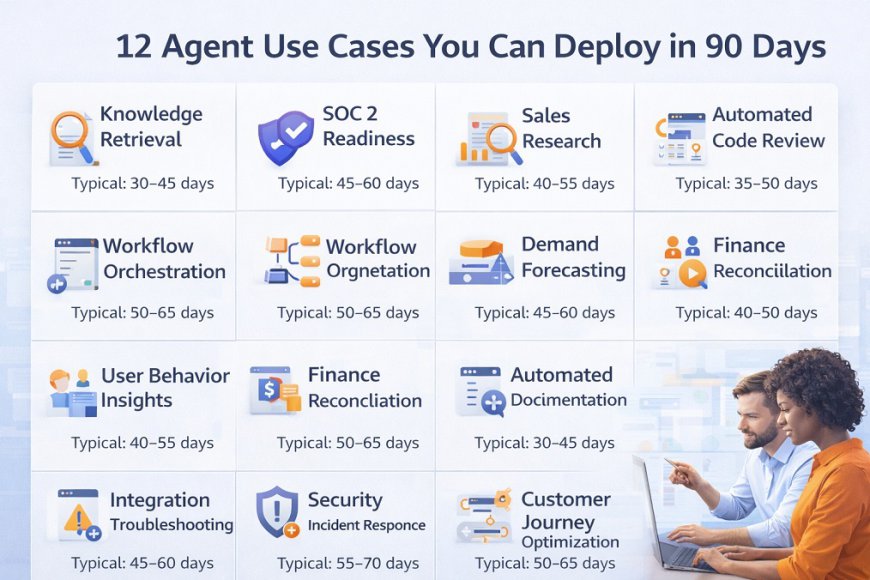
SaaS companies are moving beyond slow AI experimentation and adopting production-grade agent deployments. This shift is driven by mature development frameworks such as LangChain, CrewAI, and AutoGen, which enable modular and scalable agent architectures.
With the right tooling and planning, a 90-day deployment timeline is now realistic. Many organizations are using Agentic AI Use Cases as reference models to accelerate implementation and reduce technical risk.
What Makes an AI Agent Deployable in Under 90 Days?
Rapid deployment is possible when agents are built on proven foundations. Pre-built agentic frameworks simplify orchestration, testing, and scaling across multiple workflows.
Successful deployments typically include:
-
Clearly defined tasks and objectives
-
Well-documented data sources
-
Controlled autonomy boundaries
-
Integration-ready environments
-
Reusable agent patterns
Common patterns include retrieval agents, workflow agents, monitoring agents, and reasoning agents. Projects move faster when workflows and data pipelines are already established.
The 12 Agentic AI Use Cases
Below are twelve practical use cases that SaaS teams can deploy within three months.
1. Knowledge Retrieval Agent
This agent automates Level-1 support by answering customer queries using internal documentation. Data flows through ingestion pipelines into vector databases, enabling RAG-based responses.
Typical deployment time: 30–45 days.
2. SOC 2 Readiness Agent
This agent automates compliance evidence collection and monitoring. It uses log scrapers and rule engines to feed compliance dashboards while maintaining human oversight.
Typical deployment time: 45–60 days.
3. Sales Research Agent
Sales research agents generate account insights, ideal customer profiles, and competitive analysis. They integrate data connectors with scoring engines and CRM platforms.
Typical deployment time: 40–55 days.
4. Automated Code Review Agent
This agent reviews pull requests, identifies risks, and suggests fixes. It integrates repository listeners with LLM review models and CI/CD pipelines.
Typical deployment time: 35–50 days.
5. Workflow Orchestration Agent
Workflow agents automate multi-step business processes using intent parsers and agent coordinators. They route tasks to specialist agents for execution.
Typical deployment time: 50–65 days.
6. Demand Forecasting Agent
Demand forecasting agents combine operational data with ML models to generate real-time insights and visual reports.
Typical deployment time: 45–60 days.
7. User Behavior Insights Agent
These agents analyze user activity to identify churn risks and engagement gaps. Event data is stored in vector databases and processed for alerts.
Typical deployment time: 40–55 days.
8. Finance Reconciliation Agent
This agent matches invoices, transactions, and ledger records using ML-based matching and anomaly detection models.
Typical deployment time: 50–65 days.
9. Automated Documentation Agent
Documentation agents generate and update API references and release notes directly from code repositories and CMS platforms.
Typical deployment time: 30–45 days.
10. Integration Troubleshooting Agent
This agent analyzes system logs to diagnose API and microservice failures. It produces resolution suggestions through reasoning models.
Typical deployment time: 45–60 days.
11. Security Incident Response Agent
Security agents monitor SIEM data to detect threats and recommend mitigation actions. They integrate with ticketing systems and audit tools.
Typical deployment time: 55–70 days.
12. Customer Journey Optimization Agent
These agents evaluate A/B test data and user behavior to improve messaging, UX flows, and conversion performance.
Typical deployment time: 50–65 days.
Scaling These Use Cases for Long-Term Impact
While these agents can be deployed quickly, long-term success depends on governance, monitoring, and continuous optimization. Organizations investing in structured agentic AI development for SaaS are better positioned to scale these systems reliably.
Conclusion
Agentic AI is no longer limited to experimental pilots. With modern frameworks and repeatable architectures, SaaS teams can deploy high-impact agents within 90 days. By focusing on proven use cases and disciplined execution, organizations can accelerate automation, improve decision-making, and build competitive advantages.