3D Printing in Australia: Advancing Australian Manufacturing One Layer at a Time
 forgelabs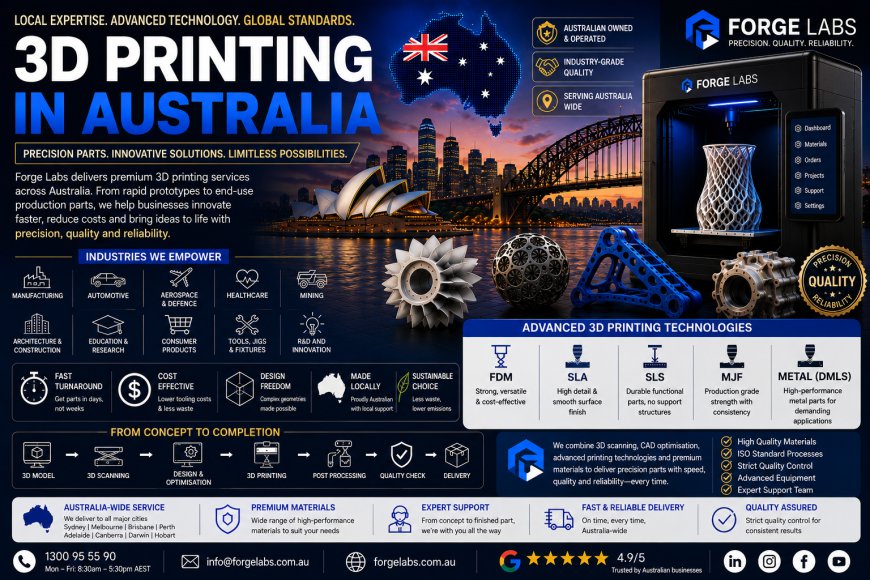
Introduction
As industries continue to embrace digital transformation, manufacturing is becoming faster, smarter, and more adaptable than ever before. Businesses no longer want production processes that require long lead times and expensive tooling before a product can be manufactured. Instead, they are turning to 3D printing in Australia to accelerate product development, simplify manufacturing, and improve production flexibility. From engineering prototypes and functional testing to low-volume manufacturing and customised components, additive manufacturing has become an essential technology across multiple industries. Forge Labs delivers industrial-grade 3D printing solutions that enable Australian businesses to innovate confidently while maintaining exceptional quality and precision.
Why 3D Printing Is Transforming Australian Manufacturing
Manufacturers today face increasing pressure to deliver products faster while maintaining high standards of quality and performance. Traditional manufacturing methods remain valuable for large production runs, but they often involve complex tooling, higher costs, and limited flexibility during product development.
With 3D printing in Australia, companies can manufacture directly from digital CAD models, allowing engineers to create prototypes, modify designs, and produce finished components much more efficiently. This digital manufacturing process significantly reduces development time while improving collaboration between designers, engineers, and production teams.
As Australian industries continue investing in advanced manufacturing, additive manufacturing is becoming an essential part of long-term business growth.
Benefits of 3D Printing
Faster Time to Market
Rapid prototyping enables businesses to evaluate products early, refine designs quickly, and launch new products ahead of competitors.
Reduced Manufacturing Costs
By eliminating tooling requirements for many projects, additive manufacturing reduces production expenses while making custom manufacturing more accessible.
High Precision and Reliability
Industrial 3D printing produces highly accurate components that meet strict engineering standards across demanding industries.
Custom Manufacturing
Every component can be tailored to specific customer requirements without increasing manufacturing complexity or significantly raising production costs.
Improved Supply Chain Resilience
Manufacturing parts locally helps businesses reduce shipping delays, improve inventory management, and strengthen Australian supply chains.
Industries Using 3D Printing in Australia
Advanced Manufacturing
Businesses use 3D printing in Australia to create production tooling, engineering prototypes, custom fixtures, replacement parts, machine components, and assembly equipment that improve manufacturing productivity.
Healthcare
Medical providers produce prosthetics, orthopaedic devices, dental models, surgical guides, hearing aids, and patient-specific anatomical models that improve treatment outcomes.
Mining
Mining companies manufacture maintenance tools, specialised equipment, and replacement components locally to minimise operational downtime and improve efficiency.
Automotive
Automotive manufacturers rely on additive manufacturing for concept models, prototype parts, custom accessories, restoration projects, testing fixtures, and performance upgrades.
Aerospace
Aircraft manufacturers use lightweight engineering components that combine outstanding strength, precision, and operational efficiency.
Defence and Engineering
Engineering companies and defence contractors utilise additive manufacturing to produce specialised equipment, functional prototypes, and mission-critical components with exceptional accuracy.
Choosing the Right 3D Printing Technology
Every manufacturing project has unique technical requirements, making technology selection an important part of successful production.
FDM (Fused Deposition Modeling) is widely used for engineering prototypes and functional parts manufactured from PLA, PETG, ABS, ASA, Nylon, TPU, and carbon fibre composite materials.
SLA (Stereolithography) produces smooth, highly detailed models suitable for healthcare, industrial design, jewellery, and presentation-quality prototypes.
SLS (Selective Laser Sintering) creates durable nylon components with excellent mechanical strength for engineering applications and production-ready products.
Metal 3D Printing enables businesses to manufacture industrial components using titanium, stainless steel, aluminium, and other advanced engineering alloys.
Engineering Expertise Improves Every Project
Producing high-quality components requires more than advanced machinery. Proper design optimisation, print orientation, material selection, and finishing processes all contribute to the final product's performance.
Forge Labs provides engineering support throughout the entire manufacturing process, ensuring every CAD model is optimised specifically for additive manufacturing. This results in stronger components, improved manufacturing efficiency, reduced production costs, and greater product reliability.
Why Forge Labs Is a Leading Manufacturing Partner
Forge Labs offers comprehensive 3D printing in Australia solutions designed for businesses across manufacturing, healthcare, mining, automotive, aerospace, and research sectors.
Its services include:
- Industrial 3D printing
- Rapid prototyping
- Reverse engineering
- Professional 3D scanning
- CAD optimisation
- Functional prototype development
- Low-volume manufacturing
- Engineering consultation
- Material selection expertise
- Precision finishing and quality assurance
Every project is supported by advanced industrial equipment, experienced engineers, and a commitment to delivering reliable manufacturing solutions.
The Future of 3D Printing in Australia
The future of 3D printing in Australia will be shaped by advances in artificial intelligence, digital manufacturing, automation, and next-generation engineering materials. These innovations are making additive manufacturing faster, more precise, and increasingly capable of supporting full-scale commercial production.
Industries including renewable energy, robotics, agriculture, biomedical engineering, marine technology, defence, and advanced manufacturing are expected to continue investing heavily in additive manufacturing, strengthening Australia's position as a global manufacturing innovator.
Conclusion
The continued growth of 3D printing in Australia demonstrates how additive manufacturing is transforming modern production. Businesses can accelerate product development, lower manufacturing costs, improve design flexibility, and strengthen local supply chains through advanced manufacturing technologies.
Whether you're creating engineering prototypes, manufacturing industrial components, or launching innovative commercial products, Forge Labs provides industrial-grade 3D printing solutions supported by technical expertise and cutting-edge manufacturing capabilities. By combining precision engineering, advanced technology, and dependable service, Forge Labs continues to help Australian businesses lead the future of manufacturing.