3D Printing in Australia: Driving the Next Era of Advanced Manufacturing
 forgelabs
Introduction
The manufacturing industry is experiencing rapid technological advancement as businesses look for more efficient ways to design and produce high-quality products. Across Australia, companies are adopting advanced manufacturing techniques to reduce development time, improve precision, and create customised solutions. 3D printing in Australia has become a major driver of this transformation by allowing businesses to produce prototypes, functional components, and complex parts directly from digital designs. This innovative approach provides greater flexibility compared to traditional manufacturing methods while supporting faster product development. Forge Labs delivers professional additive manufacturing solutions that help Australian businesses achieve reliable and efficient production outcomes.
The Evolution of Manufacturing Through 3D Printing
Traditional manufacturing processes often require significant investment in tooling, equipment, and production preparation. While these methods are effective for large-scale production, they can limit innovation when businesses need quick design changes or customised components.
With 3D printing in Australia, manufacturers can move from digital concepts to physical products much faster. Engineers can create prototypes, test functionality, and make improvements without the need for expensive moulds or lengthy setup processes.
This ability to quickly adapt has made additive manufacturing an essential technology for businesses seeking greater flexibility and competitiveness.
Benefits of 3D Printing for Businesses
Rapid Prototyping
Businesses can create prototypes quickly, allowing teams to test ideas, identify improvements, and reduce product development timelines.
Cost-Effective Production
Additive manufacturing reduces tooling requirements, making it suitable for customised parts, small production runs, and product development projects.
Advanced Design Capabilities
3D printing enables engineers to create complex shapes, lightweight structures, and innovative designs that traditional manufacturing methods may not support.
Improved Manufacturing Efficiency
By simplifying production workflows and reducing development delays, additive manufacturing helps businesses improve productivity.
Customised Manufacturing
Companies can produce unique components tailored to specific requirements without significant increases in production costs.
Industries Benefiting from 3D Printing in Australia
Manufacturing Industry
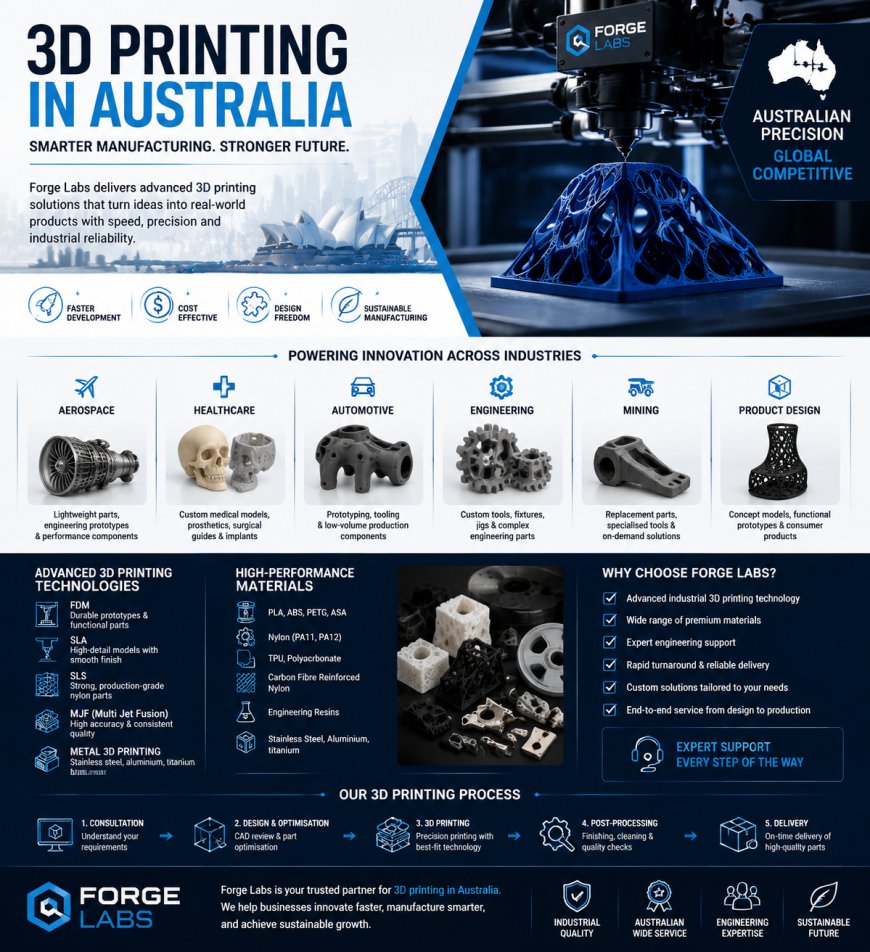
Manufacturers use 3D printing in Australia to create prototypes, production tooling, machine components, custom fixtures, and replacement parts that enhance operational efficiency.
Healthcare Sector
Medical organisations use 3D printing to develop customised prosthetics, dental models, surgical guides, and anatomical models that support improved patient care.
Automotive Industry
Automotive companies use additive manufacturing for prototype testing, vehicle components, custom solutions, and design validation.
Aerospace Sector
Aerospace manufacturers utilise 3D printing to produce lightweight components with complex geometries and excellent structural performance.
Mining Industry
Mining companies use additive manufacturing for specialised tools, equipment parts, and replacement components that help reduce downtime.
Advanced 3D Printing Technologies
Different projects require different manufacturing technologies based on material requirements and application needs.
FDM (Fused Deposition Modeling) is commonly used for functional prototypes, engineering components, and durable parts created using PLA, PETG, ABS, Nylon, TPU, and composite materials.
SLA (Stereolithography) provides high-resolution results with smooth finishes, making it ideal for detailed prototypes, medical models, and design applications.
SLS (Selective Laser Sintering) produces strong and durable components suitable for mechanical testing and industrial applications.
Metal 3D Printing enables manufacturers to produce high-performance components using advanced metals such as titanium, aluminium, and stainless steel.
The Importance of Engineering Support
Successful 3D printing requires more than advanced equipment. Proper design optimisation, material selection, and manufacturing planning are essential for achieving accurate and reliable results.
Forge Labs works closely with businesses to optimise designs and select the most suitable manufacturing approach. This ensures components achieve the required strength, durability, and performance standards for real-world applications.
Why Choose Forge Labs
Forge Labs provides complete 3D printing in Australia solutions designed for businesses across multiple industries.
Services include:
- Industrial 3D printing
- Rapid prototyping
- Reverse engineering
- 3D scanning
- CAD optimisation
- Functional prototypes
- Low-volume manufacturing
- Engineering consultation
- Material selection
- Precision finishing
With advanced technology and technical expertise, Forge Labs helps businesses transform ideas into practical manufacturing solutions.
The Future of 3D Printing in Australia
The future of 3D printing in Australia continues to expand as businesses integrate automation, artificial intelligence, and advanced materials into manufacturing processes. These technologies are improving production speed, accuracy, and scalability while creating new opportunities for innovation.
Industries such as renewable energy, robotics, defence, healthcare, aerospace, and engineering will continue adopting additive manufacturing to improve efficiency and develop advanced products.
Conclusion
The continued growth of 3D printing in Australia demonstrates its importance as a modern manufacturing technology that delivers flexibility, precision, and innovation. Businesses can accelerate product development, reduce costs, and create customised solutions through advanced additive manufacturing.
With professional expertise and advanced manufacturing capabilities, Forge Labs helps Australian businesses take advantage of 3D printing technology to build better products and improve production processes. As industries continue evolving, additive manufacturing will remain a key technology shaping the future of Australian manufacturing.