3D Printing in Australia: Enhancing Engineering, Prototyping, and Production
 forgelabs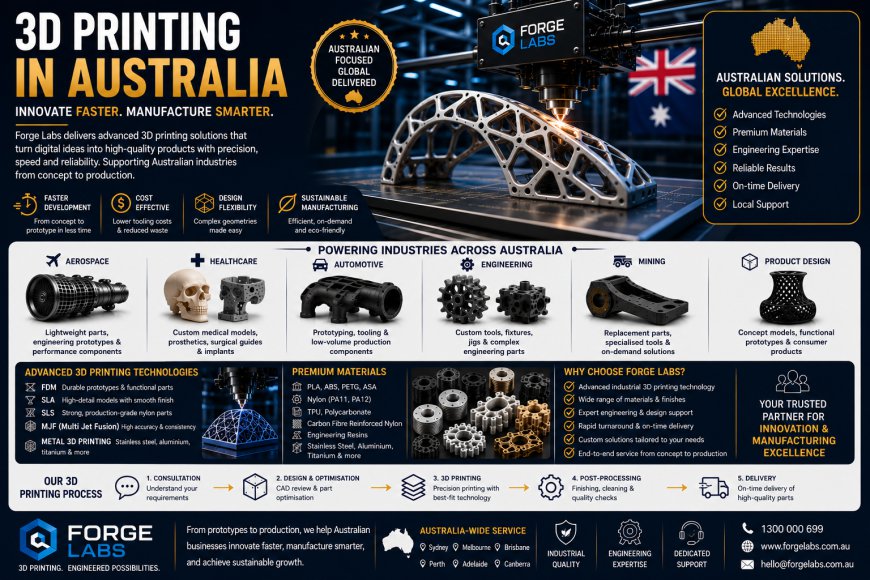
Introduction
The demand for efficient and flexible manufacturing continues to grow across Australian industries. 3D printing in Australia provides businesses with a digital production method for creating prototypes, custom components, functional parts, tooling, and specialised products. By manufacturing directly from CAD designs, additive manufacturing can reduce traditional tooling requirements and make design changes easier to implement. Forge Labs provides advanced 3D printing in Australia, combining modern technologies, engineering materials, and technical expertise to support businesses throughout the product development process.
Supporting Engineering Innovation
Engineering teams frequently need to test new ideas before moving into final production. Traditional manufacturing can make experimental designs expensive because each prototype may require machining or specialised tooling. 3D printing in Australia gives engineers a faster way to turn digital concepts into physical models. Prototypes can be evaluated for dimensions, fit, functionality, and appearance before further improvements are made. This allows businesses to experiment with designs while reducing some of the costs and delays associated with conventional prototyping.
Flexible Manufacturing for Changing Designs
Product specifications can change throughout development, particularly when businesses are creating new or customised products. Conventional production methods can make these changes difficult when tooling needs to be redesigned. With 3D printing in Australia, modifications can often be made directly to the digital CAD model before producing the next version. This flexibility allows businesses to respond to engineering feedback, customer requirements, and testing results without rebuilding an entire conventional production setup.
Custom Parts and Specialised Components
Many industries require components that are designed for a specific application rather than mass-market use. Additive manufacturing can make these specialised requirements more accessible. 3D printing in Australia can be used to produce custom brackets, housings, fixtures, replacement parts, machine components, prototypes, and specialised tools. Businesses can manufacture individual designs or smaller quantities without necessarily carrying the same tooling burden associated with conventional production.
Efficient Use of Material and Design Space
Additive manufacturing builds components layer by layer, allowing engineers to place material where it is needed according to the design. This can support lightweight structures, lattice patterns, internal channels, and integrated geometries in suitable applications. 3D printing in Australia provides designers with opportunities to optimise components for their intended function rather than simply replicating shapes designed around conventional machining. This can contribute to innovative product development and efficient component design.
Applications Across Australian Industries
The use of 3D printing in Australia continues to expand across manufacturing, aerospace, automotive, healthcare, mining, engineering, education, architecture, and research. Aerospace businesses can create lightweight prototypes and engineering components, while automotive companies can use additive manufacturing for development and testing. Healthcare providers can produce anatomical models and customised components. Mining and engineering organisations can manufacture specialised tools and replacement parts, while manufacturers can produce fixtures, jigs, housings, and functional prototypes.
Advanced Technologies at Forge Labs
Forge Labs provides multiple additive manufacturing technologies for different technical requirements. FDM is suitable for durable prototypes and functional components, while SLA can produce detailed and accurate parts. SLS provides strong nylon components, and Multi Jet Fusion supports production-grade polymer manufacturing. Metal 3D printing offers additional capabilities for demanding applications using materials such as stainless steel, aluminium, and titanium. The appropriate technology can be selected based on the component's intended use and required performance.
Engineering Materials
Material selection is critical when producing functional and industrial components. Forge Labs offers PLA, ABS, PETG, ASA, Nylon PA11, Nylon PA12, TPU, Polycarbonate, Carbon Fibre Reinforced Nylon, Engineering Resins, Stainless Steel, Aluminium, and Titanium. These materials provide different combinations of strength, flexibility, durability, impact resistance, thermal stability, and environmental resistance. Selecting an appropriate material helps ensure that a component is capable of performing effectively in its intended application.
From Engineering Concept to Physical Component
The digital nature of additive manufacturing creates a direct connection between engineering design and physical production. A business can develop a CAD model, create a prototype, test the component, modify the design, and produce an improved version. 3D printing in Australia can support this iterative workflow throughout product development. Once the design is validated, an appropriate technology can also be used for functional or low-volume production where suitable.
Why Choose Forge Labs?
Forge Labs provides comprehensive 3D printing in Australia services including rapid prototyping, custom manufacturing, functional prototypes, production-ready components, reverse engineering, CAD optimisation, engineering consultation, and material selection. By combining advanced printing technologies with engineering expertise, Forge Labs helps businesses identify suitable processes for their individual requirements. This enables companies to move efficiently from digital concepts to accurately manufactured physical products.
Future of 3D Printing in Australia
The future of 3D printing in Australia will be influenced by advancements in automation, artificial intelligence, robotics, digital manufacturing software, and engineering materials. These developments can improve production consistency, increase manufacturing capabilities, and enable more sophisticated applications. As Australian businesses continue seeking flexible production methods and efficient supply chains, additive manufacturing will remain an important technology for industrial innovation and product development.
Conclusion
3D printing in Australia is helping businesses improve engineering workflows, accelerate prototyping, manufacture customised components, and explore new product designs. Its flexibility, digital workflow, and ability to produce complex geometries make it valuable across a broad range of industries. Forge Labs combines advanced additive manufacturing technologies, engineering materials, and professional technical expertise to help Australian businesses transform digital designs into accurate, functional, and reliable physical products.
Frequently Asked Questions
What industries benefit from 3D printing?
Manufacturing, aerospace, automotive, healthcare, mining, engineering, architecture, education, and research can all benefit from additive manufacturing.
Can 3D printing be used for engineering prototypes?
Yes. It is widely used to create physical prototypes for testing dimensions, fit, functionality, and design.
Can customised parts be manufactured in small quantities?
Yes. Additive manufacturing is well suited to many customised and low-volume applications.
What materials does Forge Labs offer?
Forge Labs offers engineering plastics, nylon, TPU, resins, carbon fibre-reinforced materials, stainless steel, aluminium, titanium, and other industrial materials.
Why choose Forge Labs?
Forge Labs provides professional 3D printing in Australia with advanced technologies, engineering expertise, quality materials, and customised manufacturing solutions.