3D Printing in Australia: Powering the Next Generation of Australian Manufacturing
 forgelabs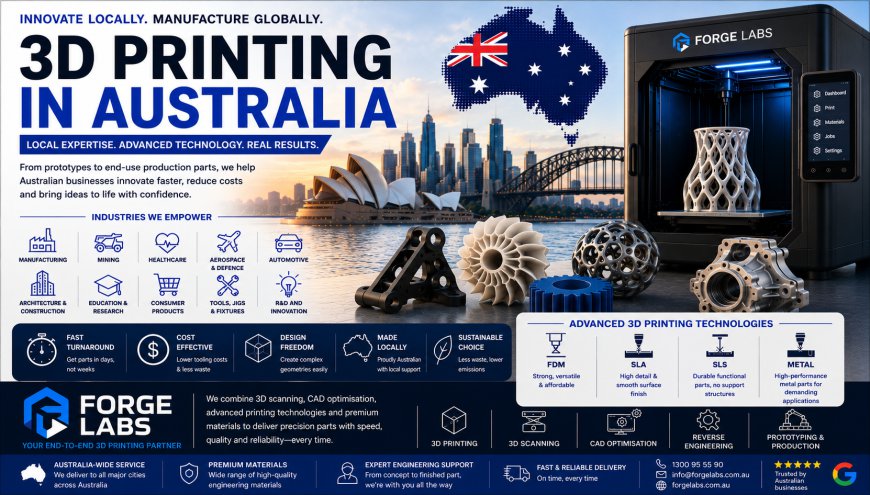
Introduction
Australia's manufacturing sector is evolving rapidly as businesses embrace technologies that improve efficiency, reduce costs, and support innovation. Among these advancements, 3D printing in Australia has become one of the most influential manufacturing solutions. Also known as additive manufacturing, this technology enables companies to produce prototypes, functional parts, and end-use products with remarkable speed and precision. Instead of relying on expensive tooling and long production schedules, businesses can manufacture directly from digital designs, making product development faster and more flexible.
Whether you're an engineer developing a new mechanical component, a startup launching an innovative product, or a manufacturer seeking production efficiencies, Forge Labs delivers professional 3D printing in Australia with industry-leading technology and engineering expertise.
Why Australian Businesses Are Choosing 3D Printing
The demand for faster innovation has changed how products are designed and manufactured. Traditional production methods remain valuable for mass manufacturing, but they often involve significant setup costs and extended lead times.
3D printing in Australia offers a more agile approach by allowing businesses to produce components exactly when they are needed. Engineers can quickly refine designs, test functionality, and manufacture updated versions without rebuilding expensive tooling. This flexibility helps organisations respond to customer feedback faster while reducing overall development costs.
How Additive Manufacturing Creates Better Products
Every project starts with a digital CAD file that accurately represents the desired product. The file is processed into printable layers before being sent to an industrial 3D printer.
Depending on the selected technology, the printer deposits thermoplastic filament, cures liquid resin, sinters nylon powder, or fuses metal powder to create the final component. After printing, finishing techniques such as machining, polishing, vapour smoothing, or coating can further improve the part's appearance and performance.
This streamlined workflow allows manufacturers to produce complex designs that would be difficult or impossible using traditional manufacturing methods.
Advantages of 3D Printing
Faster Innovation
Rapid prototyping allows businesses to evaluate product concepts quickly and reduce development timelines.
Lower Production Costs
Without the need for moulds or specialised tooling, businesses save money during prototype and low-volume manufacturing.
Improved Product Design
Engineers can develop lightweight structures, internal channels, and highly detailed geometries while maintaining structural strength.
Local Manufacturing
Producing components within Australia shortens lead times, improves communication, and strengthens supply chain reliability.
Sustainable Manufacturing
Because material is deposited only where required, additive manufacturing generates less waste than conventional machining processes.
Industries Transforming with 3D Printing
Engineering
Engineers manufacture prototypes, machine components, testing equipment, and production tools that accelerate product development.
Manufacturing
Factories use additive manufacturing to create jigs, fixtures, spare parts, and customised production equipment.
Medical and Healthcare
Healthcare providers manufacture anatomical models, surgical guides, prosthetics, orthotics, and dental applications with exceptional precision.
Mining and Resources
Mining companies reduce downtime by producing replacement parts and maintenance tools locally instead of waiting for imported components.
Automotive
Vehicle manufacturers use 3D printing to produce concept models, functional prototypes, lightweight parts, and specialised assembly tooling.
Architecture and Construction
Architectural firms create detailed presentation models that improve design reviews, client meetings, and project approvals.
Advanced 3D Printing Technologies
FDM (Fused Deposition Modelling)
An affordable and dependable technology suitable for engineering prototypes, production tooling, and durable functional parts.
SLA (Stereolithography)
Produces extremely detailed components with smooth surfaces for medical devices, jewellery, product development, and visual prototypes.
SLS (Selective Laser Sintering)
Manufactures strong nylon components capable of handling demanding industrial applications.
Multi Jet Fusion (MJF)
Provides production-quality nylon parts with excellent dimensional accuracy, strength, and repeatability.
Metal 3D Printing
Supports industrial manufacturing with stainless steel, titanium, aluminium, and other high-performance engineering alloys.
Material Selection
Choosing the correct material is critical to achieving the desired performance.
Forge Labs offers a broad range of industrial materials, including:
- PLA
- ABS
- PETG
- Nylon (PA11 & PA12)
- TPU
- Engineering-grade resins
- Carbon fibre-reinforced composites
- Stainless steel
- Aluminium
- Titanium
Every material is selected according to durability, flexibility, heat resistance, mechanical strength, and project requirements.
Why Partner with Forge Labs?
Forge Labs provides complete 3D printing in Australia solutions designed to support businesses from concept development to final production.
Customers benefit from:
- Rapid prototyping
- Functional testing
- Production-grade manufacturing
- Reverse engineering
- CAD optimisation
- Material selection guidance
- Quality inspection
- Australia-wide delivery
By combining advanced manufacturing technologies with experienced engineers, Forge Labs delivers consistent quality and reliable outcomes across every project.
Best Practices for Successful 3D Printing Projects
To maximise manufacturing success, businesses should create accurate CAD models, clearly define performance objectives, select appropriate materials, and choose the right printing technology for each application. Early collaboration with experienced additive manufacturing specialists helps reduce design revisions, improve component performance, and optimise production efficiency.
The Future of 3D Printing in Australia
As additive manufacturing technologies continue evolving, 3D printing in Australia will play an increasingly important role in supporting local industry. Innovations in artificial intelligence, robotics, automation, and sustainable materials are enabling manufacturers to produce stronger, lighter, and more efficient components.
With growing investment in advanced manufacturing, Australian businesses are expected to rely more heavily on 3D printing to shorten supply chains, reduce production costs, and accelerate innovation across industries.
Conclusion
The continued growth of 3D printing in Australia demonstrates its value as a modern manufacturing solution capable of improving speed, precision, and flexibility. Businesses across engineering, healthcare, mining, automotive, architecture, and manufacturing are using additive manufacturing to develop better products while reducing costs and increasing efficiency.
Forge Labs combines cutting-edge technology, premium materials, and engineering expertise to deliver reliable 3D printing solutions for organisations throughout Australia. Whether you need a concept prototype, custom industrial component, or production-ready part, Forge Labs has the capabilities to help your business succeed.
Frequently Asked Questions
What are the advantages of 3D printing over traditional manufacturing?
3D printing reduces tooling costs, shortens development time, enables complex designs, and minimises material waste.
Is 3D printing suitable for production?
Yes. Industrial 3D printing supports rapid prototyping, bridge manufacturing, custom production, and low-volume end-use manufacturing.
Which industries use 3D printing the most?
Engineering, manufacturing, healthcare, mining, automotive, aerospace, architecture, education, and research all use additive manufacturing extensively.
What materials are available through Forge Labs?
Forge Labs offers PLA, ABS, PETG, Nylon, TPU, engineering resins, carbon fibre composites, stainless steel, aluminium, titanium, and other specialised industrial materials.
Why choose Forge Labs for 3D printing in Australia?
Forge Labs provides industrial-grade equipment, expert engineering support, premium materials, rapid turnaround times, and customised 3D printing in Australia services that help businesses accelerate innovation and manufacture with confidence.