3D Printing in Australia: Why It’s Becoming the First Choice for Modern Manufacturing
 forgelabs
Introduction
Manufacturing is no longer limited by traditional production methods. Businesses today need faster turnaround times, greater design flexibility, and cost-effective production solutions to stay competitive. That's why 3D printing in Australia has become an essential technology for companies across industries.
From creating functional prototypes to manufacturing production-ready parts, additive manufacturing allows businesses to transform digital concepts into physical products with remarkable speed and precision. Whether you're an entrepreneur launching a new product or an established manufacturer improving production efficiency, 3D printing in Australia offers a practical solution for reducing costs and accelerating innovation.
As one of Australia's leading additive manufacturing companies, Forge Labs provides advanced 3D printing services that help businesses move confidently from concept to production.
The Evolution of 3D Printing in Australia
A decade ago, 3D printing was primarily associated with rapid prototyping. Today, it has evolved into a sophisticated manufacturing process capable of producing high-performance industrial components, medical devices, automotive parts, aerospace components, and customised consumer products.
Australian businesses are embracing additive manufacturing because it enables local production while reducing dependence on overseas suppliers. Faster lead times, better communication, and improved quality control have made domestic manufacturing more attractive than ever before.
The rise of Industry 4.0 has also encouraged companies to integrate digital manufacturing technologies into their operations, making 3D printing in Australia a key part of the country's advanced manufacturing future.
How 3D Printing Works
Unlike subtractive manufacturing, where material is removed from a solid block, 3D printing builds an object layer by layer using a digital design.
The process begins with a CAD model that is prepared using slicing software. The printer then deposits or fuses material according to the design until the finished part is complete.
Depending on the technology used, printed components may undergo additional finishing processes such as sanding, polishing, machining, coating, or painting to achieve the desired appearance and performance.
Because production is entirely digital, manufacturers can make design updates quickly without investing in new tooling.
Why Australian Businesses Are Investing in 3D Printing
Faster Innovation
Businesses can create multiple design iterations within days instead of waiting weeks for conventional manufacturing processes. This accelerates product development and reduces time to market.
Lower Development Costs
Traditional manufacturing often requires expensive moulds and tooling. Additive manufacturing removes these upfront costs, making product development more affordable.
Greater Design Freedom
Complex internal structures, lightweight geometries, and intricate designs can be manufactured without increasing production complexity.
Flexible Production
Whether producing a single prototype or a short production run, 3D printing allows businesses to manufacture exactly what they need when they need it.
Local Manufacturing
Producing components within Australia reduces shipping costs, shortens delivery times, and improves supply chain reliability.
Industries Driving the Growth of 3D Printing in Australia
Manufacturing
Manufacturers use additive manufacturing to produce prototypes, production tooling, fixtures, and end-use components while reducing downtime and improving efficiency.
Aerospace
The aerospace sector relies on lightweight yet durable components that improve aircraft performance while maintaining structural integrity.
Healthcare
Medical professionals use 3D printing for surgical planning models, prosthetics, orthotics, patient-specific devices, and medical research.
Mining
Mining companies manufacture replacement parts, equipment modifications, and specialised tooling to minimise operational interruptions.
Automotive
Automotive businesses create concept models, functional prototypes, custom accessories, and performance parts for testing and production.
Architecture
Detailed architectural models help developers and clients visualise projects before construction begins, improving communication and design accuracy.
Popular 3D Printing Technologies
Every application requires a different manufacturing approach.
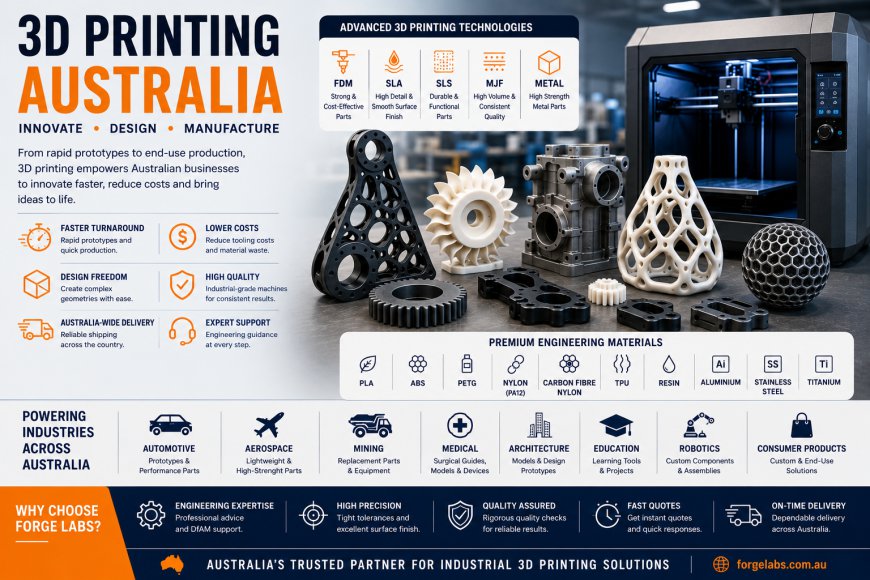
FDM (Fused Deposition Modelling) is widely used for functional prototypes, engineering components, and affordable production parts.
SLA (Stereolithography) delivers outstanding surface quality and exceptional detail for presentation models, dental applications, and product development.
Selective Laser Sintering (SLS) creates durable nylon parts capable of handling demanding engineering applications without requiring support structures.
Multi Jet Fusion (MJF) provides high-speed production of strong nylon components with excellent dimensional accuracy.
Metal 3D Printing enables the production of complex industrial parts using stainless steel, titanium, aluminium, and other advanced alloys.
Materials Used in Modern 3D Printing
The versatility of 3D printing in Australia comes from the wide range of materials available.
Common plastics include PLA, ABS, PETG, ASA, Nylon, TPU, and Polycarbonate.
Engineering-grade composites reinforced with carbon fibre provide superior stiffness and durability for industrial applications.
Resins are ideal for projects requiring fine details and smooth surface finishes.
Metal materials such as stainless steel, aluminium, titanium, and Inconel support demanding industries where strength, heat resistance, and durability are critical.
Selecting the appropriate material ensures every printed component performs as expected in real-world conditions.
Choosing the Right 3D Printing Partner
Not all 3D printing providers offer the same level of expertise. Businesses should consider several factors before selecting a manufacturing partner.
Look for a provider that offers multiple printing technologies, industrial-grade equipment, engineering consultation, quality assurance, fast turnaround times, and a comprehensive selection of materials.
Working with experienced engineers helps optimise designs, reduce manufacturing costs, and improve final product performance.
Why Businesses Choose Forge Labs
Forge Labs has earned the trust of Australian businesses by providing reliable additive manufacturing solutions backed by technical expertise.
The company supports projects across every stage of development, from concept validation to full-scale production.
Forge Labs offers:
- Rapid prototyping
- Production manufacturing
- Reverse engineering
- Engineering consultation
- Design optimisation
- Advanced FDM, SLA, SLS, MJF, and metal 3D printing
- Fast Australia-wide delivery
- Consistent quality assurance
By combining advanced technology with experienced engineering support, Forge Labs helps businesses transform ideas into production-ready components quickly and efficiently.
The Future of 3D Printing in Australia
The future of additive manufacturing continues to evolve.
Artificial intelligence is helping engineers optimise designs for strength and weight reduction.
Automation is increasing production efficiency, making 3D printing suitable for larger manufacturing volumes.
Sustainable materials and recycled polymers are reducing environmental impact while supporting Australia's commitment to greener manufacturing.
Digital manufacturing networks will allow businesses to produce parts closer to customers, reducing logistics costs and improving supply chain resilience.
These developments ensure that 3D printing in Australia will remain a critical technology for modern manufacturing in the years ahead.
Conclusion
As industries continue embracing digital manufacturing, 3D printing in Australia is becoming an indispensable tool for innovation, efficiency, and growth. Its ability to shorten development cycles, reduce production costs, and create highly customised components makes it valuable across manufacturing, healthcare, mining, aerospace, automotive, and architecture.
Forge Labs combines cutting-edge technology with engineering expertise to deliver professional 3D printing solutions that meet the needs of Australian businesses. Whether you require a single prototype or large-scale production support, Forge Labs provides the quality, reliability, and technical guidance needed to bring your ideas to life.
Frequently Asked Questions
Is 3D printing only used for prototypes?
No. Industrial 3D printing is widely used for functional parts, production components, tooling, and customised end-use products.
How long does a typical project take?
Many prototype projects are completed within a few business days, depending on complexity and material selection.
What file formats are accepted?
Most professional providers accept STL, STEP, IGES, OBJ, and 3MF files.
Which industries benefit most from 3D printing?
Manufacturing, aerospace, healthcare, mining, automotive, architecture, education, and research all benefit from additive manufacturing.
Why choose Forge Labs?
Forge Labs offers advanced technologies, industrial-quality production, expert engineering consultation, rapid turnaround, premium materials, and Australia-wide delivery, making it a trusted partner for professional 3D printing in Australia.