AI GPU: The Engine Behind Modern Artificial Intelligence
 anekpatel25
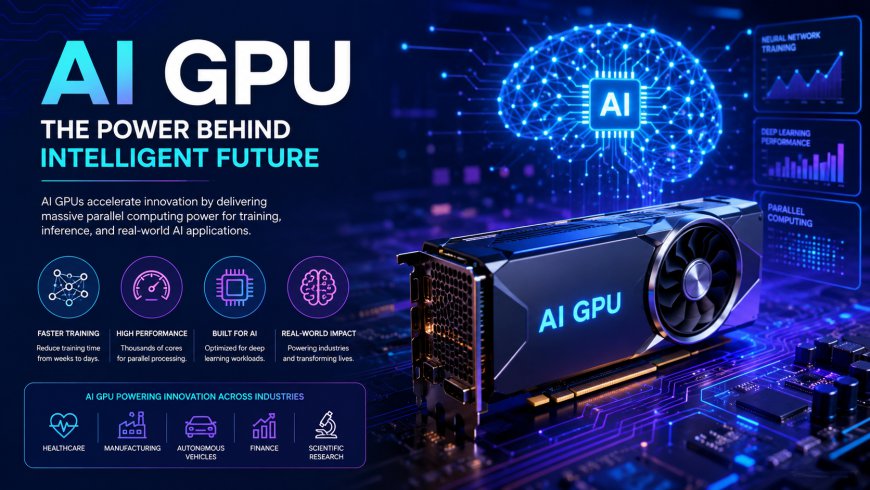
Artificial intelligence has evolved from a specialized research field into a technology that powers everything from virtual assistants and recommendation systems to autonomous vehicles and advanced scientific research. Behind many of these breakthroughs is a piece of hardware that has transformed the way computers process data: the AI GPU.
An AI GPU, or Artificial Intelligence Graphics Processing Unit, is more than just a graphics processor. While GPUs were originally designed to render images and video for gaming and professional graphics, they have become the preferred hardware for training and running complex AI models. Their ability to perform thousands of calculations simultaneously has made them essential for machine learning, deep learning, and high-performance computing.
As AI applications continue to expand across industries, understanding the role of AI GPUs provides valuable insight into why modern artificial intelligence has advanced so rapidly.
What Is an AI GPU?
An AI GPU is a specialized processor optimized to handle the massive parallel computations required by artificial intelligence workloads. Unlike traditional processors that excel at handling sequential tasks, GPUs are built with hundreds or even thousands of smaller processing cores that can work simultaneously.
This parallel architecture allows AI systems to process enormous datasets efficiently, making GPUs ideal for tasks such as:
- Neural network training
- Deep learning inference
- Natural language processing
- Computer vision
- Speech recognition
- Scientific simulations
Although CPUs remain important for managing overall system operations, GPUs perform the computationally intensive tasks that AI models require.
Why AI Needs Powerful Computing
Artificial intelligence models learn by analyzing vast amounts of information. A modern deep learning model may contain millions—or even billions—of parameters that require constant mathematical calculations during training.
For example, an image recognition model processes countless images, comparing predictions against correct answers and adjusting its internal parameters repeatedly. This training process can involve trillions of mathematical operations.
Without highly parallel processors like GPUs, completing these calculations would take significantly longer. AI GPUs dramatically reduce training times, enabling researchers and developers to build more sophisticated models in practical timeframes.
How AI GPUs Work
AI GPUs divide complex computational problems into many smaller tasks that can be processed simultaneously.
Instead of executing one instruction after another like many CPU operations, GPUs distribute workloads across thousands of cores. Each core performs calculations independently, allowing the processor to solve numerous mathematical operations at the same time.
This architecture is especially effective for matrix multiplication and tensor operations, which form the mathematical foundation of deep learning.
During AI training, GPUs repeatedly perform operations such as:
- Matrix multiplication
- Vector calculations
- Floating-point arithmetic
- Tensor processing
- Parallel memory access
The result is dramatically faster execution for AI algorithms.
AI GPU vs Traditional CPU
Although CPUs and GPUs work together in AI systems, their strengths differ considerably.
CPU Characteristics
A CPU is designed to handle diverse computing tasks, including operating systems, software applications, and sequential processing.
Advantages include:
- Excellent single-thread performance
- Efficient task management
- Low-latency execution
- Flexible processing capabilities
However, CPUs are not optimized for the highly parallel workloads common in AI.
GPU Characteristics
GPUs specialize in parallel processing.
Key strengths include:
- Thousands of processing cores
- High computational throughput
- Faster neural network training
- Efficient large-scale mathematical calculations
Rather than replacing CPUs, AI GPUs complement them by accelerating demanding computational tasks.
Core Components of an AI GPU
Several hardware features contribute to the impressive performance of modern AI GPUs.
Massive Core Count
AI GPUs contain significantly more processing cores than traditional CPUs. These cores work together to execute thousands of calculations simultaneously.
High Memory Bandwidth
AI models frequently access enormous datasets. High-bandwidth memory enables rapid movement of data between memory and processing units.
Tensor Processing Units
Many AI GPUs include dedicated tensor processing hardware specifically optimized for deep learning calculations. These specialized units accelerate neural network operations even further.
Efficient Cooling Systems
AI computations generate substantial heat. Advanced cooling technologies help maintain consistent performance during extended workloads.
Optimized Software Support
Hardware alone is not enough. AI GPUs rely on optimized software libraries, drivers, and frameworks that maximize computational efficiency.
Applications of AI GPUs
AI GPUs are used across numerous industries where intelligent computing plays a vital role.
Healthcare
Medical professionals use AI GPUs to accelerate diagnostic imaging, analyze medical scans, and support drug discovery.
Applications include:
- MRI analysis
- CT scan interpretation
- Disease prediction
- Personalized treatment planning
Manufacturing
Factories use AI-powered vision systems to inspect products, detect defects, and optimize production lines.
AI GPUs allow these systems to analyze images in real time, improving both quality and efficiency.
Autonomous Vehicles
Self-driving technologies rely on continuous analysis of data from cameras, radar, lidar, and sensors.
AI GPUs process this information rapidly enough to support real-time navigation and decision-making.
Financial Services
Banks and financial institutions use AI GPUs for fraud detection, algorithmic trading, customer service automation, and risk analysis.
Large-scale data processing allows financial systems to identify suspicious activities almost instantly.
Scientific Research
Researchers use AI GPUs to accelerate simulations in fields such as:
- Climate science
- Genomics
- Particle physics
- Astronomy
- Materials science
Large computational models that once required weeks may now complete in a fraction of the time.
AI GPUs in Generative AI
Generative AI has become one of the fastest-growing areas of artificial intelligence.
Large language models, image generators, music creation tools, and video generation systems all depend heavily on GPU acceleration.
Training these models requires enormous computational resources because they process massive datasets while learning complex relationships between words, images, sounds, and patterns.
During inference—the stage when users interact with AI—the GPU rapidly generates responses by performing billions of calculations in real time.
Without AI GPUs, many modern generative AI applications would not deliver the speed users expect.
Advantages of AI GPUs
The growing adoption of AI GPUs is driven by several significant benefits.
Faster Training
AI models that once required weeks of training can often be completed much faster using GPU acceleration.
Improved Scalability
Organizations can combine multiple GPUs to train increasingly complex AI models without dramatically changing their software architecture.
Better Performance
Parallel computing enables AI applications to deliver quicker predictions and more responsive user experiences.
Enhanced Productivity
Researchers spend less time waiting for experiments to finish, allowing faster innovation and model improvement.
Broad Software Compatibility
Most leading machine learning frameworks support GPU acceleration, making deployment relatively straightforward for developers.
Challenges of AI GPUs
Despite their advantages, AI GPUs also present several challenges.
High Power Consumption
Powerful AI processors consume considerable electricity, especially in large computing clusters.
Organizations must carefully manage energy usage to maintain operational efficiency.
Heat Generation
Intensive AI workloads produce significant heat, requiring advanced cooling infrastructure to ensure reliable operation.
Programming Complexity
Optimizing software for GPU architectures often requires specialized programming knowledge and performance tuning.
Developers may need expertise in parallel computing concepts to achieve maximum efficiency.
Infrastructure Requirements
Large AI projects frequently require specialized servers, networking equipment, and storage systems to support multiple GPUs working together.
Emerging Trends in AI GPU Technology
The evolution of AI hardware continues at a rapid pace.
Future AI GPUs are expected to emphasize:
- Greater computational efficiency
- Lower energy consumption
- Improved memory technologies
- Advanced interconnect systems
- Enhanced support for increasingly large AI models
Manufacturers are also focusing on specialized AI accelerators that complement traditional GPU architectures, creating more flexible computing environments.
Edge AI is another important trend. Smaller, power-efficient AI GPUs are enabling intelligent processing directly on devices such as drones, industrial robots, smart cameras, and autonomous machines without relying entirely on cloud computing.
Choosing the Right AI GPU
Selecting an AI GPU depends on the intended workload rather than simply choosing the most powerful processor available.
Important considerations include:
- Model size
- Training frequency
- Inference requirements
- Available memory
- Power efficiency
- Software compatibility
- Budget
- Future scalability
Organizations often balance performance with operational costs to build systems that can support long-term AI development.
The Future of AI GPUs
Artificial intelligence continues to expand into nearly every sector, increasing the demand for efficient computing hardware. AI GPUs are expected to remain a cornerstone of this progress by enabling faster model development, real-time decision-making, and more sophisticated applications.
Future innovations will likely focus on delivering greater performance while reducing power consumption and improving accessibility for organizations of all sizes. As AI models become more capable, GPUs will continue to evolve alongside them, supporting breakthroughs in healthcare, transportation, education, entertainment, scientific research, and countless other fields.
Conclusion
AI GPUs have fundamentally reshaped the landscape of artificial intelligence by providing the computational power needed for advanced machine learning and deep learning workloads. Their highly parallel architecture allows complex mathematical operations to be completed with remarkable speed, making them indispensable for modern AI development.
From enabling real-time language translation and intelligent robotics to supporting medical discoveries and autonomous systems, AI GPUs are driving innovation across industries. While challenges such as energy consumption and infrastructure demands remain, ongoing advancements in hardware design and software optimization continue to improve their efficiency and capabilities.
As artificial intelligence becomes increasingly integrated into everyday life, AI GPUs will remain one of the key technologies powering the next generation of intelligent systems, helping organizations and researchers turn ambitious ideas into practical, high-impact solutions.