Animal Feed Market Size, Growth and Forecast 2026 | 699.0 Billion by 2034
Asia Pacific holds the largest animal feed market share globally - driven by its substantial livestock population, strong demand for animal protein, and heavy investment by countries like China, India, and Japan in advanced feed formulations for poultry, swine, and aquaculture industries.
 torylanez27
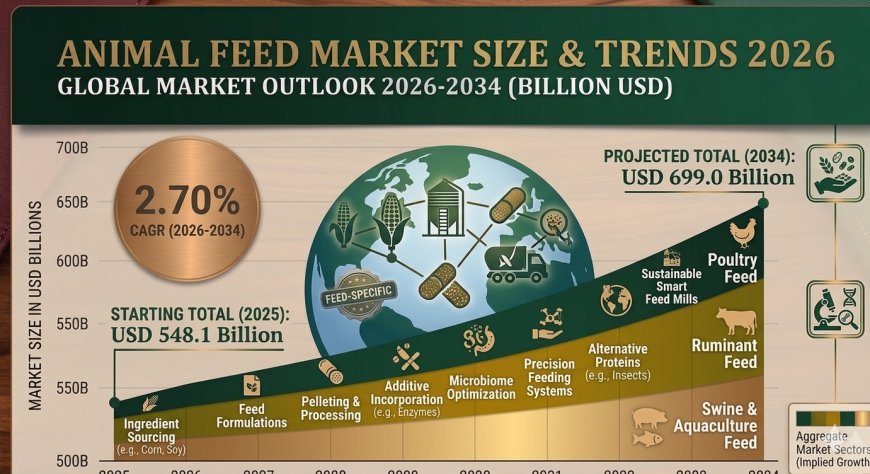
According to a research report by IMARC Group, the global animal feed market size is anticipated to reach USD 548.1 Billion in 2025. Looking forward, the market is estimated to reach USD 699.0 Billion by 2034 exhibiting a growth rate (CAGR) of 2.70% during 2026–2034. Asia Pacific currently dominates the animal feed market share. The growth of the Asia Pacific region is driven by its large livestock population, increasing demand for animal protein, government support for agriculture, and advancements in feed production technologies.
Market at a Glance
|
Report Attribute |
Key Statistics |
|
Base Year |
2025 |
|
Forecast Years |
2026–2034 |
|
Historical Years |
2020–2025 |
|
Market Size in 2025 |
USD 548.1 Billion |
|
Market Forecast in 2034 |
USD 699.0 Billion |
|
Market Growth Rate (CAGR) |
2.70% |
Key Animal Feed Market Trends Driving Expansion
Population Growth and Rising Protein Demand
The demand for animal feed from protein products has been one of the most important trends in the market․ The world population has increased from 2․5 billion in 1950 to 8 billion in 2022 and is projected to reach 9․7 billion by 2050‚ putting enormous pressure on the global food value chain․ To meet the need for existing nations to feed growing populations and to augment global food security‚ the animal feed industry must meet the needs of livestock health and production through the continual pursuit of greater nutritional quality of animal feeds and affordability for producers throughout the food supply chain․
Technological Innovation in Feed Formulations
Technology used to improve feed quality for livestock‚ such as precision feed optimization‚ specialty feed products‚ probiotics‚ amino acids‚ feed acidifiers‚ and other feed additives‚ is furthering livestock health and increasing livestock growth rates and productivity․ The US launch of FORMYL as an innovation in feed acidifier products for swine health in 2024 by Kemin Industries is one example․ Encapsulated calcium formate and citric acid provide targeted release and deliver efficacy‚ thereby reducing the pathogen load‚ improving gastrointestinal tract health and supporting overall gut wellbeing naturally without the use of antibiotics․ These innovations help the industry deliver effective‚ responsible and sustainable feed solutions to improve the efficiency and productivity of livestock‚ to meet consumer and regulatory demands around the world․
Growing Environmental Consciousness and Sustainability
In light of environmental concerns‚ the increasing awareness around the use of sustainable feed materials will be balanced by the use of additives to reduce emissions of methane‚ and sustainably produced feed materials including by-products of agriculture blended into animal feeds․ In May 2024‚ Elanco Animal Health announced that Bovaer‚ a new feed supplement‚ was approved by the U․S․ FDA․ Bovaer is a feed supplement for lactating dairy cows that reduces greenhouse gas emissions by approximately 30 percent by reducing methane emissions․ In November 2024‚ UPL and CH4 Global announced that the U․S․ FDA approved Methane Tamer‚ a feed additive that reduces cattle methane emissions by up to 90 percent․ Such developments show the rapid transition of the animal feed market to more sustainable livestock production practices․
Evolving Regulatory Frameworks and Quality Standards
Market regulations are key to setting trends for the animal feed market as they are intended to ensure the safety‚ quality and sustainability of the feed value chain at every stage of the pathway‚ from composition to distribution․ Feed additive ingredients‚ as well as antibiotics and GM feed ingredients‚ are subject to a growing level of governance and compliance․ Rising preference for sustainability from the public and government influences its promotion and the creation of new production systems for animal feed around the world․ Despite the challenges‚ following compliance can help increase consumer trust and long-term competitive advantage for manufacturers within the industry and the market․
Animal Feed Market Segmentation Analysis
By Form
- Pellets
- Crumbles
- Mash
- Others
Pellets represent the largest form segment - owing to their high efficiency, consistent nutrient distribution, and suitability across diverse livestock types. The dense composition of pellets reduces feed wastage, making them a cost-effective choice for farmers, while their ease of handling, storage, and transport contributes to widespread adoption. Advanced feed pelleting techniques continue to improve pellet quality and strength, reinforcing their position as the preferred feed form in modern livestock production systems across poultry, swine, and aquaculture farming.
By Animal Type
- Poultry (Broilers, Layers, Turkeys, Others)
- Swine (Starter, Finisher, Grower)
- Ruminants (Calves, Dairy Cattle, Beef Cattle, Others)
- Aquaculture (Carps, Crustaceans, Mackerel, Milkfish, Mollusks, Salmon, Others)
- Others
Poultry holds the biggest market share by animal type - driven by the growing global demand for poultry meat and eggs, cost-effective feed conversion ratios, and the widespread expansion of poultry farming. Feed formulations for broilers, layers, and turkeys are designed to provide balanced nutrition incorporating essential proteins, vitamins, and minerals. Technological advancements in poultry feed production and heightened awareness of nutrition’s role in disease prevention are further strengthening the dominance of this segment in the global animal feed market.
By Ingredient
- Cereals
- Oilseed Meal
- Molasses
- Fish Oil and Fish Meal
- Additives (Antibiotics, Vitamins, Antioxidants, Amino Acids, Feed Enzymes, Feed Acidifiers, Others)
- Others
Cereals dominate the ingredient segment - primarily due to their role as a reliable and cost-effective energy source for livestock. Cereals such as corn, wheat, barley, and sorghum are rich in carbohydrates, making them essential for meeting the high energy demands of poultry, swine, and cattle. Their widespread availability, high digestibility, and ease of integration into diverse feed formulations drive their market leadership, while the increasing adoption of cereal-based compound feeds further reinforces this segment’s dominance across global livestock production systems.
By Region
- Asia Pacific
- North America
- Europe
- Latin America
- Middle East and Africa
Asia Pacific holds the largest animal feed market share globally - driven by its substantial livestock population, strong demand for animal protein, and heavy investment by countries like China, India, and Japan in advanced feed formulations for poultry, swine, and aquaculture industries. In 2024, a state-of-the-art animal feed facility with a daily production capacity of 800 metric tons was launched in Gujarat, India for INR 210 crore — supporting farmers, promoting sustainable farming, and improving rural development. The region’s expanding advanced feed production infrastructure continues to enhance supply capabilities and drive sustainable agricultural growth.
Connect for Detailed Segmentation Analysis - Speak to an Analyst: https://www.imarcgroup.com/request?type=report&id=2565&flag=C
Competitive Landscape in the Animal Feed Industry
The global animal feed business is competitive and reflects long-established multinational and regional companies that have pursued product development‚ calculated alliances and joint ventures‚ and increased manufacturing capacity in their animal feed businesses․ Companies have also been investing heavily in research and development of next-generation feed to improve livestock health‚ productivity and sustainability․ Digital solutions and data analytics are increasingly being used across the feed production process‚ and companies are geographically expanding into emerging markets with potential for important growth․
Key Animal Feed Market Players Include:
- Alltech
- Anova Feed
- Archer-Daniels-Midland Company
- Bunge Global SA
- Cargill Incorporated
- Charoen Pokphand Foods PCL
- Godrej Agrovet Limited
- Nutreco N.V.
- Purina Animal Nutrition LLC
Key Regional Insights
United States
The demand for protein diets is the driving factor for the U․S․ animal feed market․ Red meat accounted for 58% of total U․S․ meat consumption‚ according to National Institutes of Health (NIH) statistics․ Innovation in machinery for automated processing‚ as well as feed technology‚ precision feeding‚ as well as insect- and plant-based proteins‚ have defined the U․S․ animal feed market landscape․ Regulatory action to promote non-antibiotic feed additives is accelerating a transition towards organic and functional feed additives․
Europe
There is increasingly more precise precision feeding‚ along with a focus on sustainability and the growing importance of organic or chemical-free feed․ The EU is the world's second-largest milk producer‚ with around 150 million tons per year and 10‚000 kg yield per dairy cattle‚ which increases the need for high-performance feeding․ Investments in plant-based algae‚ insects and single-cell proteins reduce dependence on customary soy protein and fishmeal‚ while circular agriculture reduces waste and input costs through recycling of agricultural byproducts․
Asia Pacific
The expanding middle class of the region‚ who will make up 41% of the population in India by 2031‚ is expected to increase demand for animal protein and demand for livestock production․ Other factors include advances in aquafeed and poultry feed technologies‚ government investment in agricultural infrastructure‚ and automatic feeding systems․ In India alone‚ over 250 million people are moving out of poverty‚ which is expected to create important new demand for animal feed products․
Latin America
The Latin America feed market's e-commerce sales grew by a factor of 2․8 from USD 130 million in 2019 to USD 364 million in 2023‚ this growth is attributed to the region's more than 300 million digital buyers․ Agricultural residue and sustainable feed developments in poultry and aquaculture are driving growth․
Middle East and Africa
The interest in feed innovation is driven by investments in agriculture‚ such as Saudi Arabia where the agriculture‚ forestry and fishing sector received USD 41 million in FDI in 2023․ Climate-resilient feed innovations using drought-resistant crops provide critical options for producers to seek to sustain livestock production during climate shocks․ Regional food security initiatives are geared toward implementing better feed management systems in light of increased protein demand․
Market Drivers, Challenges & Opportunities
Major Market Drivers:
- Increasing global population and rising demand for meat, dairy, and poultry products.
- Continuous technological innovations in feed formulations, precision nutrition, and advanced additives.
- Government policies, subsidies, and infrastructure investments supporting livestock farming globally.
Key Challenges:
- Economic fluctuations and inflationary pressures affecting feed raw material costs and consumer purchasing power.
- Navigating complex and evolving regulatory frameworks across multiple global markets.
Emerging Opportunities:
- Growing adoption of sustainable and eco-friendly feed solutions reducing methane emissions and environmental impact.
- Expansion into fast-growing Asia Pacific, Latin America, and Middle East markets with rising protein demand.
- Innovation in alternative protein ingredients including algae, insects, and single-cell proteins.
Latest Market Developments
November 2024: UPL and CH4 Global revealed a collaboration to introduce Methane Tamer, a feed additive that decreases methane emissions from cattle by as much as 90%, targeting major livestock markets including India and Brazil.
November 2024: TrinamiX GmbH and Eurofins Agro Testing announced a strategic collaboration at EuroTier 2024, facilitating on-farm forage testing with a portable device to help farmers optimize silage production and feed rations.
November 2024: Angel Yeast, in partnership with PT. Tunas Baru Lampung Tbk, invested USD 43.46 Million to launch a yeast production facility in Indonesia’s Lampung Province, boosting its animal feed market presence across Asia.
March 2024: EW Nutrition launched Axxess XY, a thermostable xylanase, at VICTAM 2024. The product breaks down fiber in feed ingredients including sunflower cakes, corn, and wheat, improving intestinal environment quality and feed efficiency.
Conclusion: Animal Feed Market Outlook to 2034
The global market for animal feed is expected to continue to grow steadily until 2034‚ driven by growing worldwide demand for protein‚ new opportunities from innovations in feed technologies and livestock production‚ and a general trend toward sustainability in the agriculture and animal feed business as manufacturers invest in feed formulation and additives‚ and move toward digitized supply chain management․
With Asia Pacific leading in global market share and North America and Europe continuing to be top centers for feed technology research and development‚ the global animal feed market will continue to provide opportunities for manufacturers‚ investors‚ and farmers until 2034․
About the Author
IMARC Group is a leading global market research company providing data-driven insights and expert consulting services to businesses seeking to achieve their strategic objectives. With a multi-disciplinary team of industry experts, IMARC delivers thorough, reliable market intelligence across sectors including Technology, Construction, Healthcare, Energy, Food & Beverages, and more.
Media & Sales Contact
IMARC Group
United States: +1-201-971-6302
India: +91-120-433-0800
United Kingdom: +44-753-714-6104