How Construction Estimating Services Price Building Electrification Projects
Learn how Construction Estimating Services account for heat pumps, EV infrastructure, electric equipment, and upgraded electrical systems in building budgets.
 concept-estimating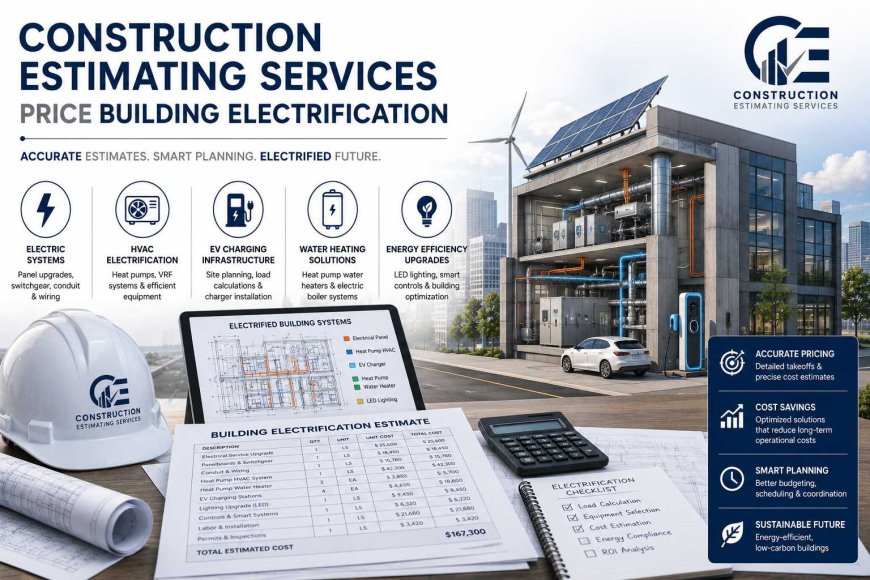
Building electrification is changing the way contractors and developers plan modern construction projects. As buildings move away from combustion-based equipment toward electric systems, project budgets are being affected by much more than the cost of replacing one piece of equipment with another.
Heat pumps, electric water heaters, induction equipment, EV charging stations, electrical distribution upgrades, battery systems, controls, and expanded service capacity can all influence construction costs. In many projects, electrification also creates connections between mechanical, electrical, plumbing, and architectural scopes that were previously estimated more independently.
This makes accurate Construction Estimating Services increasingly important during preconstruction. A reliable estimate needs to understand not only the equipment being added but also the infrastructure required to operate it.
Through detailed Construction Cost Estimating, Commercial Estimating, and accurate Construction Takeoff Services, contractors can evaluate how electrification changes material quantities, labor requirements, equipment costs, and overall project budgets.
Why Building Electrification Changes the Construction Budget
Traditional buildings often rely on a combination of natural gas, electricity, and other energy sources. Electrification shifts more building functions onto the electrical system.
A heating system that once depended on gas may now require a heat pump. Water heating may move to electric heat-pump technology. Parking areas may require EV charging infrastructure. Commercial kitchens may replace gas appliances with electric alternatives.
Each change can create additional electrical demand.
The result is a project where the cost of one equipment decision can affect several other trades. A larger heat pump may require different electrical service, larger conductors, new breakers, upgraded panels, or even a service-capacity increase.
Professional Construction Estimating Services help identify these connections before the project reaches the bidding stage.
Heat Pumps Are More Than an HVAC Equipment Replacement
Heat pumps are one of the most visible components of building electrification.
From an estimating perspective, however, the equipment itself is only one part of the scope. The project may also require refrigerant piping, condensate drainage, controls, electrical connections, disconnects, equipment pads, structural supports, and changes to existing ductwork.
For larger commercial buildings, electrification may also involve multiple heat pumps or centralized systems.
This makes Construction Cost Estimating more complicated because the estimator needs to understand the complete installed system rather than pricing the equipment as a standalone item.
Electrical Capacity Can Become a Major Cost Driver
One of the most important questions in an electrification project is whether the existing electrical infrastructure can support the additional load.
A building may have adequate capacity for its current operations but become undersized after adding heat pumps, EV chargers, electric water heating, and other equipment.
Potential upgrades can include new panels, switchgear, transformers, feeders, service equipment, distribution equipment, and utility-related work.
These costs can significantly change the project budget.
For Commercial Estimating, electrical capacity should therefore be reviewed early rather than treated as an issue that can be solved after equipment selections are finalized.
EV Charging Adds Another Layer of Infrastructure
EV charging is becoming an increasingly common consideration in commercial and multifamily construction.
The visible charging station is only the endpoint of the electrical system.
Depending on the project, the installation may require new distribution equipment, feeders, conduit, wiring, transformers, load management systems, communication infrastructure, trenching, concrete work, and parking-area modifications.
The number and type of chargers can also affect the required electrical capacity.
Accurate Construction Takeoff Services help quantify these components so that EV infrastructure is represented realistically in the project budget.
Load Management Can Change the Estimate
Not every building needs to provide maximum charging capacity to every EV charger simultaneously.
Energy-management and load-balancing systems can help control electrical demand.
From an estimating standpoint, this means the project team may need to compare different infrastructure strategies.
A basic approach may require significant electrical capacity. A managed approach could involve additional controls and software while potentially reducing certain infrastructure requirements.
Construction Cost Estimating allows contractors and owners to compare the installed costs of these alternatives before committing to a particular design.
Electric Water Heating Can Affect Multiple Trades
Replacing gas-fired water heating with electric equipment may seem straightforward, but the change can influence both plumbing and electrical scopes.
Electric water heaters may require dedicated circuits, disconnects, larger electrical distribution, equipment supports, controls, and potentially changes to mechanical-room layouts.
Heat-pump water heaters can also require condensate management and adequate ventilation or air volume depending on the application.
A detailed estimate should capture these related requirements rather than pricing only the water-heating equipment.
Commercial Kitchens Are Becoming More Electrified
Electrification can be particularly significant in commercial kitchens.
Replacing gas cooking equipment with electric alternatives can change electrical loads dramatically. Equipment such as induction ranges, electric ovens, fryers, griddles, and other appliances may require dedicated electrical connections.
The kitchen's electrical distribution may therefore need upgrades.
At the same time, changes in cooking equipment can influence ventilation requirements and equipment layouts.
This is why Commercial Estimating should coordinate architectural, mechanical, plumbing, and electrical information when evaluating an electrified kitchen.
Building Electrification Can Increase Mechanical Scope
Electrification does not mean that mechanical work disappears.
In many cases, the mechanical system becomes more sophisticated.
Heat pumps, variable-speed equipment, controls, heat-recovery systems, and electrified domestic hot-water equipment can require additional coordination.
The estimator needs to consider equipment, installation labor, piping, controls, supports, electrical connections, commissioning, and testing.
This broader view allows Construction Estimating Services to produce a more realistic installed-cost forecast.
Construction Takeoff Services Help Connect Equipment to Infrastructure
A detailed Construction Takeoff Services process should not stop at counting major equipment.
For building electrification, the estimator may need to quantify the supporting infrastructure associated with each system.
For example, one heat-pump installation may involve equipment, refrigerant lines, electrical conductors, conduit, disconnects, supports, controls, condensate piping, and commissioning.
Similarly, an EV charging station can involve charging equipment, feeders, conduit, trenching, distribution equipment, bollards, concrete, signage, and communications.
Connecting these quantities prevents supporting scope from being overlooked.
Existing Buildings Can Be More Difficult to Electrify
New construction allows electrical and mechanical systems to be designed around electrification from the beginning.
Existing buildings are different.
Walls may need to be opened. Existing panels may have limited capacity. Electrical rooms may be crowded. Conduit routes may be difficult to access. Mechanical equipment may occupy spaces that are needed for new systems.
These conditions can increase labor and create additional demolition and restoration costs.
For renovation projects, Construction Cost Estimating should therefore include allowances for existing-condition uncertainty when sufficient field information is not available.
Electrification Can Trigger Utility Upgrades
A significant increase in electrical demand may require coordination with the local utility.
Depending on the project, this could involve service upgrades, new transformers, equipment changes, or other infrastructure outside the building.
The exact responsibility for these costs varies by project and utility arrangement.
Professional Construction Estimating Services can identify potential utility-related requirements early so that they are not overlooked during budget development.
Electrical Rooms May Need More Space
Electrification can increase the amount of electrical equipment required inside a building.
Additional panels, switchgear, transformers, controls, and distribution equipment may require more physical space.
In a new building, this can be addressed during design.
In an existing building, space limitations can create significant construction challenges.
The estimate should therefore consider equipment-room modifications, structural requirements, ventilation, access, and installation logistics where applicable.
The Cost of Electrification Is Not Just Equipment Cost
One of the most common estimating mistakes is comparing the purchase price of electric equipment with the purchase price of conventional equipment.
That does not represent the complete construction cost.
The correct comparison should include equipment, installation, electrical infrastructure, mechanical modifications, controls, demolition, site work, commissioning, and related labor.
This broader approach makes Commercial Estimating much more useful for decision-making.
How Material Quantities Change
Electrification can increase quantities in some trades while reducing them in others.
For example, eliminating gas-fired equipment may reduce certain gas piping requirements while increasing electrical conduit, feeders, panels, and wiring.
A heat-pump system may eliminate some conventional heating components but introduce additional refrigerant piping and controls.
This makes accurate Construction Takeoff Services essential for comparing the old and proposed systems.
Labor Productivity Must Be Considered
Electrification projects can require specialized labor.
Electrical contractors may need additional installation hours for feeders, equipment connections, controls, and distribution upgrades. Mechanical contractors may have different installation requirements for heat pumps and heat-recovery systems.
Existing-building projects can also reduce productivity because crews may have limited access and must work around occupants or existing operations.
Professional Construction Cost Estimating should reflect these actual site conditions instead of applying generic labor assumptions.
Electrification Requires Better Trade Coordination
Mechanical and electrical systems become increasingly interconnected as buildings electrify.
For example, HVAC equipment selection affects electrical loads. Electrical service capacity affects equipment selection. Equipment locations affect piping and conduit routes.
This creates a feedback loop between design disciplines.
A strong Construction Estimating Services process reviews these relationships so that the budget reflects the coordinated design rather than isolated trade estimates.
Prefabrication Can Help Control Electrification Costs
Some electrification components can be prefabricated or assembled before arriving at the jobsite.
Electrical distribution assemblies, mechanical piping sections, equipment skids, and other components may be prepared in controlled environments.
This can potentially reduce field labor and improve installation consistency.
However, transportation, handling, fabrication, and coordination costs must also be included in the estimate.
Therefore, Construction Cost Estimating should compare the complete installed cost rather than assuming prefabrication automatically creates savings.
How Estimators Handle Design Uncertainty
Electrification projects can evolve quickly during design.
Equipment models may change. EV charger quantities may increase. Electrical service requirements may be revised. Heat-pump selections may change based on engineering calculations.
Instead of hiding uncertainty inside one large contingency, professional estimators can identify specific assumptions and allowances.
This creates a more transparent budget and makes it easier to update the estimate as design information becomes available.
Value Engineering for Electrified Buildings
Cost optimization does not necessarily mean reducing electrification.
The project team can evaluate equipment efficiency, system sizing, distribution layouts, charger configurations, controls, installation methods, and equipment locations.
For example, optimizing feeder routes can reduce conductor and conduit quantities. Better equipment placement can reduce piping lengths. Coordinated charger layouts can reduce unnecessary trenching.
Detailed Commercial Estimating provides the cost information needed to evaluate these options.
Why Early Construction Estimating Matters
Electrification decisions are often made before construction begins, when the project team still has flexibility.
An early estimate can identify whether the existing electrical service is likely to support the proposed design, whether additional infrastructure is needed, and which systems are likely to become major cost drivers.
This allows owners and designers to make adjustments while changes are still relatively inexpensive.
Waiting until construction documents are complete can make significant budget corrections more difficult.
Frequently Asked Questions
What are Construction Estimating Services for building electrification?
Construction Estimating Services provide a detailed forecast of the materials, labor, equipment, infrastructure, and installation costs associated with electrifying building systems.
How do heat pumps affect construction costs?
Heat pumps can affect equipment costs, electrical service requirements, wiring, controls, refrigerant piping, condensate systems, supports, and installation labor. The impact depends on the project's size and system design.
Why can EV infrastructure increase construction costs?
EV charging can require new electrical distribution, feeders, conduit, wiring, transformers, trenching, concrete work, controls, and load-management systems in addition to the chargers themselves.
What is Construction Cost Estimating?
Construction Cost Estimating is the process of calculating expected project expenses, including materials, labor, equipment, subcontractors, logistics, and related construction requirements.
Why are Construction Takeoff Services important for electrification projects?
Construction Takeoff Services quantify the electrical, mechanical, plumbing, architectural, and site components needed to implement electrification. Accurate quantities provide a stronger foundation for project pricing.
How does Commercial Estimating help with building electrification?
Commercial Estimating evaluates the complete installed cost of electrification measures, including equipment, infrastructure, labor, demolition, modifications, and coordination requirements.
Final Takeaway
Building electrification is reshaping construction budgets because more building functions are becoming dependent on electrical infrastructure. Heat pumps, EV charging, electric water heating, commercial kitchen equipment, and other electric systems can increase electrical loads and create new requirements across multiple trades.
For contractors and developers, accurate Construction Estimating Services provide a practical way to understand these changes before construction begins. Detailed Construction Cost Estimating helps forecast material and labor expenses, while Commercial Estimating evaluates the broader cost implications of electrifying commercial facilities.