Physics Tutors in Adelaide: A Smarter Approach to Learning Physics
For students looking for Physics Tutors in Adelaide, personalised support can provide an opportunity to work through difficult concepts at an appropriate pace, strengthen weak areas and develop a more structured approach to Physics.
 johnmarker
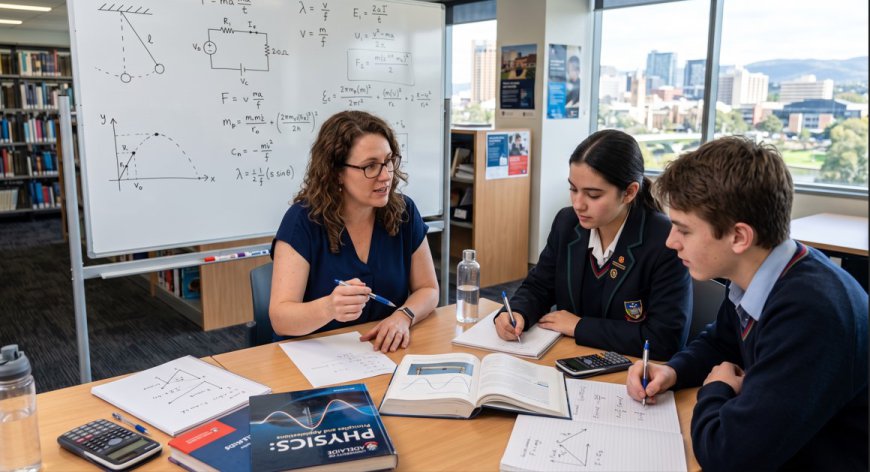
Physics can be a demanding subject because it requires students to combine scientific understanding, mathematics, logical reasoning and problem-solving. Knowing a formula is only part of the process. Students also need to understand why a particular formula applies, interpret the information in a question and explain what their answer means.
For students looking for Physics Tutors in Adelaide, personalised support can provide an opportunity to work through difficult concepts at an appropriate pace, strengthen weak areas and develop a more structured approach to Physics.
Whether a student is preparing for SACE Physics, IB Physics or school assessments, the goal should be more than simply completing homework. Effective tutoring should help students become more confident and independent problem-solvers.
Why Is Physics Difficult for Some Students?
Physics introduces students to concepts that are not always easy to visualise.
Ideas involving motion, forces, electricity, waves, energy, fields and atoms often require students to connect theoretical explanations with mathematical relationships.
Students may struggle with:
- Understanding complex concepts
- Applying formulas
- Rearranging equations
- Interpreting graphs
- Understanding units
- Solving multi-step problems
- Connecting mathematics with scientific concepts
- Explaining answers clearly
- Applying knowledge to unfamiliar questions
- Preparing effectively for assessments
The important point is that struggling with Physics does not necessarily mean a student lacks ability.
Sometimes a single unresolved concept can affect performance across several topics.
Start With Understanding, Not Memorisation
Memorising equations can help students recall important relationships, but memorisation alone does not create strong Physics skills.
Consider a question that requires students to calculate an unknown quantity.
A student who has memorised several equations may know many formulas but still be unsure which one to select.
A student with stronger conceptual understanding will consider:
- What is happening in the physical situation?
- Which quantities are involved?
- How are those quantities related?
- Which physical principle describes the situation?
- What information is relevant?
- What should the final answer represent?
This approach helps students deal with questions that look different from examples they have previously practised.
Build Strong Mathematical Foundations
Mathematics is an important tool in senior Physics.
Students may need to manipulate equations, substitute values, interpret graphs, work with scientific notation and convert between units.
Common mathematical difficulties include:
- Rearranging formulas
- Handling fractions
- Working with powers of ten
- Reading gradients
- Interpreting relationships
- Converting units
- Managing positive and negative values
If a student understands the Physics concept but repeatedly makes mathematical errors, addressing those underlying skills can improve their overall performance.
This is one reason experienced Physics Tutors in Adelaide should be able to recognise the difference between a Physics problem and a mathematical problem.
Learn a Structured Way to Solve Problems
Students often become overwhelmed when they see a long Physics question.
Breaking the problem into stages makes the process more manageable.
Step 1: Read the Question
Understand the physical situation before beginning calculations.
Step 2: Identify the Information
Write down the relevant known quantities and units.
Step 3: Identify the Unknown
Determine precisely what the question is asking.
Step 4: Select the Principle
Identify the relevant Physics concept or relationship.
Step 5: Choose the Equation
Select an equation that represents that relationship.
Step 6: Calculate
Work through the mathematics carefully and show appropriate steps.
Step 7: Check
Consider whether the answer and units are reasonable.
Developing this process can make students less dependent on guessing which formula to use.
Understand What the Answer Means
Physics is not simply about producing numbers.
Suppose a calculation produces a numerical result. Students should still ask:
What does this number represent?
Does the unit make sense?
Is the magnitude reasonable?
What does the result tell us about the physical situation?
This final stage is often overlooked.
Developing the habit of interpreting answers can improve both conceptual understanding and problem-solving accuracy.
Get Comfortable With Unfamiliar Questions
A student can perform extremely well when practising familiar questions but struggle when the assessment changes the wording.
This is common because familiar practice often tells students which method to use.
Unfamiliar questions require them to make that decision themselves.
Effective Physics preparation should therefore gradually increase the level of challenge:
Conceptual questions
↓
Standard calculations
↓
Application questions
↓
Multi-step problems
↓
Unfamiliar problems
↓
Timed assessment questions
This progression helps students develop mathematical and scientific flexibility.
Use Graphs as a Source of Information
Graphs are an important part of Physics.
Students may need to interpret relationships between physical quantities, understand changes over time or extract information from experimental data.
When approaching a graph, students should consider:
- What does the horizontal axis represent?
- What does the vertical axis represent?
- What are the units?
- What does the gradient indicate?
- What does the shape of the graph tell us?
- Is there a relationship between the variables?
- What physical conclusion can be drawn?
Learning to interpret graphs effectively can make many Physics problems considerably easier.
Make Units Part of the Problem-Solving Process
Units can provide an additional way of checking work.
Before completing a calculation, students should determine whether the quantities are expressed in compatible units.
After completing the calculation, they should check whether the final unit corresponds to the quantity being calculated.
This simple habit can help identify mistakes that may otherwise go unnoticed.
For students who regularly lose marks through avoidable calculation errors, unit awareness can become an important part of their study routine.
Keep a Physics Mistake Journal
Instead of correcting a question and immediately moving on, students can record important mistakes.
For each error, write:
What did I get wrong?
Why did I get it wrong?
What should I have done?
What will I look for next time?
Mistakes can be categorised as:
- Conceptual
- Mathematical
- Formula selection
- Unit conversion
- Question interpretation
- Calculation
- Communication
- Time management
Over time, this creates a personalised revision resource based on the student's actual weaknesses.
Preparing for SACE Physics
Students studying SACE Physics should develop their understanding consistently throughout the year.
Rather than waiting for major assessments, students can build a weekly routine that includes:
- Reviewing classroom concepts
- Revisiting difficult material
- Practising calculations
- Working through application problems
- Analysing mistakes
- Completing assessment-style questions
- Revising previous topics
This approach is particularly useful because Physics concepts can build on one another.
A weakness that is ignored early can become more difficult to address later.
How a Physics Tutor Can Support SACE Students
Personalised tutoring can provide additional time for students to ask questions and explore concepts that may not have been fully understood in class.
A tutor can help students:
- Review difficult topics
- Strengthen mathematical skills
- Understand complex scientific concepts
- Develop problem-solving strategies
- Practise unfamiliar questions
- Analyse assessment mistakes
- Prepare for examinations
- Build greater confidence
The objective should not be for the tutor to solve every difficult question for the student.
Instead, the tutor should gradually help the student develop the skills to approach those questions independently.
Choosing the Right Physics Tutors in Adelaide
Choosing a Physics tutor requires consideration of the student's individual needs.
Parents may want to look for a tutor who has:
Relevant Subject Knowledge
The tutor should have a strong understanding of Physics and the student's level of study.
Curriculum Awareness
For SACE students, familiarity with the relevant curriculum and assessment expectations can be valuable.
Strong Communication
Complex scientific concepts should be explained in a way that the student can understand.
A Personalised Approach
The lesson should respond to the student's current knowledge rather than follow an inflexible program.
Problem-Solving Focus
Students should be encouraged to reason through problems rather than simply memorise solutions.
Physics Tutoring for Different Students
Not every student needs the same type of support.
Students Who Are Struggling
The focus may be on rebuilding foundations and resolving knowledge gaps.
Students With Specific Difficulties
Tutoring can target areas such as mechanics, electricity, waves, graphs or mathematical calculations.
Students Preparing for Assessments
Sessions can focus on application questions, assessment technique and timed practice.
High-Achieving Students
Students already achieving strong results may benefit from more challenging problems and deeper conceptual exploration.
The purpose of personalised tutoring is to meet the student where they are and help them progress from there.
Why Choose Advanced Education?
Advanced Education provides Physics Tutors in Adelaide for students seeking personalised academic support.
Tutoring can be tailored to the student's:
- Current academic level
- School curriculum
- Areas of difficulty
- Learning pace
- Assessment schedule
- Academic objectives
Students can receive support with school Physics as well as senior secondary programs such as SACE and IB.
The emphasis is on understanding concepts, improving problem-solving and helping students develop greater confidence in their own ability.
A More Effective Physics Study Routine
A strong weekly routine does not have to involve endless hours of study.
Students can use a simple structure:
Review
Revisit the Physics concepts covered during the week.
Practise
Complete targeted questions related to those concepts.
Challenge
Attempt unfamiliar or multi-step problems.
Analyse
Review incorrect answers carefully.
Consolidate
Return to concepts that remain unclear.
Test
Complete selected questions under timed conditions.
This creates a consistent cycle of learning and improvement.
Frequently Asked Questions
Are Physics Tutors in Adelaide suitable for students who are already doing well?
Yes. High-performing students can use tutoring to deepen conceptual understanding, tackle more challenging questions and prepare more strategically for assessments.
Can a Physics tutor help with SACE Physics?
Yes. Personalised tutoring can support students with SACE Physics concepts, calculations, problem-solving and assessment preparation.
Does Physics tutoring include mathematics?
Physics tutoring can address the mathematical skills required to solve Physics problems, including algebra, equations, graphs and unit conversions.
How often should a student have Physics tutoring?
This depends on the student's needs, current workload and academic goals. Some students benefit from regular weekly support, while others may seek additional sessions around assessments.
Is memorising Physics formulas enough?
No. Students need to understand the physical relationships represented by the formulas and know when and how to apply them.
Turn Difficult Physics Concepts Into Manageable Problems
Strong Physics performance comes from combining knowledge with application.
Students need to understand scientific principles, work confidently with mathematical relationships, interpret information accurately and approach unfamiliar problems logically.
For families searching for Physics Tutors in Adelaide, personalised support can provide a structured environment where students can ask questions, address weaknesses and build stronger problem-solving habits.
Advanced Education works with students to develop learning strategies around their individual needs and academic goals.
Contact Advanced Education to discuss personalised Physics tutoring in Adelaide and create a learning plan designed around your child's goals.