Enhancing Financial Transparency: Why Statutory Auditing is Crucial for Investor Trust
Financial transparency is not built through a single annual audit alone. It is the product of consistent internal review, honest reporting, and a working relationship between internal audit functions and external auditors that reinforces trust at every level.
 jameswill
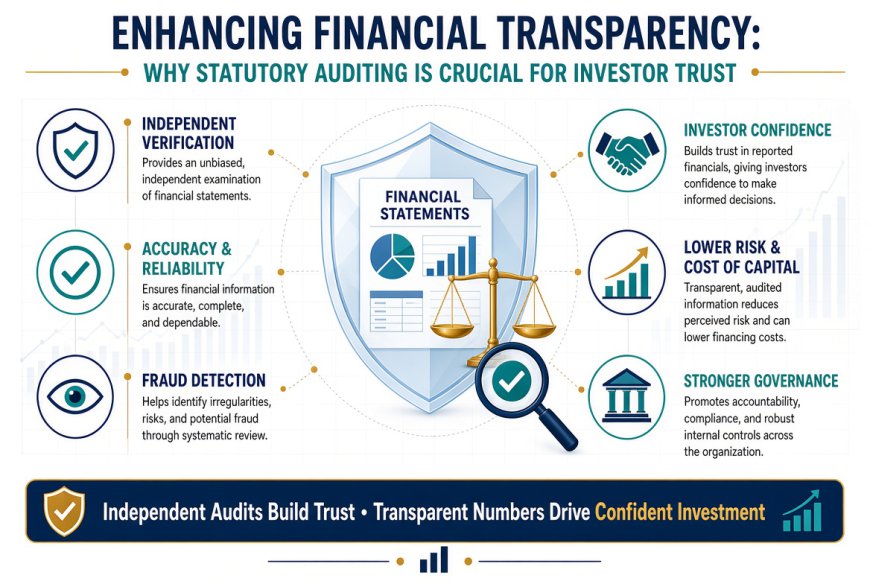
Investors do not put money into companies they cannot see clearly, and in Qatar's increasingly competitive business environment, financial transparency has become one of the strongest signals a company can send. Statutory auditing, supported by consistent internal review processes, is what makes that transparency credible rather than just claimed. This is exactly why partnering with an established internal audit company in Qatar has become a strategic priority for businesses that want to attract serious investors and maintain long-term credibility.
In this article, we will look at what statutory auditing actually involves, how internal audit processes support it, and why the two working together build the kind of trust that investors, regulators, and business partners genuinely rely on. By the end, you will understand how to strengthen your company's financial governance and where professional audit support fits into that picture.
Background: What Statutory Auditing and Internal Audit Actually Mean
Statutory auditing refers to the legally mandated examination of a company's financial statements by an independent external auditor, confirming that the figures presented accurately reflect the business's true financial position. In Qatar, companies above certain size thresholds, along with those operating in regulated sectors, are required to undergo this process annually.
Internal audit, by contrast, is an ongoing, company-led function that reviews operational processes, financial controls, and risk management practices throughout the year rather than at a single year-end point. A well-maintained internal audit report gives management and, eventually, external auditors, a clear paper trail showing that controls are being followed consistently, not just documented on paper.
Why Internal Audit and External Audit Work Together
1. Internal Audit Builds the Foundation for a Smooth External Audit
Companies that maintain strong internal audit practices throughout the year typically experience far fewer surprises when the external auditor arrives. A thorough internal audit report highlights discrepancies early, giving management time to correct issues before they become findings in the statutory audit.
2. External Auditors Rely on Internal Controls
An external auditor does not review every single transaction. Instead, they assess the strength of a company's internal controls to determine how much testing is required. Weak internal audit processes often mean more extensive, more time-consuming, and more costly external audit procedures.
3. Regulatory Compliance in Qatar
Qatar's regulatory framework, overseen by bodies including the Qatar Financial Markets Authority for listed entities, expects companies to demonstrate sound governance practices. Working with an internal audit company in Qatar that understands these local requirements helps businesses stay ahead of compliance obligations rather than scrambling to meet them at deadline time.
4. Investor Confidence and Due Diligence
When investors or potential partners conduct due diligence, a company with a documented history of internal audits and clean statutory audits presents a far stronger case than one with limited financial oversight. This documentation often becomes a deciding factor in funding rounds, mergers, or partnership negotiations.
Benefits of Strong Internal Audit and Statutory Auditing Practices
Businesses that invest in consistent internal audit processes typically see improvements well beyond compliance checkboxes. Operational inefficiencies get caught earlier, fraud risks are reduced through regular control testing, and financial reporting becomes more reliable across every department.
For example, a Qatar-based trading company that implemented quarterly internal audits ahead of its annual statutory audit identified inconsistencies in its inventory valuation process months before the external auditor arrived. Correcting this internally not only avoided a qualified audit opinion but also improved the accuracy of the company's financial reporting going forward, strengthening its standing with existing investors.
Beyond individual cases, businesses that consistently demonstrate strong audit practices generally find it easier to secure financing, negotiate favorable terms with lenders, and attract investors who prioritize governance as part of their decision-making process.
Common Challenges Businesses Face
Despite the clear value, many companies in Qatar treat internal audit as a formality rather than a genuine risk management tool, often assigning it to staff without dedicated audit expertise. This tends to produce internal audit reports that lack the depth needed to catch meaningful issues before they escalate.
Resource constraints are another common obstacle, particularly for small and medium businesses that view audit functions as a cost center rather than an investment. Without proper planning, this can lead to rushed year-end preparations, higher external audit fees, and increased risk of findings that damage investor confidence.
Best Practices for Strengthening Audit Processes
Establishing a regular internal audit schedule, rather than a single annual review, gives management ongoing visibility into financial and operational risks throughout the year. It also helps to involve an independent internal audit company in Qatar rather than relying solely on internal staff, since external expertise brings objectivity that in-house teams sometimes lack.
Clear documentation practices matter just as much as the audit work itself. A detailed internal audit report that tracks findings, corrective actions, and follow-up reviews gives both management and the external auditor confidence that issues are being addressed rather than simply noted and forgotten.
Finally, maintaining open communication between internal audit teams and the external auditor throughout the year, rather than only at audit time, tends to produce a smoother statutory audit process with fewer last-minute complications.
Case Study: Turning Audit Findings Into Investor Confidence
A mid-sized manufacturing firm in Qatar approached its internal audit process reactively for several years, addressing issues only after the external auditor flagged them. After restructuring its approach with dedicated internal audit support, the company began producing detailed internal audit reports every quarter, tracking corrective actions against a clear timeline.
Within two audit cycles, the company's statutory audit findings dropped significantly, and its external auditor noted a marked improvement in control reliability. This shift became a talking point in the company's next round of investor discussions, where documented governance improvements played a direct role in securing new funding.
Conclusion
Financial transparency is not built through a single annual audit alone. It is the product of consistent internal review, honest reporting, and a working relationship between internal audit functions and external auditors that reinforces trust at every level. For businesses in Qatar looking to strengthen investor confidence and meet regulatory expectations with fewer surprises, partnering with an experienced internal audit company in Qatar is one of the most practical steps available.