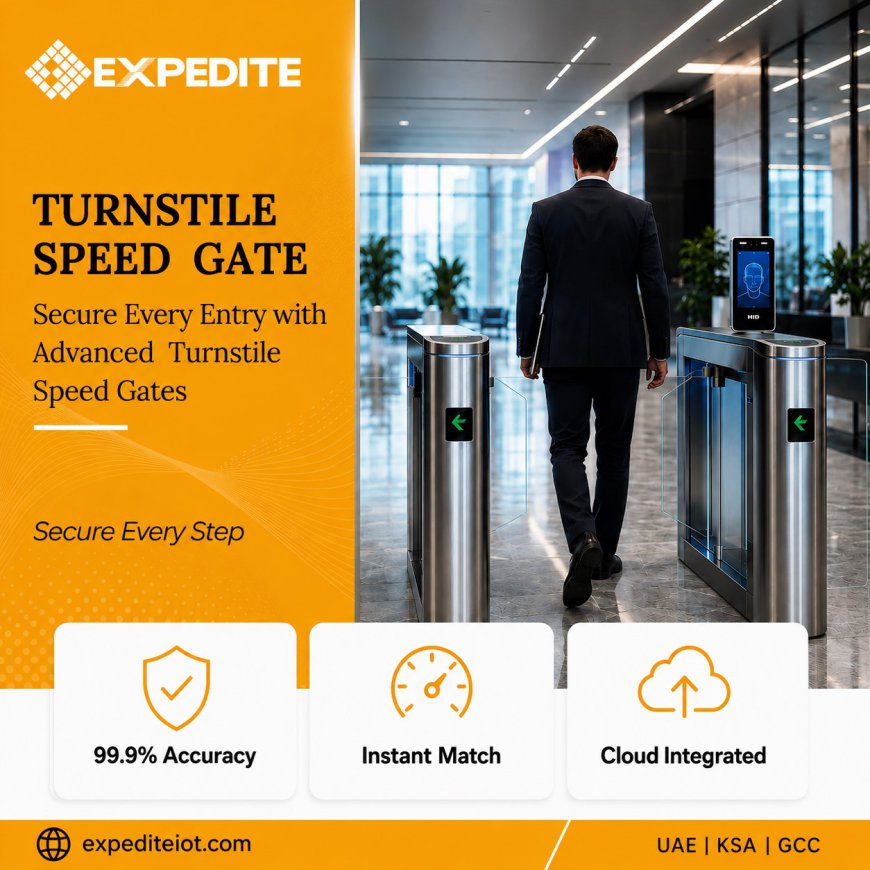
Turnstile Speed Gates for Modern Offices & Corporate Towers in Oman
 TekYousuf26
The modernisation of Oman’s corporate office landscape demands access control infrastructure that matches the sophistication of the buildings it protects, and Turnstile Speed Gates have emerged as the definitive solution for forward-thinking facility managers, property developers, and corporate security teams across the Sultanate. From Muscat’s landmark financial towers and business park precincts to the emerging commercial hubs of Sohar and Salalah, organisations are replacing outdated manual checkpoints with intelligent, automated pedestrian access systems that deliver security, speed, and the professional aesthetic that premium corporate environments demand. Purpose-engineered turnstile speed gate and access control solutions for the GCC corporate market are redefining what it means to enter a modern office building in Oman — and why that first impression matters.
Oman’s Corporate Evolution and the Case for Intelligent Pedestrian Access
Vision 2040, Oman’s national economic diversification blueprint, has catalysed a wave of commercial real estate development that is fundamentally reshaping the Sultanate’s business infrastructure. Knowledge Oasis Muscat (KOM), Oman Technology and Science Park (OTSP), Al Mouj Business Park, and the rapidly expanding Muscat Bay commercial precinct are attracting regional headquarters operations, financial services firms, technology companies, and government-linked entities that collectively require a level of physical security, operational efficiency, and professional presentation that legacy guard-based access systems cannot deliver.
The transformation is not limited to Muscat. Sohar’s industrial and logistics free zones, Duqm Special Economic Zone’s expanding business district, and Salalah’s growing commercial sector are all experiencing the same demand dynamic: corporate occupiers and their insurers, regulators, and international parent organisations expect physical access control systems that meet global standards — systems that generate auditable access records, integrate with HR and visitor management platforms, and prevent unauthorised entry through intelligent mechanical and electronic controls rather than the inherently fallible judgement of a security guard at a reception desk.
Turnstile Access Control: From Reception Desk to Operational Intelligence Platform
Turnstile Access Control in a corporate office or tower environment does far more than prevent unauthorised pedestrian entry. When properly integrated with the building’s broader technology ecosystem, a turnstile system becomes a real-time operational intelligence platform that delivers continuous visibility into who is on site, which floors and zones they have accessed, how many people are currently in the building, and whether any access pattern anomalies warrant a security response.
Enterprise turnstile platforms deployed in Oman’s corporate towers integrate with Active Directory and HR information systems to provision and revoke access rights automatically based on employment status, eliminating the chronic security risk of former employees whose access credentials were never manually deactivated. They connect with visitor management systems, allowing tenants to pre-register visitors who arrive to find their access credential — a QR code on their smartphone, a temporary contactless smart card, or a one-time facial recognition enrolment — already waiting for them. And they feed live occupancy data to the building’s emergency management system, ensuring that in the event of a fire evacuation or security lockdown, accurate headcount information is immediately available to the incident commander and Oman Civil Defence teams.
Tripod Turnstile Gates: Reliable Control for Secondary and Service Access Points
Tripod Turnstile Gates represent the foundational tier of mechanical pedestrian access control, deploying a three-arm rotating rotor that mechanically enforces one-person-at-a-time passage. Their value in a corporate tower environment is not at the main lobby — where higher-specification units provide the throughput and aesthetic required — but at the secondary access points where reliable, cost-effective physical control is needed without the investment in premium barrier hardware.
In Oman’s corporate buildings, tripod units are ideally deployed at car park pedestrian gates, service corridor entries, rooftop plant room access points, IT server room antechambers, and staff-only stairwell entrances where the volume of traffic is lower but the requirement for credential-based physical control is equally real. Their compact 550 to 600 mm lane width allows installation in doorways and corridors that cannot accommodate wider barrier formats, and their stainless-steel marine-grade construction ensures longevity in Oman’s high-temperature, high-humidity coastal climate. Battery-backed fail-safe release guarantees free passage during power failures or fire alarm activation, satisfying Oman Civil Defence emergency egress requirements.
Full Height Turnstile Gates: Maximum-Security Pedestrian Control for Sensitive Zones
Full Height Turnstile Gates deliver the highest physical security rating available in the pedestrian access control spectrum. Using a full floor-to-ceiling rotating rotor configuration, they physically prevent the three most common barrier bypass methods: climbing over, ducking under, and forcing through. This makes them the only appropriate technology for corporate zones where the consequences of unauthorised entry are severe enough to justify both the higher capital cost and the somewhat reduced throughput compared to waist-height alternatives.
Within Oman’s corporate towers, full height units are specified for data centres and server rooms housing sensitive client or operational data; treasury and cash management facilities at financial institutions; evidence storage and secure document archives at legal and government-linked organisations; executive floors at organisations with elevated physical threat profiles; and communications infrastructure rooms at telecommunications operators. For multinational corporations whose parent organisation’s global security standards mandate physical intrusion resistance ratings that standard waist-height barriers cannot achieve, full height turnstile gates are often the only compliant technology option available.
Full Height Turnstile Specifications for Oman’s Corporate Environment
- SIL-rated mechanical interlocking preventing simultaneous multi-person passage
- Anti-lift and anti-climb rotor designs with hardened steel construction
- IP54-rated sealed electronics for Gulf climate resistance
- Bidirectional or unidirectional configuration options depending on security policy
- Emergency break-out panels compliant with Oman Civil Defence egress requirements
- Integration with intrusion detection and CCTV systems for tailgating alert generation
Flap Barrier Turnstile Gates: Premium Throughput and Architectural Elegance
Flap Barrier Turnstile Gates — also referred to as optical turnstiles or wing barriers in the industry — are the specification of choice for the main lobby entry points of Oman’s premium corporate towers, financial headquarters, and five-star business hotels where the visual environment communicates brand values and sets the tone for every visitor’s experience of the building. Slim, architecturally refined housings in brushed 316L stainless steel, tempered glass, or powder-coated aluminium profiles integrate seamlessly into high-specification lobby interiors designed by international architecture practices, presenting a professional, welcoming entrance experience that contrasts sharply with the institutional appearance of traditional tripod or full-height barrier systems.
Retractable acrylic or toughened glass panels extend horizontally to create the physical barrier and retract rapidly — in 0.2 to 0.5 seconds — upon credential validation to permit passage. Lane throughput rates of 30 to 45 persons per minute per lane make flap barrier lines the optimal solution for corporate lobbies managing morning arrival rushes where 500 to 1,500 employees converge within a 30-minute window. The absence of large rotating mechanical components simplifies maintenance significantly: most service procedures on leading-brand flap barrier units are performable without taking the lane fully offline, an important operational consideration for corporate buildings where entry point downtime during business hours is commercially and reputationally unacceptable.
Lobby Design Considerations for Flap Barrier Installations in Muscat
- Minimum approach zone of 1,500 mm in front of the barrier line for queuing management
- Lane width options from 550 mm (standard) to 900 mm (accessible and equipment transit lanes)
- Integrated credential reader mounting on the barrier housing for clean aesthetic presentation
- Directional LED guidance strips embedded in barrier tops for intuitive passenger flow
- Integrated display panels showing access confirmation, denial, and directional messages
- ADA-compliant wide-lane configuration for wheelchair and mobility aid users per JCI and OBC requirements
Intelligent Facial Recognition Turnstiles: The Contactless Future of Corporate Access
Intelligent Facial Recognition Turnstiles represent the most significant advancement in pedestrian access control technology of the past decade, eliminating the physical credential entirely and replacing it with the individual’s own face. As an employee approaches the turnstile lane, an embedded multi-camera array captures a facial image at a distance of 0.3 to 1.5 metres, a deep-learning neural network matches it against the enrolled biometric database in under 300 milliseconds, and the barrier panels retract before the person reaches the physical gate — the entire interaction invisible, instantaneous, and hands-free.
For Oman’s corporate buildings, the operational implications are compelling. The morning arrival rush at a 2,000-person corporate campus generates a continuous stream of employees with both hands occupied — carrying laptops, coffee, documents, and phones — for whom presenting a smart card to a reader is a minor but genuine daily friction. Facial recognition eliminates that friction entirely, reducing average per-person transit time from three to four seconds to under two seconds and meaningfully increasing lobby throughput during peak periods. The absence of any shared-touch surface at the entry point also addresses the hygiene expectations that Oman’s corporate occupiers have carried forward from pandemic-era operational protocols.
On the security dimension, facial recognition provides stronger identity assurance than any physical credential. A smart card can be lent, stolen, or cloned. A face cannot. Anti-spoofing liveness detection certified to ISO 30107-3 Level 2 ensures that a photograph, video replay, or 3D mask cannot defeat the biometric verification engine — addressing the most common attack vectors against facial recognition systems and providing the assurance level required for genuinely security-critical corporate environments.
Biometric Turnstiles: Multi-Modal Verification for Maximum Security and Flexibility
Biometric Turnstiles extend the facial recognition paradigm to incorporate multiple biometric modalities — fingerprint, iris, palm vein, and voice recognition — within a single integrated turnstile unit, enabling organisations to select the verification method most appropriate for each user population, access zone, and security classification without deploying separate hardware for each credential type.
In Oman’s diverse corporate environment — where building populations span Omani nationals, GCC citizens, and expatriate employees from dozens of nationalities — multi-modal biometric capability provides important flexibility. Fingerprint recognition, while widely accepted, performs less reliably for users whose fingerprints are affected by manual work, certain medical conditions, or the dry skin that Oman’s climate can cause. Iris recognition provides an alternative biometric modality with equivalent or superior accuracy that is unaffected by these factors. Facial recognition with mask detection capability handles the persistent reality of face-covering in both cultural and health-safety contexts. A multi-modal biometric turnstile platform accommodates all of these variables within a single hardware and software framework, managed through a unified credential administration console.
For the highest-security corporate zones — data centres, treasury rooms, executive floors — biometric turnstiles enable two-factor biometric verification: a facial recognition match followed by an iris scan, for example, before the barrier releases. This dual-modality approach delivers an identity assurance level equivalent to the most rigorous physical security standards in the financial services and government sectors, without the operational overhead of managing separate hardware systems for each verification stage.
Turnstile Speed Gates Oman: Sector-by-Sector Corporate Deployment Overview
Turnstile Speed Gates Oman deployments across the corporate sector span a wide range of building types, tenant profiles, and security requirements, each calling for a tailored configuration of hardware, credential technology, and management platform.
Financial Services Headquarters and Branch Networks
Bank Muscat, National Bank of Oman, Oman Arab Bank, HSBC Oman, and the growing cohort of international financial institutions operating in the Sultanate manage corporate headquarters with elevated physical security requirements and branch network environments requiring efficient visitor throughput. Headquarters deployments typically combine flap barrier lanes at the main lobby with full height turnstile units at treasury, data centre, and executive floor access points, all managed through a centralised security operations platform. Branch network deployments use compact two-lane flap barrier configurations integrated with the bank’s national identity verification systems for customer authentication at service entry points.
Oil, Gas, and Energy Sector Corporate Campuses
Petroleum Development Oman (PDO), OQ Group, Shell Oman, and the network of international energy company offices in Muscat and Sohar manage corporate campuses with complex, multi-category personnel populations: permanent employees, long-term contractor staff, short-term project visitors, and regulatory inspectors. Zoned turnstile access architectures — where permanent staff hold unrestricted campus credentials, contractors hold zone-limited time-bound credentials, and visitors require host-approved temporary access — provide the granular access control that energy sector HSE management systems and international parent organisation security standards require.
Technology and Innovation Hubs
Knowledge Oasis Muscat and Oman Technology and Science Park host a diverse ecosystem of technology start-ups, established IT companies, and research institutions whose employee populations are among Oman’s most digitally sophisticated. Facial recognition turnstile installations in these environments are not merely a security upgrade — they are an active signal of technological sophistication that attracts the talent and investment these organisations compete for. Mobile credential integration, allowing employees to manage their access profile from a smartphone app, resonates particularly strongly with the younger professional demographic that populates Oman’s technology sector.
Legal, Professional Services, and Consulting Firms
International law firms, management consulting practices, and audit firms operating in Muscat’s legal and financial district manage buildings where client confidentiality is a professional and regulatory obligation that extends to physical access control. Turnstile systems with anti-tailgating detection, floor-level zoning that prevents visitors from accessing attorney work areas without escort, and visitor movement audit trails that can be produced for professional conduct investigations provide the physical security infrastructure that professional services confidentiality standards require.
Turnstile Speed Gates Muscat: Smart City Integration and Future Architecture
Muscat’s ongoing Smart City programme, coordinated through Muscat Municipality and the Ministry of Transport, Communications and Information Technology (MTCIT), is building a city-level technology infrastructure with which corporate building access control systems are increasingly expected to interoperate. Turnstile Speed Gates Muscat deployments at leading corporate towers are being specified today with open API architectures and cloud connectivity that positions them for integration with municipal emergency management, traffic optimisation, and urban mobility platforms as those city-level systems mature.
Emergency response integration is the most immediately valuable city-level connectivity: turnstile systems that share real-time building occupancy data with Oman Civil Defence’s incident management platform allow emergency commanders to know exactly how many people are in a building and on which floors before response teams enter. This data, previously unavailable without a manual headcount that could take many minutes, can be critical to the outcome of a high-rise emergency response. For Muscat’s corporate building operators, providing this integration capability is increasingly expected as part of their Civil Defence compliance obligations and their duty of care to building occupants.
Integration Architecture: Connecting Turnstiles to the Corporate Technology Stack
The intelligence of a turnstile speed gate system is directly proportional to the depth and quality of its integration with the corporate building’s broader technology ecosystem. A standalone barrier with a local whitelist is a significant improvement over manual access control — but it is a fraction of the value that a fully integrated enterprise access platform delivers.
HR and Identity Management Integration: Microsoft Active Directory, SAP SuccessFactors, Oracle HCM, and regional HR platforms connect to the turnstile management system through standard LDAP, REST API, or SCIM protocols, ensuring access rights are provisioned on day one and revoked instantly on departure.
Visitor Management System Integration: Pre-registered visitors receive QR code or SMS credentials that activate the turnstile barrier automatically upon arrival, eliminating reception desk bottlenecks and creating a digital visitor audit trail accessible to security and compliance teams.
CCTV and Video Analytics Integration: ONVIF-compliant camera connections time-synchronise access events with video footage from entry point cameras, creating a correlated audit trail where every access event — granted, denied, or anomalous — is linked to the corresponding video clip.
Fire and Emergency System Integration: Automatic barrier release across all lanes upon fire alarm activation satisfies Oman Civil Defence fast-egress requirements. Real-time occupancy counts transmitted to the building’s fire control panel support headcount accuracy at muster stations.
Elevator and Floor Access Control Integration: Turnstile systems integrated with destination dispatch elevator controls allow a single credential presentation at the lobby turnstile to simultaneously grant floor access in the elevator, eliminating the dual credential interaction that frustrates employees and slows lobby throughput during peak periods.
Why Regional Expertise and Proven Track Record Define Deployment Success
Google’s E-E-A-T framework — Experience, Expertise, Authoritativeness, and Trustworthiness — is as relevant to technology procurement as it is to content evaluation. A turnstile system is only as good as the integration partner who designs, installs, configures, and supports it. The most sophisticated hardware platform will underperform if the integration lacks the regional experience to navigate Oman’s building authority approval processes, the technical depth to achieve seamless connectivity with the customer’s specific HR and security management platforms, or the local support capability to resolve a barrier failure at 7:30 a.m. on a Monday without requiring an overseas support escalation.
Expedite IoT brings demonstrable experience delivering intelligent turnstile and access control deployments across GCC corporate, government, and institutional environments. Their smart turnstile solutions for Oman and the GCC region are engineered to meet the specific regulatory, climatic, and operational demands of the Sultanate’s corporate market — combining proven hardware partnerships, cloud-native management platform capability, and a regional support infrastructure that ensures critical access control systems remain operational without interruption.
Deployment Planning: A Structured Methodology for Corporate Tower Installations
Phase 1 — Occupancy and Traffic Analysis: Model peak-hour throughput requirements at each entry point based on building occupancy, shift patterns, and visitor volume projections. Calculate the minimum number of lanes required to process peak traffic within the lobby’s available queuing zone without spilling into the building approach.
Phase 2 — Security Zoning Design: Map the building’s access zones against the tenant’s or owner’s security classification requirements. Define which credential types, verification methods, and access time restrictions apply to each zone and each personnel category.
Phase 3 — Hardware Specification and Integration Design: Select turnstile types, lane widths, credential technologies, and mounting configurations. Produce integration architecture diagrams for HR, visitor management, CCTV, fire, and elevator systems. Confirm network, power, and civil requirements with building services consultants.
Phase 4 — Installation, Configuration, and Testing: Execute civil works, cabling, and hardware installation. Configure the management platform, load credential databases, and test all integration connections. Conduct full functional acceptance testing across normal, denied, emergency, and fault scenarios before handover.
Phase 5 — Go-Live, Training, and Continuous Optimisation: Commission the system during a controlled go-live period with integration partner support on site. Train security operations, facilities, and IT teams. Review alert thresholds, throughput performance, and integration data quality at 30, 60, and 90 days post-launch, and establish a preventive maintenance schedule for the system’s operational life.
Conclusion
Oman’s corporate towers and modern offices deserve access control infrastructure that reflects their ambition, and Turnstile Speed Gates deliver precisely that — combining the reliable mechanical simplicity of Tripod Turnstile Gates at secondary access points with the architectural refinement of Flap Barrier Turnstile Gates in premium lobbies and the uncompromising perimeter security of Full Height Turnstile Gates at restricted zones, all unified under a single Turnstile Access Control platform. The transformative potential of Intelligent Facial Recognition Turnstiles and fully integrated Biometric Turnstiles is now within reach for every serious commercial property in the Sultanate, enabling frictionless, contactless, credential-free access that is simultaneously faster, more secure, and more dignified than any card-based alternative. From the financial district towers of Turnstile Speed Gates Muscat to the emerging business hubs served by Turnstile Speed Gates Oman deployments across Sohar, Duqm, and Salalah, the organisations that invest in intelligent pedestrian access infrastructure today are building a security and operational foundation that will serve them through Oman’s Vision 2040 transformation and beyond. The technology is proven, the integration expertise is available, and the regulatory environment is supportive — the only remaining question is which entry point you want transformed first.
FAQs
1. How many turnstile lanes does a corporate tower lobby in Muscat typically need?
The number of lanes required is determined by peak-hour throughput demand and the acceptable maximum queue length at the barrier line. As a planning rule, a single flap barrier lane processing 35 persons per minute can serve approximately 1,050 persons during a 30-minute peak arrival window without queue accumulation beyond two to three persons. A corporate tower with 1,500 employees arriving within a 30-minute morning peak therefore requires a minimum of two standard lanes plus one accessible wide lane — three lanes total — to maintain free-flow entry. Buildings with faster peak concentration (a campus with a fixed 9:00 a.m. start time versus a flexible arrival window) or higher daily occupancy will require proportionally more lanes. A traffic modelling exercise during the design phase, using actual building occupancy data and arrival pattern assumptions, is the only reliable basis for lane count specification.
2. Can facial recognition turnstiles work reliably with face coverings in Oman’s corporate environment?
Yes. Modern facial recognition engines deployed in GCC corporate environments are trained on diverse datasets that include partial face occlusion scenarios, including traditional face coverings common in Oman and the broader Gulf region. Contemporary systems use periocular recognition — identifying individuals from the eye region and surrounding facial geometry — when the lower face is covered, achieving accuracy rates that, while marginally lower than full-face recognition, remain suitable for corporate access control applications. Dual-camera configurations that simultaneously capture standard visible-light and near-infrared images improve accuracy in high-contrast lighting conditions common in Omani lobbies with strong natural light. For organisations where face covering is prevalent among a significant portion of the building population, a multi-modal biometric configuration — offering iris recognition as an alternative primary modality — provides a fully inclusive, equally frictionless alternative without requiring any change to the user’s personal practice.
3. How does a turnstile system handle emergency evacuation in a high-rise corporate tower in Oman?
Emergency evacuation management is a core design requirement for every turnstile installation in a multi-storey corporate building. Upon receipt of a fire alarm signal from the building’s fire control panel — via a direct relay connection or BACnet integration — the turnstile management system automatically releases all barrier panels across all lanes to the fully open position, creating the maximum possible egress width through the lobby. This state is maintained for the duration of the alarm condition and cannot be overridden by normal credential presentations. The system simultaneously transmits the building’s real-time occupancy count and last-known floor distribution data to the fire control panel and, where integration exists, to Oman Civil Defence’s incident management platform. Manual override panels located at the security desk and fire warden stations allow authorised staff to release individual lanes or all lanes independently of the automated system if required. All of these behaviours are documented and tested during commissioning acceptance and must satisfy the requirements of the Oman Civil Defence before the building’s occupancy certificate is issued.
4. What data protection obligations apply to biometric turnstile deployments in Oman?
Biometric data processing in Oman is governed by the Personal Data Protection Law (Royal Decree No. 6/2022), which defines biometric data as a special category requiring explicit consent or another specified lawful basis for processing, enhanced security measures, and strict purpose limitation. For corporate turnstile deployments, the lawful basis is typically legitimate interest or the employment contract for staff, and explicit consent for visitors and contractors. Practical compliance obligations include conducting a Data Protection Impact Assessment (DPIA) before deployment, storing only encrypted biometric templates rather than raw facial images, defining and enforcing automated data retention and purge schedules, providing data subjects with rights of access, correction, and erasure, and appointing a Data Protection Officer if the processing is large-scale. Reputable integration partners provide a compliance documentation package as standard project deliverable, mapping the system’s technical controls to each applicable legal obligation under Oman’s data protection framework.
5. Can a turnstile system in Oman be managed remotely across multiple corporate sites from a single platform?
Yes, and multi-site remote management is one of the most operationally valuable capabilities of modern cloud-native turnstile management platforms. A corporate group operating office in Muscat, Sohar, and Salalah — or across multiple buildings within Muscat’s business district — can manage all sites from a single web-based administration console, regardless of the physical distance between locations. Credential administration — provisioning new employees, modifying access zones, issuing visitor credentials, revoking leavers — is performed centrally and propagates to all sites in real time. Security event monitoring aggregates alerts, access anomalies, and equipment fault notifications from all sites onto a unified dashboard that the central security operations team monitors continuously. Site-level reporting allows facility managers at each location to access the data relevant to their building independently, while group-level reporting gives corporate security leadership the portfolio-wide overview needed for compliance reporting and strategic security planning.