Enterprise-Grade Access Control Systems Across Oman
A Security Access Control System at enterprise scale is typically built on a hierarchical architecture: a central management server or cloud platform sits above regional or site-level controllers, which in turn manage the individual door hardware.
 expsufiyan
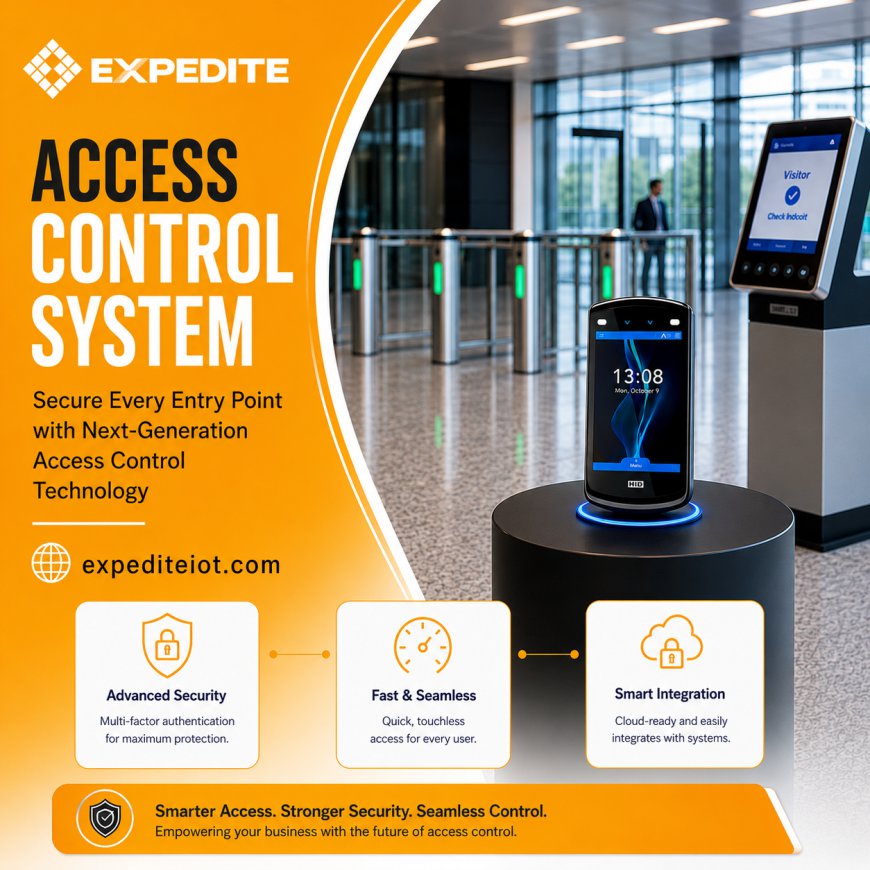
An Access Control System built for enterprise scale looks very different from a single-office installation. Organizations running multiple branches, warehouses, and facilities across Oman need a centralized enterprise access platform that enforces consistent security policy everywhere, while still adapting to the specific risk profile of each site — a bank branch in Muscat, a logistics yard near Duqm, and a corporate headquarters all demand very different levels of verification under one unified system.
Large organizations operating in Oman rarely sit inside a single building. Banks run branch networks, logistics and energy companies manage distributed sites across the Sultanate, and government-adjacent entities operate facilities spread across multiple governorates. Managing security consistently across that footprint with mechanical locks or disconnected, site-by-site systems becomes close to impossible once an organization grows past a handful of locations. This article covers what enterprise-grade access control looks like at scale in Oman, the architecture decisions that matter most, and why Expedite IoT has become a trusted integration partner for large, multi-site organizations across the country.
What Makes an Access Control Deployment Truly Enterprise-Grade?
Scale changes the requirements fundamentally. A single-office deployment might manage a few dozen doors and a few hundred credentials; an enterprise deployment across an Oman-wide branch network can mean hundreds of doors, thousands of credentials, and multiple independent site administrators who each need visibility into only their own location while a central security team retains oversight across everything.
Consistency of policy matters as much as scale. A group security lead needs confidence that the access rules applied to a server room in Muscat match the rules applied to an equivalent server room in Sohar or Salalah, rather than each branch manager configuring security independently based on local preference or whatever hardware happened to be available at the time.
Reporting and audit readiness scale up correspondingly. A regulator or internal auditor reviewing a national branch network expects a single, consolidated access report covering every site, not a request that has to be routed to a dozen separate branch managers each pulling their own local logs in a different format and on a different schedule.
Vendor and support continuity also matter more at scale than for a single site. An enterprise organization needs an integration partner capable of supporting hardware and software across every governorate the business operates in, with a consistent service level agreement and a single point of escalation, rather than juggling a different local vendor relationship for each regional office.
Budget planning also looks different at enterprise scale. Rather than approving a single capital expense for one office fit-out, group finance and security teams typically plan a multi-year rollout budget that accounts for phased site migration, ongoing licensing, and ordinary hardware refresh cycles across a growing network — a materially different planning exercise than a one-time project for a single location.
Security Access Control System Architecture for Multi-Site Organizations
A Security Access Control System at enterprise scale is typically built on a hierarchical architecture: a central management server or cloud platform sits above regional or site-level controllers, which in turn manage the individual door hardware. This layered design keeps day-to-day access decisions fast and local while still giving head office a single point of policy control and reporting.
● Central policy management with delegated, site-level administrative permissions
● Role-based access templates applied consistently across every branch or facility
● Consolidated, exportable reporting spanning the entire portfolio
● Resilience at each site so local doors keep functioning during a head-office network outage
Delegated Administration Without Losing Central Control
Enterprise platforms typically implement a permissions model where a branch manager can add a new local employee or issue a visitor pass for their own site, but cannot alter the security tier assigned to a restricted door or override a group-wide policy set by head office. This balance between local operational flexibility and centrally defined guardrails is what allows a small security team to responsibly oversee a network of many locations.
Access Control System Oman Deployments Spanning Multiple Governorates
An Access Control System Oman rollout for a national organization has to account for real operational differences across the Sultanate — different building stock in older commercial districts versus newer developments, different landlord base-building systems, and in some cases different free zone requirements layered on top of the organization's own security policy.
For an Access Control System Muscat headquarters coordinating branches elsewhere in the country, the head office deployment typically becomes the reference template — the security tiering, credential types, and reporting structure proven at HQ is then replicated to each additional site as the network expands, rather than each new branch reinventing its own approach from scratch.
Biometric Access Control System for High-Security Enterprise Zones
Biometric Access Control System deployments are increasingly standard at the highest-security points within an enterprise network — data centers, cash handling rooms, pharmaceutical or hazardous materials storage, and executive floors — where a shared or lost card credential represents an unacceptable risk regardless of how strong the surrounding building security is.
At enterprise scale, biometric enrollment data needs to be managed centrally so an employee transferring between branches, or a regional auditor visiting from another site, does not need to re-enroll their fingerprint or face at every location. A single enrollment synced across the network keeps the experience seamless for staff who travel between sites regularly, which is common at large Omani organizations with a mobile regional management structure covering multiple governorates.
Sector-specific expectations also shape where biometric verification becomes mandatory rather than optional. Banking and energy sector operators, for instance, often apply biometric or dual-factor verification uniformly to every branch's highest-risk area regardless of that branch's individual risk assessment, simply because the internal audit expectation is for a consistent, demonstrable standard across the entire network rather than a patchwork of differing controls from site to site.
Door Access Control Standardization Across Every Site
Standardizing Door Access Control hardware across an enterprise portfolio simplifies both procurement and ongoing maintenance. Rather than each branch selecting its own reader and lock hardware independently, a centrally approved hardware list ensures spare parts, technician familiarity, and firmware update cycles remain consistent no matter which site a maintenance visit covers.
Consistent Fire and Life-Safety Compliance
Fail-safe and fail-secure lock configuration need to follow the same civil defense compliance logic at every site, and a standardized hardware and configuration approach makes it far easier for a facilities team to confirm compliance across many locations rather than auditing each site's door hardware individually against differing historical installation choices.
Centralized Firmware and Lifecycle Management
Enterprise deployments benefit from being able to push firmware updates and security patches to door controllers across the entire network from a single console, rather than requiring a technician to visit each site individually — a meaningful operational efficiency once a portfolio grows beyond a handful of locations spread across different governorates.
Mobile Access Control for a Distributed Enterprise Workforce
Mobile Access Control is particularly valuable for enterprise organizations whose staff move between sites as part of their normal role — regional managers, traveling auditors, and field technicians who might need building access at three or four different locations across Oman in a single week.
A single mobile credential automatically granted the correct access at whichever branch the employee is visiting, based on their role and current assignment, removes the administrative burden of issuing and managing a separate physical card at every site an employee might ever need to enter. Access can also be time-boxed to a specific visit, expiring automatically once the assignment ends.
Choosing Access Control Devices for a National Deployment
Selecting the right Access Control Device for an enterprise rollout means balancing site-specific needs against the practical benefits of standardization. A busy branch lobby, a quiet back-office corridor, and an outdoor warehouse loading bay all have different throughput and environmental requirements, but sourcing from a limited, pre-approved hardware catalogue still keeps procurement, training, and support manageable at scale.
● High-throughput readers for busy branch lobbies and staff entrances
● Weatherproof devices for warehouse, loading dock, and yard access points
● Biometric or dual-factor devices reserved for the highest-security zones network-wide
● Consistent device firmware versioning to simplify enterprise-wide support
End-to-End Access Control Solutions for Large Omani Organizations
Enterprise buyers evaluating Access Control Solutions at this scale need to look well beyond door hardware to the full operational picture: integration with HR systems for automated onboarding and offboarding across every branch, a unified visitor and contractor management workflow, and reporting that satisfies group-wide internal audit, insurance, and sector-specific regulatory requirements.
HR system integration delivers particularly strong value at enterprise scale. When an employee resigns from any branch in the network, a single action in the central HR platform can revoke their access across every site simultaneously, closing what is otherwise one of the most common and highest-risk gaps in multi-site security — a departed employee whose credential remains active at a branch the central security team was not immediately aware needed updating.
Cross-site analytics are another benefit unique to the enterprise scale. Comparing access patterns, alarm frequency, and credential usage across the full portfolio helps a group security function identify which sites carry disproportionate risk or unusual activity, informing where additional investment or a policy review is genuinely needed rather than spreading resources evenly regardless of actual risk profile.
Visitor and contractor management deserves particular attention for organizations with sites in industrial areas or free zones, where third-party contractor traffic can be substantial. A unified workflow that applies the same pre-approval, ID capture, and time-boxed credential rules at every site — rather than each facility improvising its own contractor sign-in process — keeps this often-overlooked category of access under the same governance as full-time staff credentials.
Access Control System Muscat: Trusted Deployment Across the Sultanate
Expedite IoT designs and deploys access control system architecture for large, multi-site organizations across Oman, from national branch networks to distributed logistics and energy sector campuses. Our integration team has delivered enterprise access control for commercial and institutional clients around Knowledge Oasis Muscat and corporate towers in the capital, alongside deployments for logistics and industrial clients connected to the Duqm Special Economic Zone. Access control policies and site-hardening approaches are designed with reference to Royal Oman Police guidance on facility security and access documentation, and reflect the broader smart-infrastructure priorities set out under Oman Vision 2040 for more secure, technology-enabled commercial facilities across the Sultanate.
Every enterprise engagement includes a portfolio-wide security assessment, standardized hardware and policy design, phased rollout planning, and central admin training. You can review the full solution scope on our access control system page or request a portfolio assessment for your organization.
Rolling Out Access Control Across a Multi-Site Enterprise
A phased rollout is the standard approach for national deployments, starting with a flagship site — typically head office or the largest branch — to validate hardware selection, policy templates, and reporting before replicating the proven configuration across the rest of the network. This avoids the far more expensive scenario of discovering a design flaw only after it has already been rolled out to many locations.
Change management across a distributed workforce deserves as much planning as the technical rollout itself. Branch managers who understand why the standardized system matters, and who are trained on their delegated administrative permissions before go-live, adopt the platform far more smoothly than sites where the new system simply appears with no prior communication or local ownership built in.
Common Enterprise Rollout Pitfalls to Avoid
The most frequent pitfall is allowing early sites to deviate from the agreed hardware and policy standard for local convenience, which compounds into a fragmented, harder-to-support network by the time the rollout reaches its later phases. The second common pitfall is under-resourcing central IT and security support during the rollout window itself, when the volume of onboarding requests, questions, and exceptions is naturally at its highest across a growing number of newly live sites.
A third pitfall specific to Oman's geography is underestimating logistics and travel time between sites during planning. A rollout schedule built without accounting for the distance between, say, a Muscat head office and a facility near Duqm or Salalah can quickly fall behind if technician travel time is not properly built into the project timeline from the outset.
A fourth pitfall is neglecting site-specific environmental factors during hardware standardization. A single hardware catalogue is efficient for procurement, but a coastal facility near Salalah and an inland site near the interior can face meaningfully different heat, humidity, and dust exposure, and a rigid one-size-fits-all approach to enclosure ratings sometimes needs a documented exception process rather than forcing every site onto identical hardware regardless of local conditions.
Measuring Success Across the Portfolio
Group security teams typically track policy compliance rate across all sites, the percentage of the network fully migrated from legacy or mechanical systems, and the time taken to complete an organization-wide offboarding action after it is triggered centrally. Consistent improvement across these three measures over the course of a rollout is the clearest sign the enterprise architecture is functioning as a genuinely unified system rather than a collection of independently managed sites.
For a tailored enterprise rollout plan covering hardware standardization, central policy design, and phased site sequencing, reach out through our access control solutions team.
Conclusion
An enterprise-grade Access Control System gives large Omani organizations consistent security across every branch and facility. Centralized Security Access Control System architecture, standardized Door Access Control hardware, and network-wide Mobile Access Control credentials work together with high-security Biometric Access Control System zones and carefully selected Access Control Device choices. Comprehensive Access Control Solutions close the offboarding and audit gaps mechanical or disconnected systems leave behind. For organizations scaling their Access Control System Oman or Access Control System Muscat footprint, Expedite IoT delivers proven, portfolio-wide integration experience.
FAQs
1. How is an enterprise access control deployment different from a single-office system?
An enterprise Security Access Control System needs centralized policy control, delegated site-level administration, and consolidated reporting across dozens of doors, rather than the simpler single-site setup a standalone office requires.
2. Can access be revoked across every branch at once when an employee leaves?
Yes. HR system integration allows a single offboarding action to revoke an employee's access across every site in the network simultaneously, rather than requiring each branch to update its own local system separately.
3. Do staff need to re-enroll their biometric credential at every branch they visit?
No. Biometric enrollment data is managed centrally and synced across the network, so an employee transferring or visiting another site does not need to re-enroll their fingerprint or face at each location.
4. How do doors continue functioning if the central system loses connectivity?
Site-level controllers retain their access rules locally, so doors keep operating correctly during a temporary loss of connection to the central management platform, with logs syncing automatically once connectivity returns.
5. What is the best approach for rolling out access control across many sites at once?
A phased rollout starting with a flagship site to validate hardware and policy templates, then replicating the proven Access Control Solutions design across the rest of the network, avoids costly rework compared to deploying everywhere simultaneously.
For more information contact us on:
Expedite IT
+966 502104086
Office No 01, Conference Building (Kirnaf Finance), Abi Tahir Al Dhahabi Street, Al Mutamarat,
Riyadh 12711, Saudi Arabia