Fruit Juice Market Size, Growth and Forecast 2026 | USD 226.9 Billion by 2034
The global fruit juice market is expected to continue growing over the next 10 years‚ driven by continuing wellness trends‚ innovation and premiumization‚ and e-commerce retail channels․
 torylanez27
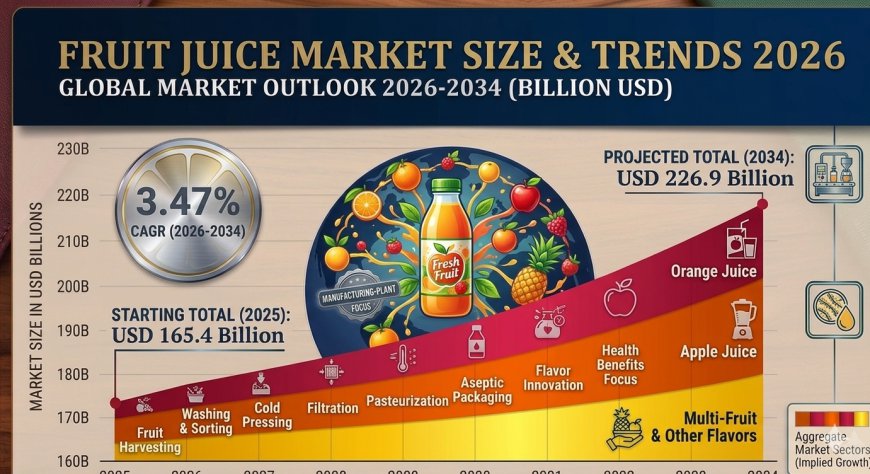
According to a research report by IMARC Group, the global fruit juice market size reached USD 165.4 Billion in 2025. Looking forward, the market is projected to reach USD 226.9 Billion by 2034, exhibiting a growth rate (CAGR) of 3.47% during 2026–2034. The increasing health and wellness trends, rising disposable incomes, significant product innovations and introduction of flavor varieties, expanding retail channels, and growing interest in natural ingredients due to their benefits are among the major factors propelling the fruit juice market share.
Market at a Glance
|
Report Attribute |
Key Statistics |
|
Base Year |
2025 |
|
Forecast Years |
2026–2034 |
|
Historical Years |
2020–2025 |
|
Market Size in 2025 |
USD 165.4 Billion |
|
Market Forecast in 2034 |
USD 226.9 Billion |
|
Market Growth Rate (CAGR) |
3.47% |
Request for a Sample Report for Detailed Evaluation: https://www.imarcgroup.com/fruit-juice-manufacturing-plant/requestsample
Key Fruit Juice Market Trends Driving Expansion
Increasing Health and Wellness Trends
Another trend in the fruit juice market is the growing health-conscious consumer behavior․ As a natural source of vitamins‚ minerals‚ and antioxidants‚ fruit juices can fit into consumers' wellness routines and dietary needs․ With consumer perception of fruit juices being a healthy product that increases immunity and provides energy‚ key players are launching fruit juices that are low in sugar or fortified with probiotics‚ vitamins‚ and plant extracts․ This trend for convenient yet nutritionally useful fruit juices is driving the growth of the global fruit juice market and has influenced beverage companies to formulate and market other juice products․
Rise in Disposable Income and Premiumization
Increasing disposable income of consumers in developed and developing countries is projected to increase fruit juice demand owing to high demand for expensive fruit juices across the globe․ Consumers are demanding premium quality juices made from organic raw materials with unique flavors and processing technologies such as cold pressed and High Pressure Processing (HPP) technique․ To meet these needs‚ manufacturers are launching super premium variations of fruit juices targeting more affluent health conscious consumers with products positioned at the top of the price spectrum and value chains․ This trend is most popular in Asia Pacific‚ Latin America and the Middle East where a burgeoning middle class is․
Significant Innovations and Flavor Varieties
Innovation in fruit juice formulations and flavors acts as a meaningful driver for the global market․ Consumers are increasingly looking for new tastes and flavors‚ prompting manufacturers to introduce new exotic fruit combinations‚ functional juice blends‚ and add flavoring agents․ The development of processes such as cold-pressing and high pressure processing (HPP) are helping to increase the shelf life and improve the nutritional value of juice products‚ while sugar-free‚ clean label and functional foods such as probiotic and plant-based protein drinks are becoming increasingly popular in the marketplace․ These developments provide for a competitive market that meets the needs of a range of different consumers with diverse preferences․
Expanding Retail Channels and E-Commerce Growth
An expanding array of retail channels has also helped the global distribution of fruit juices‚ including supermarkets and hypermarkets‚ convenience store outlets‚ specialist and independent food retailers‚ and online channels․ The COVID-19 pandemic accelerated consumer demand for e-commerce and direct-to-consumer sales channels‚ which now represent two of the most important global channels for major brands․ Digital channels allow companies to send the message directly to the consumer‚ personalizing the offer‚ and including home delivery․ Digital retailing channels‚ especially e-retail and quick commerce‚ are growing the fastest in the Asia Pacific region․ Infrastructure development in e-commerce is increasing the availability of a diverse range of fruit juice products in urban and semi-urban areas․
Fruit Juice Market Segmentation Analysis
By Product Type
- Juice Drinks
- 100% Fruit Juice
- Nectars
- Concentrates
- Powdered Juice
- Others
Juice drinks dominate the market as the largest product type segment - encompassing a wide variety of fruit-based beverages that blend fruit juices with water, additional flavors, or sweeteners, creating a versatile array of options for different taste preferences and sweetness levels. Their popularity spans multiple age groups, from children seeking refreshing thirst-quenchers to adults looking for convenient on-the-go choices. Additionally, juice drinks can be formulated with reduced sugar content and fortified with vitamins and minerals, aligning with evolving health-oriented consumer demand.
By Flavor
- Orange
- Apple
- Mango
- Mixed Fruit
- Others
Orange holds the largest share of the flavor segment - recognized for its tangy and refreshing taste profile that resonates with a broad spectrum of consumers across demographics. Orange juice's enduring status as a breakfast staple, combined with its high vitamin C content and immune-boosting reputation, makes it a consistently preferred choice. Its versatility also plays a crucial role — orange juice serves as the base for numerous blends, fortified variants, and reduced-sugar formulations, enabling manufacturers to cater to evolving consumer preferences while preserving its core nutritional attributes.
By Distribution Channel
- Supermarkets and Hypermarkets
- Convenience Stores
- Specialty Food Stores
- Online Retail
- Others
Supermarkets and hypermarkets represent the dominant distribution channel - offering consumers the distinct advantage of finding a diverse array of fruit juice brands, flavors, and packaging formats all under one roof. Spacious store layouts enable extensive product display, while fresh produce sections provide access to both bottled and freshly squeezed juices. Economies of scale in these retail formats drive competitive pricing and promotional offers, making them particularly attractive to budget-conscious shoppers. In-store advertising, marketing displays, and loyalty programs further reinforce fruit juice purchasing decisions at these high-footfall retail destinations.
By Region
- Europe
- North America
- Asia Pacific
- Latin America
- Middle East and Africa
Europe leads the global market with the largest fruit juice market share - underpinned by a strong cultural emphasis on health and wellness, stringent food safety regulations that reassure consumers about product authenticity, and a deep appreciation for diverse, high-quality flavors. Northern and Western European markets - particularly Germany, the UK, and France — are significant contributors. The push to reduce sugar consumption has stimulated demand for reduced-sugar and organic juice formulations, while the strategic density of supermarkets, hypermarkets, and online retail channels ensures widespread product accessibility across the continent.
Connect for Detailed Segmentation Analysis - Speak to an Analyst: https://www.imarcgroup.com/request?type=report&id=506&flag=C
Competitive Landscape in the Fruit Juice Industry
The global fruit juice market is shaped by a mix of multinational beverage giants and regional specialty players. Leading companies are continuously innovating with new flavors, functional ingredients, and sustainable packaging to align with changing consumer values. Strategic partnerships, acquisitions, and brand extensions are helping key players expand their portfolios and market presence. Brands are actively leveraging e-commerce growth and direct-to-consumer channels to engage customers, while investing in eco-friendly sourcing and production to meet rising sustainability expectations.
Key Fruit Juice Market Players Include:
- Del Monte Foods Corporation
- Dole Packaged Foods LLC
- Florida's Natural Growers Inc.
- Huiyuan Group Co. Ltd.
- Keurig Dr Pepper Inc.
- Kraft Heinz
- Ocean Spray
- Odwalla
- PepsiCo
- The Coca-Cola Company
- Welch's
Key Regional Insights
United States
The US market for fresh fruit juice is maturing‚ with consumers now interested in lower-sugar‚ organic‚ or functional juice․ Cold-pressed juice has gained the most traction with health-focused millennials․ Brands have stressed clean label transparency‚ environmentally sustainable packaging‚ responsible sourcing‚ and e-commerce and direct-to-consumer selling since the COVID-19 pandemic․ To compete with lower-cost‚ higher-production brands‚ companies use proprietary blends and flavor variations to attract consumers who are interested in new and unique products․
Europe
Legislation on food safety‚ increased awareness of healthy lifestyles as well as consumers' general preference for natural products have contributed to an increasing demand for organic and cold pressed juices‚ particularly in Germany‚ UK and France․ Premiumization‚ exotic flavor innovations and functional varieties including added vitamins or plant-based proteins are accelerating․ Manufacturers are responding to regulation and consumer demand for lower sugar levels through reformulation‚ improved labeling‚ consolidation through mergers and acquisitions‚ and diversifying their portfolios․
Asia Pacific
The Asia Pacific market is expected to see the fastest growth due to rapid urbanization‚ improving health awareness‚ and rising disposable incomes‚ especially China‚ India‚ and Japan․ The demand is rising for juices prepared with ingredients like aloe vera and tropical fruit․ Expanding retail outlets‚ booming e-commerce channels‚ and international brands' ability to adapt flavor profiles to local consumer preferences have made products increasingly accessible․
Latin America
Latin America has abundant fruit resources‚ with Brazil and Mexico constituting the largest market for tropical and organic juice‚ where natural beverages are gradually replacing the carbonated soft drinks․ Consumer behavior across the region is beginning to shift towards local brands offering value-motivated‚ nutritious product ranges‚ along with sustainable and innovative packaging solutions․
Middle East and Africa
The market growth in Middle East and Africa is owing to changing lifestyles‚ a large population of youth‚ and increased demand for health-oriented and on-the-go beverages․ The major countries contributing to this market are the U․A․E․‚ Saudi Arabia‚ and South Africa․ Consumption of functional and exotic juices is rising․ Halal certification and products with clean labels are important purchasing considerations; growth is helped by health consciousness and urbanization․
Market Drivers, Challenges & Opportunities
Major Market Drivers:
- Growing health and wellness consciousness driving demand for natural, nutrient-rich beverages.
- Rising disposable incomes fueling premiumization and demand for high-quality fruit juice variants.
- Expanding e-commerce and direct-to-consumer retail channels enhancing product accessibility globally.
Key Challenges:
- High sugar content concerns and regulatory pressures compelling reformulation across product portfolios.
- Seasonal fruit dependency, rising raw material costs, and supply chain disruptions affecting profitability.
Emerging Opportunities:
- Growing demand for functional, fortified, and immunity-boosting juice formulations in emerging markets.
- Expansion of plant-based and wellness-focused product lines addressing new consumer health priorities.
- Sustainable packaging innovations and clean-label offerings driving brand loyalty and premium positioning.
Latest Market Developments
April 2025: Tropicana launched Fresh & Light, a new juice range with 30% less sugar than the market average, targeting health-conscious consumers. Available in three flavors, the range reached Spar and Nisa stores at GBP 2.75 for 850ml.
August 2024: Dabur India expanded its Réal portfolio with Réal Bites, a new fruit beverage range featuring real fruit chunks priced at INR 40 for a 180ml can, with Bollywood actress Sara Ali Khan joining as brand ambassador.
July 2024: Yu entered the hydration segment with 100% Natural Coconut Water and Fruit Juices in Tropical Punch and Berry Blast variants, with distribution across offline, online, quick-commerce, and airline channels, and plans for 3–4 more juice flavors by year-end.
Conclusion: Fruit Juice Market Outlook to 2034
The global fruit juice market is expected to continue growing over the next 10 years‚ driven by continuing wellness trends‚ innovation and premiumization‚ and e-commerce retail channels․ Juice manufacturers are responding to rapidly changing consumer preferences for cleaner‚ functional and sustainably produced products․ The juice market keeps developing‚ becoming more competitive and diverse․
Although Europe has the largest market share for fruit juice‚ Asia Pacific is the fastest growing market for fruit juice․ The global market size and growth for fruit juice is considerably positive‚ which presents multiple opportunities for fruit juice brands‚ new market entrants‚ investors and other stakeholders in the food and beverage value chain․
About the Author
IMARC Group is a leading global market research company providing data-driven insights and expert consulting services to businesses seeking to achieve their strategic objectives. With a multi-disciplinary team of industry experts, IMARC delivers thorough, reliable market intelligence across sectors including Technology, Construction, Healthcare, Energy, Food & Beverages, and more.
Media & Sales Contact
IMARC Group
United States: +1-201-971-6302
India: +91-120-433-0800
United Kingdom: +44-753-714-6104