Future-Ready Gate Barrier Systems for a Smarter UAE
 TekYousuf26
As the UAE races toward smart-city infrastructure across Dubai, Abu Dhabi, and Sharjah, a reliable Gate Barrier System has quietly become one of the most important pieces of that puzzle. From residential compounds and shopping mall car parks to industrial yards and toll corridors, vehicle entry points are being re-engineered around speed, automation, and integration with the broader smart infrastructure the country is building.
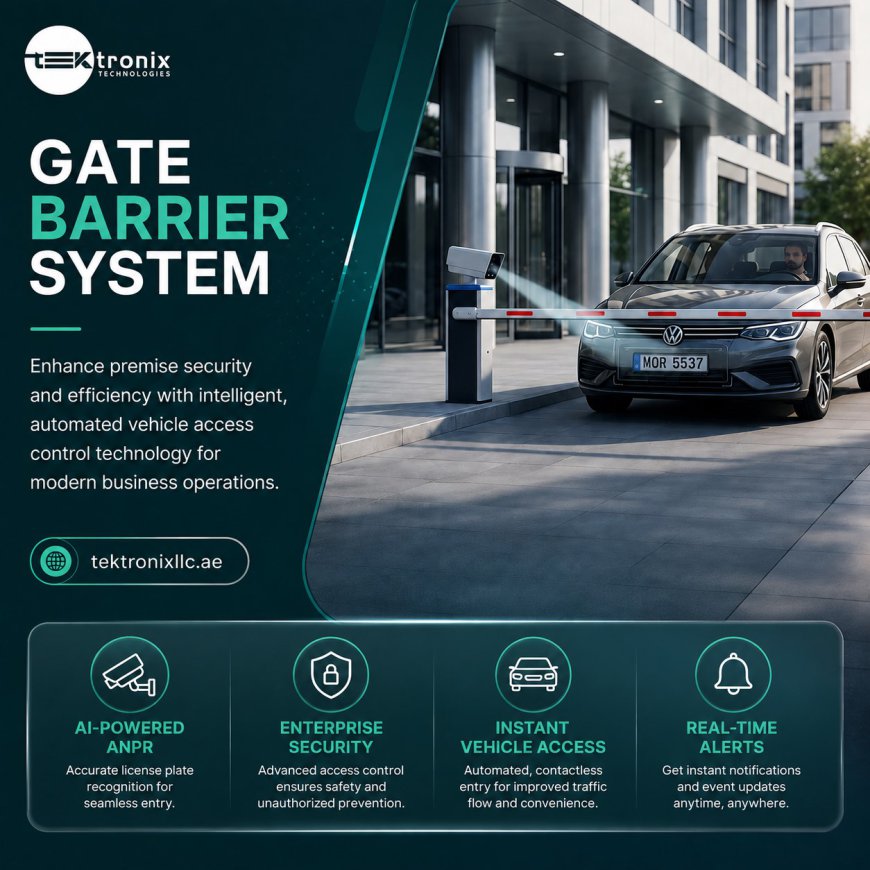
This guide walks through the main categories of vehicle barrier technology used across the Emirates today, what separates a future-ready installation from a basic boom gate, and how UAE facility owners can plan a system that scales alongside the country's smart-mobility ambitions.
Why the UAE's Smart Infrastructure Push Starts at the Gate
Every smart building, gated community, and logistics hub in the UAE shares one common bottleneck: the vehicle entry point. Traffic authorities across the Emirates have been steadily pushing property developers and facility operators toward automated, sensor-driven access as part of wider smart-city and traffic-management initiatives, which means the humble gate is now expected to talk to parking apps, licence-plate databases, and building-management software rather than operate as an isolated mechanical device.
For developers and facility managers, this shift changes the buying decision. A barrier is no longer chosen purely on price and durability; it is chosen on how well it integrates with the rest of a connected property, from visitor pre-registration apps to centralised security dashboards covering multiple sites.
Boom Barrier System Basics: The Foundation of Vehicle Entry Control
At its core, a Boom Barrier System uses a motorised arm that raises and lowers to control vehicle passage, triggered by a remote, sensor, card, or licence-plate read. It remains the most widely deployed vehicle-control mechanism across UAE properties because it is cost-effective, fast to install, and easy to retrofit into existing driveways and compound entrances.
Modern boom barriers built for UAE conditions are rated for continuous outdoor operation in extreme heat and dust, with arm-cycle counts and duty ratings that matter far more in a Gulf climate than in a temperate one. Facility owners should always confirm a barrier's rated cycles-per-hour before installing it at a high-traffic entrance, since undersized motors are the most common cause of early failure.
Common Boom Barrier Configurations
- Straight-arm barriers for standard single or double-lane driveways.
- Articulated-arm barriers for narrow lanes where a full-length arm would obstruct a footpath.
- Skirted or fence-arm barriers that add a physical mesh guard beneath the arm for pedestrian safety at busy entrances.
Toll Gate Barriers for High-Volume Corridors and Managed Roadways
On higher-traffic corridors, such as private toll roads, airport approach lanes, and large mixed-use developments with metered parking, operators need equipment built for continuous, high-cycle use rather than the intermittent traffic of a residential compound. Toll Gate Barriers are engineered for exactly this: rapid open-close cycles, heavy-duty motors rated for thousands of operations per day, and tight integration with ticketing, payment, or free-flow tolling systems.
Because these installations sit on live traffic corridors, uptime is non-negotiable. Redundant power supplies, battery backup for grid outages, and fail-safe arm behaviour during a power loss are standard requirements for any toll-grade barrier deployment in the UAE.
Parking Access Barriers for Malls, Offices, and Residential Towers
Retail and residential developments face a different challenge: managing large volumes of short-stay vehicles without creating queues at peak hours. Parking Access Barriers paired with ticketing kiosks, ANPR cameras, or app-based entry are now standard across Dubai and Abu Dhabi mall and tower developments, letting a single system handle paid visitor parking, resident vehicle recognition, and validated tenant access from one platform.
A well-specified parking barrier system also feeds live occupancy data back to digital signage at the entrance, directing drivers to available floors and reducing the time vehicles spend circling for a space, which in turn improves throughput at the barrier itself.
Vehicle Access Control: Bringing Barriers into the Smart Building Ecosystem
A barrier arm is only the visible half of the system. Behind it sits the Vehicle Access Control platform that decides who gets through, logs every entry and exit, and connects that data to security, facilities, and finance teams. For UAE developments pursuing smart-building certification, this software layer is often the deciding factor between vendors, more than the barrier hardware itself.
Key capabilities to look for in a vehicle access control platform include centralised management across multiple gates and sites from a single dashboard, real-time integration with visitor management and building-management systems, exportable logs formatted for compliance and insurance audits, and role-based permissions so security, facilities, and finance teams see only what is relevant to them.
Automatic Road Barrier Technology for Public and Semi-Public Roadways
Government facilities, free-zone perimeters, and semi-public roadways across the UAE increasingly rely on Automatic Road Barrier systems that combine heavier-duty arms with vehicle-detection loops, radar sensors, or number-plate recognition to control access without a permanent security presence at every entry point.
These installations typically sit alongside supporting infrastructure such as induction loop detectors embedded in the road surface, warning lights and audible alarms during arm operation, and anti-crash or hydraulic-rated arms for locations where vehicle speed on approach is a genuine safety concern.
Industrial Boom Barrier Systems for Ports, Warehouses, and Logistics Yards
Ports, free-zone logistics parks, and warehouse yards across the UAE run a fundamentally harsher duty cycle than an office car park, with heavy trucks, near-constant operation, and exposure to dust, salt air, and extreme heat. An Industrial Boom Barrier built for this environment uses reinforced arms, higher-torque motors, and corrosion-resistant housings rated for continuous industrial use rather than light commercial duty.
For logistics operators, the barrier is also usually the first checkpoint in a chain of yard-management technology, working alongside weighbridges, container-tracking systems, and driver ID verification to keep trucks moving without compromising site security.
RFID Barrier System Integration for Frictionless, Card-Free Entry
The clearest trend across new UAE developments is the move away from manual ticketing and toward automatic vehicle recognition. An RFID Barrier System reads a tag mounted on a resident or staff vehicle's windshield from several metres away, raising the barrier before the driver even needs to slow down, which removes queuing almost entirely at residential and staff entrances.
RFID-based entry also generates a precise, tamper-resistant log of vehicle movements, since a windshield tag cannot be shared as easily as a physical remote or shared PIN, making it a natural fit for gated communities, staff car parks, and multi-tenant industrial compounds that need accountable access records.
Maintenance and Lifecycle Planning for UAE Barrier Installations
The Gulf climate is unforgiving on outdoor mechanical equipment, and a barrier system that is not maintained on a proper schedule will fail well before its rated lifespan. Dust infiltration, extreme summer heat, and coastal humidity all accelerate wear on motors, gearboxes, and control electronics far faster than the same equipment would degrade in a temperate market.
A realistic UAE maintenance plan typically includes quarterly mechanical inspections covering arm alignment, gearbox lubrication, and spring tension, seasonal checks before the peak summer heat to confirm motor cooling and thermal cut-off systems are functioning correctly, firmware and software updates for any barrier connected to an access-control or ANPR platform, and a spare-parts stock for high-wear components such as loop detectors and control boards to minimise downtime at critical entrances.
Facility teams that budget for this cycle upfront typically see a meaningfully longer service life from their hardware than those who treat maintenance as a reactive, breakdown-driven cost.
Cost Factors to Weigh Before Choosing a Barrier Vendor
Barrier pricing across the UAE market varies considerably depending on duty rating, integration requirements, and site conditions, and the lowest quoted price is rarely the lowest total cost once installation and maintenance are factored in. Facility owners comparing vendors should look past the headline unit price and evaluate the full picture.
- Duty cycle rating: a barrier undersized for its actual daily cycle count will need premature replacement, erasing any initial savings.
- Civil works: trenching for loop detectors, foundation work, and power runs can add significantly to a project depending on the existing site layout.
- Software licensing: some access-control platforms charge per gate or per credential, which changes the long-term cost of scaling to additional lanes.
- Local support availability: a lower-cost import barrier with no regional service network can cost more in downtime than a slightly pricier locally supported system.
Requesting a like-for-like quote that separates hardware, civil works, software, and a first-year maintenance contract makes it far easier to compare vendors fairly rather than being drawn to the lowest single number on a proposal.
Tektronix's Track Record Deploying Gate Barrier System UAE-Wide
Tektronix Technologies has delivered vehicle access infrastructure across residential communities, logistics parks, and commercial developments in both the UAE and Saudi Arabia, working directly with facility operators and traffic consultants to specify barrier hardware that matches actual traffic patterns rather than generic manufacturer datasheets.
That field experience across a wide range of site conditions, from coastal free-zone logistics yards to high-rise residential towers, is what separates a properly engineered Gate Barrier System UAE deployment from an off-the-shelf barrier drop-in. Every installation is planned around lane width, peak traffic volume, and the site's existing security and parking software before any hardware is ordered.
Developers and facility teams evaluating vendors for this category can review Tektronix's dedicated gate barrier system solutions page, which outlines barrier types, integration options, and site-assessment support for UAE properties.
Planning a Gate Barrier System Dubai Developers Can Scale With
Dubai's pace of development, from new residential communities in Dubailand to logistics expansion around Jebel Ali, means barrier systems installed today need headroom to scale as a property grows. A Gate Barrier System Dubai developer choose now should support additional lanes, extra ANPR cameras, or a future RFID rollout without a full hardware replacement two or three years later.
Before finalising a vendor, facility planning teams should confirm the platform's capacity for future lane expansion, check whether the access-control software can integrate with third-party visitor and parking apps already used on-site, and request local UAE-based maintenance coverage rather than a remote-support-only contract. Teams ready to plan a rollout can consult Tektronix's Dubai gate barrier and vehicle access page for a site-specific recommendation.
Safety Standards and Sensor Requirements for Automated Barriers
Any automated vehicle barrier installed on a UAE property, whether a light residential unit or a heavy industrial gate, needs to be specified with pedestrian and vehicle safety built in from the outset rather than added afterward. This is especially important at entrances shared by pedestrians, cyclists, and vehicles, such as mixed-use residential compounds and school drop-off zones.
A properly specified installation includes photocell or infrared safety beams that stop the arm from closing on a vehicle or pedestrian still in its path, obstruction-detection that reverses the arm automatically on contact rather than continuing to force closure, clear warning lights and, where required, audible alerts during arm movement, and a manual override or battery backup so the arm can be raised safely during a power outage rather than trapping vehicles at the entrance.
These features are not optional extras for a UAE deployment; they are baseline expectations for any barrier installed at a location with regular pedestrian exposure, and they are increasingly checked during facility safety audits and insurance assessments.
Conclusion
The UAE's smart-infrastructure ambitions are reshaping vehicle entry from a simple mechanical checkpoint into a connected, data-driven layer of every property, and choosing the right Gate Barrier System is central to that shift. Whether a site needs a heavy-duty Industrial Boom Barrier for a logistics yard, ANPR-ready Parking Access Barriers for a mall, or a tag-based RFID Barrier System for frictionless resident entry, developers that plan for integration and scale from day one will avoid costly hardware replacements as their properties and traffic volumes grow.
FAQs
1. What is the difference between a boom barrier system and a full road barrier?
A Boom Barrier System is a general term for motorised arm gates used at driveways, compounds, and car parks, while an Automatic Road Barrier typically refers to heavier-duty units built for public or semi-public roadways with higher traffic speeds and volumes.
2. Can toll gate barriers integrate with existing payment or ticketing systems?
Yes. Most Toll Gate Barriers deployed across the UAE are designed to integrate with ticketing kiosks, RFID payment tags, or free-flow tolling platforms already in use, so operators rarely need to replace their entire payment infrastructure.
3. Are RFID barrier systems more reliable than remote-control gate access?
Generally, yes. An RFID Barrier System reads a fixed vehicle tag automatically, removing the reliability issues that come with shared or lost remotes, and it produces a far more accurate access log for site security and compliance purposes.
4. What should industrial sites look for in a boom barrier for heavy truck traffic?
Ports, warehouses, and logistics yards should prioritise an Industrial Boom Barrier rated for high daily cycle counts, corrosion-resistant housing suited to the UAE climate, and integration with existing Vehicle Access Control software used for driver and container tracking.
5. How long does it take to install a gate barrier system across a UAE development?
A single-lane residential or office installation usually takes a few days, while a full multi-lane Gate Barrier System Dubai rollout, including ANPR or RFID integration and software configuration, generally takes two to four weeks depending on the number of gates and the complexity of the existing site infrastructure.