How Robotics Data Annotation Improves Robot Navigation and Localization
Discover how robotics data annotation improves robot navigation and localization with high-quality labeled datasets for physical AI. Learn why businesses trust Annotera.
 annotera
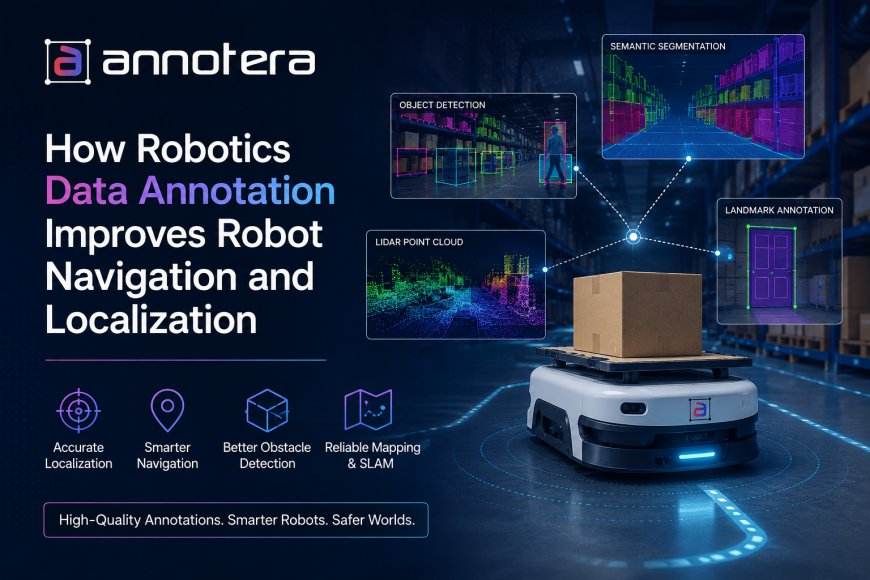
Modern robots are expected to move safely and intelligently through dynamic environments, whether they are transporting packages in warehouses, assisting surgeons, navigating factory floors, or delivering groceries. To accomplish these tasks, robots must accurately determine where they are, understand their surroundings, and make real-time decisions. These capabilities depend heavily on high-quality training data.
This is where robotics data annotation services become indispensable. By transforming raw sensor data into structured, labeled datasets, annotation enables robots to recognize objects, estimate depth, detect obstacles, and localize themselves with greater precision. As physical AI continues to evolve, accurate annotation is becoming one of the most important building blocks for reliable robotic systems.
In this article, we'll explore how robotics data annotation enhances robot navigation and localization, the annotation techniques involved, and why partnering with an experienced data annotation company can significantly improve robotic performance.
Understanding Robot Navigation and Localization
Robot navigation refers to a robot's ability to plan and execute movement from one location to another while avoiding obstacles. Localization is the process of determining the robot's exact position within its environment.
Together, these capabilities allow robots to:
-
Navigate warehouses autonomously
-
Perform indoor mapping
-
Avoid collisions
-
Identify landmarks
-
Operate alongside humans safely
-
Complete repetitive industrial tasks efficiently
To achieve this, robots rely on multiple sensors, including:
-
RGB cameras
-
Stereo cameras
-
LiDAR
-
IMUs (Inertial Measurement Units)
-
GPS
-
Radar
-
Depth sensors
However, these sensors only generate raw data. Machine learning models cannot understand this information without properly labeled datasets.
Why Data Annotation Matters for Robot Navigation
Robots learn by recognising patterns from thousands—or often millions—of annotated examples. Every labelled image, LiDAR point cloud, or video sequence helps AI models understand how different environments appear under varying conditions.
Without quality annotation, robots may struggle to:
-
Detect pedestrians
-
Recognize pathways
-
Identify shelves
-
Estimate object distance
-
Understand spatial relationships
-
Recover from localization errors
A professional data annotation company ensures that every dataset accurately reflects real-world scenarios, allowing navigation models to generalize better when deployed.
Key Annotation Types Used for Navigation and Localization
Different robotic applications require different annotation techniques.
1. Object Detection Annotation
Bounding boxes identify objects such as:
-
Humans
-
Vehicles
-
Robots
-
Machinery
-
Boxes
-
Pallets
-
Furniture
This enables navigation systems to understand which objects should be avoided or interacted with.
2. Semantic Segmentation
Semantic segmentation labels every pixel in an image.
For example:
-
Floor
-
Wall
-
Door
-
Shelf
-
Conveyor belt
-
Road
-
Sidewalk
This helps robots distinguish traversable surfaces from obstacles.
3. Instance Segmentation
Unlike semantic segmentation, instance segmentation separates individual objects belonging to the same class.
For example:
-
Multiple workers
-
Several warehouse racks
-
Different delivery carts
This improves obstacle avoidance in crowded environments.
4. LiDAR Point Cloud Annotation
LiDAR provides precise 3D environmental information.
Point cloud annotation labels:
-
Buildings
-
Vehicles
-
Pedestrians
-
Trees
-
Shelving systems
-
Structural elements
These annotations improve simultaneous localization and mapping (SLAM) algorithms and 3D perception.
5. Landmark Annotation
Many localization systems rely on fixed landmarks.
Examples include:
-
Doors
-
Windows
-
Pillars
-
Traffic signs
-
Charging stations
-
Storage racks
Accurately annotated landmarks allow robots to continuously estimate their position even when GPS signals are unavailable.
6. Trajectory Annotation
Trajectory annotation labels movement paths for:
-
Humans
-
Forklifts
-
Autonomous robots
-
Mobile equipment
This enables predictive navigation and collision avoidance.
Improving SLAM with High-Quality Annotation
Simultaneous Localization and Mapping (SLAM) is one of the most important technologies in robotics.
SLAM enables robots to:
-
Build maps
-
Determine location
-
Update environmental understanding continuously
Annotated datasets improve SLAM by helping AI models:
-
Detect visual features
-
Recognize landmarks
-
Identify loop closures
-
Filter dynamic objects
-
Improve map consistency
The higher the annotation quality, the more robust the SLAM system becomes across different environments.
Multi-Sensor Annotation for Better Localization
Modern robots rarely depend on a single sensor.
Instead, they combine:
-
Camera images
-
LiDAR scans
-
Radar data
-
GPS
-
IMU readings
This process is known as sensor fusion.
Synchronizing annotations across multiple sensor modalities helps AI models correlate visual and spatial information, leading to more accurate localization. High-quality robotics data annotation services ensure consistent labelling across all sensor streams, reducing errors during model training and improving performance in complex environments.
Handling Real-World Navigation Challenges
Robotic systems must perform reliably despite changing environmental conditions.
Training datasets should include annotations covering:
-
Low-light environments
-
Rain
-
Fog
-
Shadows
-
Crowded spaces
-
Reflective surfaces
-
Narrow corridors
-
Dynamic obstacles
-
Construction zones
-
Seasonal changes
Comprehensive annotations expose AI models to edge cases that improve generalization and reduce navigation failures in production.
Human-in-the-Loop Annotation Enhances Accuracy
While automation accelerates data labelling, human expertise remains essential for robotics datasets.
Human annotators validate:
-
Complex object boundaries
-
Ambiguous scenes
-
Occluded objects
-
Sensor inconsistencies
-
Rare navigation events
This human-in-the-loop approach produces significantly more reliable datasets than fully automated annotation alone.
As physical AI systems become increasingly sophisticated, human quality assurance continues to play a vital role in ensuring safe and dependable robotic behaviour.
Why Businesses Choose Data Annotation Outsourcing
Developing navigation datasets internally can be expensive and time-consuming. Building an in-house annotation team requires hiring specialists, implementing quality assurance workflows, and investing in annotation tools and infrastructure.
Many robotics companies therefore choose data annotation outsourcing to accelerate AI development while maintaining consistent dataset quality.
Benefits include:
-
Faster project completion
-
Access to experienced annotation specialists
-
Scalable workforce for large datasets
-
Reduced operational costs
-
Multi-level quality assurance
-
Support for multimodal sensor annotation
-
Faster AI model iterations
An experienced annotation partner also adapts workflows to the unique requirements of robotics applications, ensuring consistent, high-quality outputs across diverse datasets.
Why Annotera Is the Right Robotics Annotation Partner
At Annotera, we specialise in delivering high-quality robotics data annotation services for organisations building next-generation autonomous systems.
Our expert teams support a wide range of annotation requirements, including:
-
Image annotation
-
Video annotation
-
LiDAR point cloud annotation
-
3D cuboid annotation
-
Semantic segmentation
-
Instance segmentation
-
Landmark annotation
-
Sensor fusion annotation
-
Multi-camera synchronisation
-
Human quality assurance
As a trusted data annotation company, Annotera combines advanced workflows, rigorous quality control, and scalable delivery models to help robotics companies build safer, smarter, and more reliable navigation systems. Whether you're seeking data annotation outsourcing for warehouse automation, autonomous mobile robots, or industrial robotics, our solutions are designed to support the next generation of physical AI innovations.
Conclusion
Robot navigation and localization are only as reliable as the data used to train their perception models. Accurate annotations enable robots to understand their surroundings, detect obstacles, recognise landmarks, and navigate confidently through complex environments.
As robotics applications expand across logistics, manufacturing, healthcare, agriculture, and smart cities, the demand for precise, scalable annotation will continue to grow. Investing in high-quality robotics data annotation services helps organisations improve AI accuracy, accelerate development, and reduce operational risks.
By partnering with an experienced data annotation company like Annotera, businesses can leverage expert data annotation outsourcing solutions to build robust navigation systems that power the future of physical AI.