North America Smart Camera Market Outlook Fueled by Smart City and Infrastructure Investments
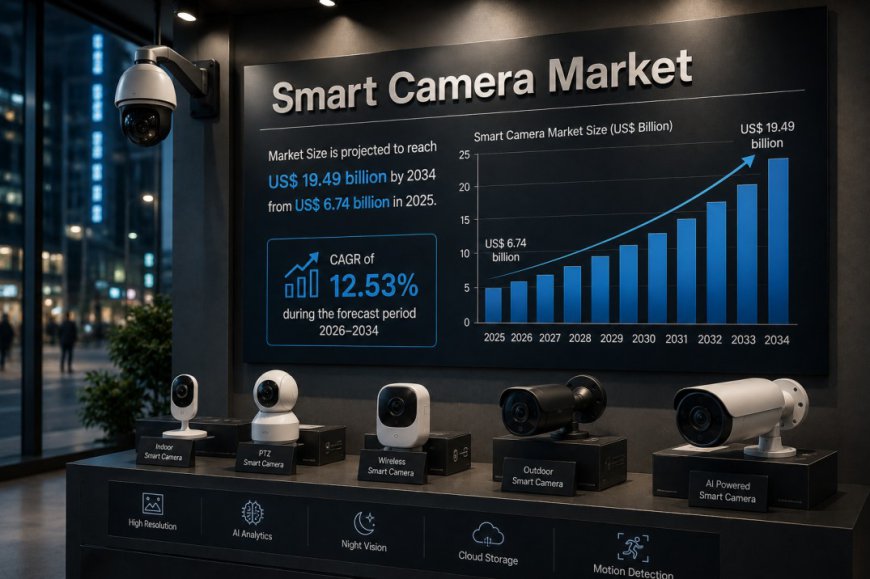
The global smart camera market size is projected to reach US$ 19.49 billion by 2034 from US$ 6.74 billion in 2025. The market is anticipated to register a CAGR of 12.53% during the forecast period 2026-2034.
 newswires
Smart cameras have emerged as an essential technology across industries by combining advanced imaging capabilities with embedded processing, artificial intelligence, and connectivity features. Unlike traditional cameras, smart cameras can analyze visual data, perform image processing, and generate actionable insights in real time. These capabilities make them valuable for applications ranging from industrial automation and quality inspection to surveillance, transportation, healthcare, and retail operations.
The growing adoption of artificial intelligence, machine vision, and Internet of Things (IoT) technologies has significantly expanded the scope of smart camera applications. Organizations are increasingly deploying intelligent imaging solutions to improve operational efficiency, strengthen security, automate processes, and enhance decision-making. As digital transformation accelerates globally, smart cameras are becoming a key component of connected ecosystems.
Smart Camera Market Overview
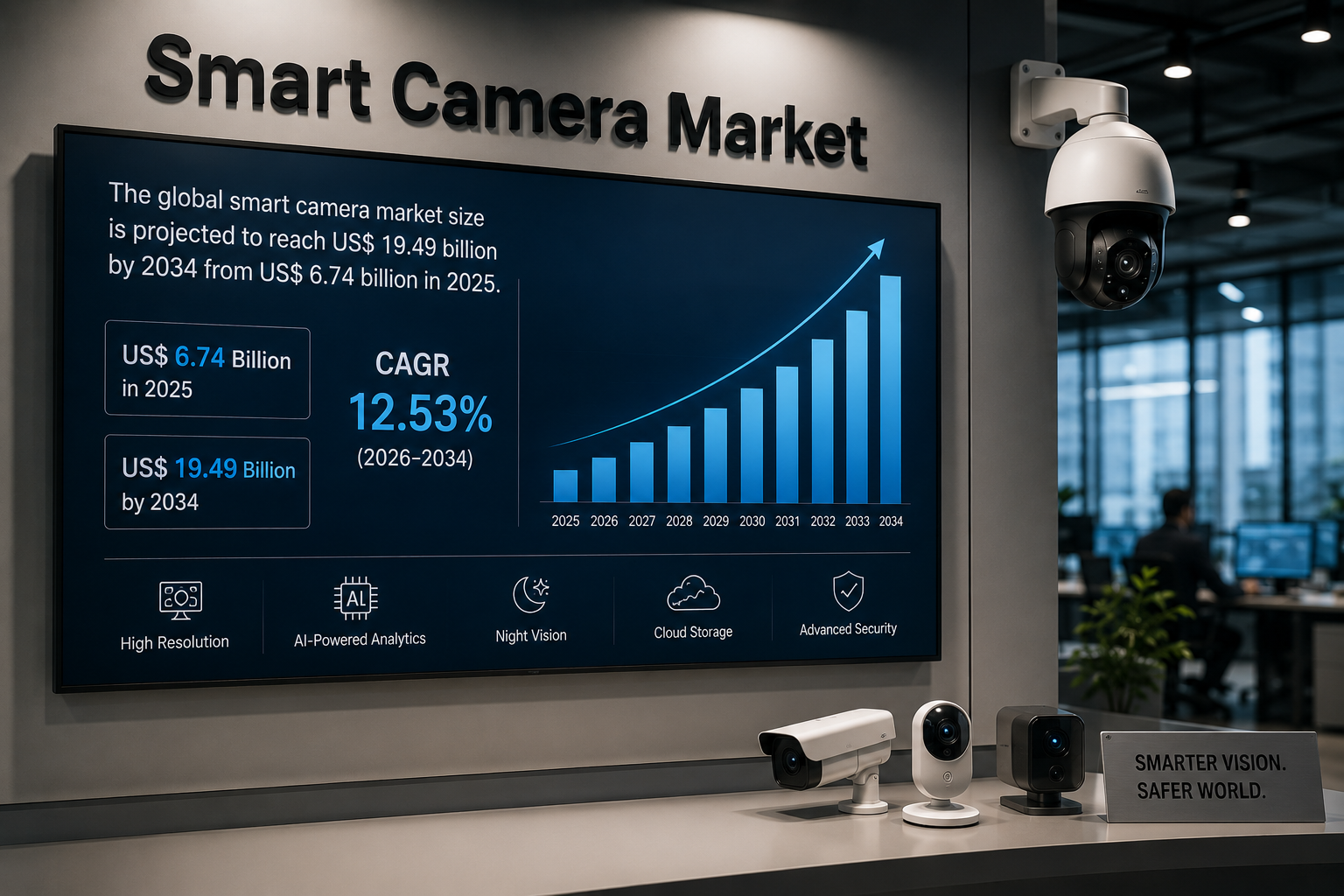
The Smart Camera Market is experiencing substantial growth due to increasing demand for intelligent surveillance solutions, industrial automation technologies, and AI-powered imaging systems. According to The Insight Partners, the global smart camera market size is projected to reach US$ 19.49 billion by 2034 from US$ 6.74 billion in 2025.
The market is anticipated to register a CAGR of 12.53% during the forecast period 2026–2034. Rising investments in machine vision technologies, smart city projects, and advanced security infrastructure are creating significant growth opportunities for market participants. The integration of edge computing, artificial intelligence, and cloud-based analytics is further driving adoption across multiple industries.
Market Drivers and Emerging Opportunities
Several factors are contributing to the growth of the Smart Camera Market. One of the primary drivers is the increasing adoption of intelligent surveillance systems across commercial, industrial, and public infrastructure environments. Organizations are seeking advanced security solutions capable of real-time monitoring, threat detection, and automated response capabilities.
The growing use of smart cameras in manufacturing and industrial automation is another key growth factor. These systems are being utilized for quality inspection, process monitoring, predictive maintenance, and robotic guidance applications. Their ability to deliver accurate visual data and automated analytics improves productivity while reducing operational costs.
Additionally, advancements in artificial intelligence and machine learning technologies are creating new opportunities within the market. Smart cameras equipped with AI-powered image recognition, facial recognition, object detection, and behavioral analytics capabilities are becoming increasingly valuable across industries such as retail, healthcare, transportation, and logistics.
Get a Sample PDF Report: https://www.theinsightpartners.com/sample/TIPRE00003618
Smart Camera Market Segmentation Analysis
The Smart Camera Market can be segmented based on technology, component, application, and end-user industry. Key components include image sensors, processors, memory systems, communication modules, and software platforms that enable intelligent image analysis and data processing.
Based on application, smart cameras are widely deployed across surveillance and security, industrial automation, transportation systems, healthcare facilities, retail environments, and smart city projects. Surveillance and security applications continue to account for a significant share due to increasing concerns regarding public safety and asset protection.
End-user industries include manufacturing, automotive, healthcare, transportation, retail, logistics, and government sectors. The increasing need for automation, operational visibility, and data-driven decision-making is accelerating smart camera adoption across these industries.
North America Smart Camera Market Analysis
North America remains one of the leading regions in the Smart Camera Market, supported by strong technological infrastructure, high adoption of advanced security solutions, and increasing investments in industrial automation. The region continues to witness substantial deployment of smart camera systems across manufacturing facilities, commercial establishments, transportation networks, and public infrastructure projects.
Organizations across North America are increasingly integrating artificial intelligence and machine vision technologies into their operations to enhance productivity, security, and operational efficiency. The region also benefits from the presence of leading technology companies, camera manufacturers, and AI solution providers that continue to drive innovation within the market.
The growing focus on smart city development and intelligent transportation systems is expected to create additional growth opportunities throughout the forecast period.
United States Market Trends and Growth Outlook
The United States plays a pivotal role in the North American Smart Camera Market. The country is witnessing strong demand for intelligent surveillance systems, industrial automation solutions, and AI-enabled imaging technologies across various sectors.
The expansion of smart infrastructure projects, increasing security investments, and rising deployment of automated manufacturing systems are supporting market growth. Retail organizations are utilizing smart cameras to enhance customer analytics and inventory management, while healthcare providers are adopting advanced imaging solutions for monitoring and patient care applications.
Furthermore, the growing adoption of edge computing technologies and connected devices is enabling more sophisticated smart camera deployments. These trends position the United States as a major contributor to technological advancement and market expansion within the global smart camera industry.
Recent Developments and Technological Advancements
The Smart Camera Market continues to evolve through rapid technological innovation and product development. Manufacturers are introducing advanced camera solutions equipped with artificial intelligence, deep learning algorithms, and edge computing capabilities to deliver faster and more accurate image analysis.
Machine vision systems are becoming increasingly sophisticated, supporting applications such as automated inspection, facial recognition, traffic monitoring, and predictive analytics. The integration of cloud connectivity and real-time data processing capabilities is further enhancing the functionality and scalability of smart camera systems.
Strategic collaborations, acquisitions, and product launches remain common across the industry as companies seek to strengthen their technological capabilities and expand their market presence.
Key Companies in the Smart Camera Market
Major companies operating in the Smart Camera Market include:
- Sony Group Corporation
- Canon Inc.
- Panasonic Holdings Corporation
- Teledyne Technologies Incorporated
- Cognex Corporation
- Basler AG
- Omron Corporation
- Hikvision Digital Technology Co., Ltd.
- Axis Communications AB
- Bosch Security Systems
These companies are focused on innovation, product enhancement, artificial intelligence integration, and strategic partnerships to strengthen their competitive positions in the market.
Competitive Landscape and Market Share Analysis
The Smart Camera Market is characterized by strong competition among global technology providers, imaging solution manufacturers, and industrial automation companies. Market participants are investing heavily in research and development to introduce advanced imaging technologies and intelligent analytics capabilities.
Competition is increasingly centered on artificial intelligence integration, edge processing performance, cybersecurity features, and cloud connectivity. Companies are also pursuing strategic acquisitions and partnerships to expand their product portfolios and strengthen geographic reach.
As demand for intelligent imaging solutions continues to grow, market participants are expected to focus on differentiation through innovation, reliability, and application-specific capabilities.
Future Outlook
The future of the Smart Camera Market appears highly promising, supported by increasing investments in artificial intelligence, machine vision, industrial automation, and smart infrastructure initiatives. The growing need for real-time analytics, enhanced security, and operational efficiency will continue to drive adoption across multiple industries.
Emerging technologies such as deep learning, edge AI, 5G connectivity, and advanced image processing are expected to further expand the capabilities of smart cameras. As organizations continue to prioritize automation, security, and digital transformation, the demand for intelligent camera systems is likely to remain strong throughout the forecast period.
Related Market Research Reports
Smart Roads Market Growth, Demand & Size by 2034
Automatic Fire Sprinkler Systems Market Size, Trends & Growth by 2034
About The Partners
Contact Us:
- Contact Person: Ankit Mathur
- E-mail:ankit.mathur@theinsightpartners.com
- Phone: +1-646-491-9876