Trade Finance Market Size and Share 2026 | USD 91.9 Billion by 2034
Overall‚ trade finance market values are projected to keep increasing by a small percentage annually until 2034
 torylanez27
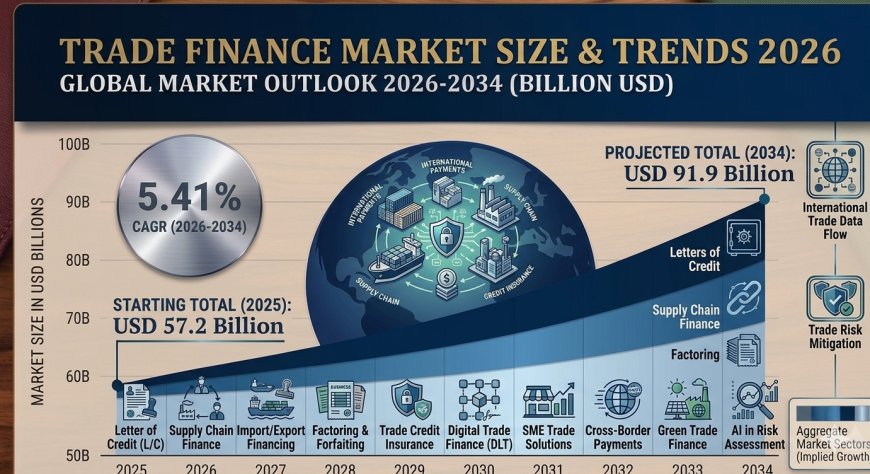
According to a research report by IMARC Group, the global trade finance market size was valued at USD 57.2 Billion in 2025. Looking forward, the market is estimated to reach USD 91.9 Billion by 2034, exhibiting a growth rate (CAGR) of 5.41% during 2026–2034. North America currently dominates the market. The market is experiencing steady growth driven by the growing volume of international trade, integration of artificial intelligence (AI) and data analytics to enhance risk assessment, and increasing complexity in global supply chains.
Market at a Glance
|
Report Attribute |
Key Statistics |
|
Base Year |
2025 |
|
Forecast Years |
2026–2034 |
|
Historical Years |
2020–2025 |
|
Market Size in 2025 |
USD 57.2 Billion |
|
Market Forecast in 2034 |
USD 91.9 Billion |
|
Market Growth Rate (CAGR) |
5.41% |
Request for a Sample Report for Detailed Evaluation: https://www.imarcgroup.com/trade-finance-market/requestsample
Key Trade Finance Market Trends Driving Expansion
Globalization and Increasing International Trade Volume
Perhaps the most important underlying trend driving the trade finance market today is the increasing globalization․ As companies of every size enter global markets‚ the need for guarantees‚ credit insurance and other secure trade-related financial instruments continues to grow substantially․ Trade credit insurance and letters of credit are becoming increasingly used for risk management․ The growth in e-commerce platforms is another way that more firms can trade internationally․ In 2023‚ the global e-commerce economy is valued at USD 21․1 Trillion and is estimated to have a compound annual growth rate (CAGR) of 27․16% between 2024 and 2032‚ to reach USD 183․8 Trillion by 2032․ The interdependence between countries and search for new markets means trade finance will remain a powerful enabler of the global economy․
Technological Advancements and Rapid Digitalization
Advanced digital technologies are transforming the trade finance ecosystem․ Blockchain is increasing transparency and security‚ and lowering the risk of fraud and error in supply chain finance and trade settlements․ Artificial Intelligence (AI) and Big Data are improving risk understanding‚ lending efficiency and closing the financing gap for SMEs․ A number of fintech entrepreneurs are developing unique new digital platforms to deliver specific value propositions to users․ On 21 November 2024‚ the Central Bank of Brazil signed a memorandum of understanding with Banco Inter‚ Microsoft Brazil‚ 7COMm‚ and Chainlink to run a DREX digital currency pilot to explore automating trade finance using blockchain through tokenized documentation and cross-border settlement using Chainlink's Cross-Chain Interoperability Protocol (CCIP)․
Evolving Regulatory Environment and Compliance Requirements
As governments and international organizations increase scrutiny of international trade due to the growth of financial crime and changing political / commercial environments‚ compliance with anti-money laundering (AML) and Know Your Customer (KYC) regulation has become increasingly complex‚ creating a demand for a trade finance that helps ease compliance․ The global e-KYC market size was valued at USD 673․2 Million in 2023 and is expected to reach USD 3398․5 Million by 2032‚ recording a CAGR of 19․71%․ This need for compliance with regulatory changes acts both as a driver and a challenge for the e-KYC market‚ due to the high investments required by the financial institutions in compliance management systems and technology-based verification solutions․
Supply Chain Complexity and the Need for Resilience
Modern‚ complex and highly fragmented global supply chains often include suppliers‚ logistics providers and intermediaries from multiple countries and continents․ This fragmentation means that supply chains face many risks‚ including natural disasters and political instability․ In response to this‚ companies are increasingly using trade finance products such as supply chain financing and trade credit insurance to manage supplier risk and working capital and strengthen supplier relationships․ According to the International Credit Insurance & Surety Association (ICISA)‚ an international credit insurance association‚ the global trade credit insurance market had a value of USD 13․89 Billion in 2022‚ protecting shipments of USD 7 Trillion worth of goods or 13․16% of total global goods trade indicating the importance of financial instruments to reduce supply chain uncertainty․
Trade Finance Market Segmentation Analysis
By Finance Type
• Supply Chain Finance
• Structured Trade Finance
• Traditional Trade Finance
Supply chain finance stands as the largest finance type segment in 2025 — driven by its unique ability to optimize working capital throughout the supply chain. Supply chain finance (SCF) allows companies to extend longer payment durations to their suppliers while enabling early payment options for those requiring liquidity. This approach is particularly beneficial for SMEs, simplifying access to affordable financing, supporting business growth, and strengthening supplier relationships within complex global supply chains.
By Offering
• Letters of Credit
• Bill of Lading
• Export Factoring
• Insurance
• Others
Letters of credit lead the offering segment in 2025 — providing a secure and universally accepted method for international trade transactions by guaranteeing seller payment upon presentation of compliant shipping documents. Their strong risk mitigation capability, particularly for parties entering new trade relationships or navigating uncertain trading environments, makes them indispensable. Irrevocable letters of credit are especially dominant due to their binding and non-cancellable nature for all parties involved.
By Service Provider
• Banks
• Trade Finance Houses
Banks lead the service provider segment with the largest market share in 2025 — benefiting from well-established global presences, extensive networks, and deep expertise in navigating complex trade regulations and compliance requirements. Banks offer a comprehensive range of trade finance services including letters of credit, trade credit insurance, and export financing. With 65.76% of people over 14 years of age holding bank accounts across 121 countries as of 2021 (World Bank), banks remain the first-choice partners for both buyers and sellers engaged in international trade.
By End-User
• Large Enterprises
• Small and Medium Sized Enterprises (SMEs)
Large enterprises represent the leading end-user segment in 2025 — owing to their extensive international trade activities, complex supply chains, and high transaction volumes. Trade finance serves as a critical tool for large enterprises in optimizing working capital, mitigating cross-border risks, and ensuring the smooth flow of goods and services. Their established relationships with major banks and financial institutions grant them access to a wide range of premium solutions including letters of credit, export financing, and trade credit insurance. The EU recorded 30.1 Million enterprises in 2021, with large enterprises employing over a third of the business labor force at 56 million employees (Eurostat).
By Region
• North America
• Asia Pacific
• Europe
• Latin America
• Middle East and Africa
North America leads the global market, accounting for the largest trade finance market share in 2025 — supported by a robust economy, substantial international trade volumes, and well-established banking institutions providing a comprehensive range of trade finance services. The region’s emphasis on technological innovation and digitalization is accelerating market growth, with the United States trade finance market specifically projected to exhibit a CAGR of 7.1% during 2024–2032. Government export promotion programs and favorable trade policies further reinforce North America’s dominant position.
Connect for Detailed Segmentation Analysis - Speak to an Analyst: https://www.imarcgroup.com/request?type=report&id=2031&flag=C
Competitive Landscape in the Trade Finance Industry
The global trade finance market features a highly competitive landscape shaped by major global banks and specialized financial institutions. Leading players are deploying AI and blockchain technologies to enhance service functionality, improve transparency, and streamline transaction efficiency. Key players are also prioritizing sustainable trade solutions aligned with ESG principles, while specialist trade finance houses are introducing customized products for specific industries such as structured trade finance and supply chain financing. A growing focus on SME inclusion is further reshaping the competitive environment by expanding access to financial instruments in international commerce.
Key Trade Finance Market Players Include:
• Asian Development Bank
• Banco Santander SA
• Bank of America Corp.
• BNP Paribas SA
• Citigroup Inc.
• Crédit Agricole Group
• Euler Hermes
• Goldman Sachs Group Inc.
• HSBC Holdings Plc
• JPMorgan Chase & Co.
• Mitsubishi UFJ Financial Group Inc.
• Morgan Stanley
• Royal Bank of Scotland
• Standard Chartered Bank
• Wells Fargo & Co.
Key Regional Insights
United States
The trade finance market in the U․S․ has a large trade partner network‚ deep financial markets‚ and is a leader in global trade overall․ As of Q3 2024‚ US Residents have foreign financial assets totaling USD 201․9 Billion more than the previous quarter․ The technology and agriculture industries‚ among many others‚ use trade finance products as an alternative after experiencing cash flow shortages‚ especially when competing in a dynamic international marketplace with other businesses․
Asia Pacific
This growth has applied to Asia Pacific‚ driven by the growth of SMEs‚ the high take up of e-commerce and government initiatives․ The Indian government will have allocated approximately USD 808 Million through its RAMP scheme to ease MSME access to markets and finance․ Sectors such as textiles‚ consumer electronics and consumer products use trade finance to a large extent․ Financial institutions are launching digital trade networks to service the region's fast-growing customer base․
Europe
The universal banking model in Germany consists of over 1679 banks and 25800 branches: strong liquidity position‚ diversified funding structure‚ and a leadership role in Europe's trade finance market are regional growth drivers․ Other growth drivers include developing sustainable trade finance products‚ green finance and the use of financial instruments in the automotive‚ pharmaceuticals and building materials sectors to support international trade․
Latin America
According to UNCTAD in 2022‚ inflow of FDI into Brazil increased by 69․9% (USD 86 Billion)‚ the second highest in history‚ with the sector also benefiting from liquidity and cross-border transactions․ In addition‚ growth in food processing‚ consumer electronics and textiles is further fuelling demand for trade finance across the region․
Middle East and Africa
According to the International Energy Agency‚ energy investment in the Middle East is expected to reach USD 175 Billion in 2024‚ with 15% of that destined for clean energy projects‚ strengthening energy markets and the foundations for trade finance in the region․ In November 2024‚ the African Development Bank approved a USD 4 Million trade finance guarantee to Access Bank Sierra Leone as part of a wider effort across Africa to expand SME access to global trade finance․
Market Drivers, Challenges & Opportunities
Major Market Drivers:
• Rapid globalization driving demand for secure financial instruments for cross-border trade.
• Integration of blockchain, AI, and data analytics streamlining trade finance processes.
• Rising focus on mitigating payment defaults and ensuring liquidity for exporters and importers.
Key Challenges:
• Increasingly complex AML and KYC regulatory requirements adding compliance costs.
• Persistent trade finance gap for SMEs in emerging markets limiting broader market participation.
Emerging Opportunities:
• Significant untapped potential in emerging markets across Asia Pacific, Latin America, and Africa.
• Growing fintech innovation enabling digital trade platforms and automated financing solutions.
• Expanding green trade finance and ESG-aligned financial instruments supporting sustainable commerce.
Latest Market Developments
• December 2024: HSBC and the World Bank’s IFC launched a USD 1 Billion trade finance program to support emerging markets, strengthen cross-border trade, and enhance exports in vital sectors while addressing global supply chain challenges.
• December 2024: Modifi allocated a significant portion of its USD 15 Million Series C funding to expand trade finance operations and improve accessibility for SMEs in global trade.
• December 2024: The International Islamic Trade Finance Corporation (ITFC) and ESCAP partnered to enhance exports in Central Asia through the Trade Connect Central Asia+ (TCCA+) Program, driving FDI and sustainable development.
• November 2024: The African Development Bank approved a USD 4 Million trade finance guarantee for Access Bank Sierra Leone, enhancing SME access to financing and bolstering Sierra Leone’s private sector.
• November 2024: Mashreq partnered with British International Investment (BII) to establish a USD 50 Million trade finance facility enhancing cross-border trade in South Asia and Africa across markets including Angola, Bangladesh, and Ivory Coast.
Conclusion: Trade Finance Market Outlook to 2034
Overall‚ trade finance market values are projected to keep increasing by a small percentage annually until 2034‚ alongside higher global trade volumes‚ faster digitalisation‚ supply chain resilience and financial inclusion policies․ The use of blockchain technology‚ artificial intelligence and fintech products and services to expand the trade finance market will increase efficiency‚ transparency and accessibility for businesses․
With North America accounting for the majority of spend‚ but Asia Pacific growing at the fastest rate‚ the future of the trade finance market presents opportunities to be captured by financial institutions‚ fintechs and businesses looking to serve their customers in the global trade ecosystem․
About the Author
IMARC Group is a leading global market research company providing data-driven insights and expert consulting services to businesses seeking to achieve their strategic objectives. With a multi-disciplinary team of industry experts, IMARC delivers thorough, reliable market intelligence across sectors including Technology, Construction, Healthcare, Energy, Food & Beverages, and more.
Media & Sales Contact
IMARC Group
United States: +1-201-971-6302
India: +91-120-433-0800
United Kingdom: +44-753-714-6104