Turnstile Speed Gates for Every Industry in UAE
 TekYousuf26
UAE facility managers across offices, airports, hospitals, and stadiums are upgrading entry security with Turnstile Speed Gates that verify every entry in a fraction of a second, replacing the mix of manned checkpoints and slow mechanical gates that struggle to keep pace with modern traffic. As every industry competes on both security and experience, a fast, secure, and visually polished entry process has become a genuine differentiator rather than a purely operational decision.
Why Every Industry in the UAE Is Upgrading Entry Security?
High-traffic entry points across sectors as varied as commercial towers, airports, hospitals, stadiums, and industrial plants all face a similar set of pressures: peak-hour crowds need to clear quickly without compromising who is allowed through, operators need an auditable record of occupancy, and visitors increasingly expect the same touchless, frictionless entry experience regardless of which industry they are walking into. A well-specified speed gate answers all three at once, provided the configuration matches the site's actual traffic pattern rather than a generic, one-size-fits-all fit-out.
Tektronix LLC has supplied and commissioned entry security infrastructure for developments linked to G42, DIFC, RTA Dubai, and EXPO 2020, giving the company direct, on-the-ground experience with the traffic volumes and operational expectations typical of Gulf facilities across multiple sectors. That experience shapes how turnstile projects are specified today, as one component of an integrated entry strategy spanning credentialing, biometric verification, and building management integration, rather than a standalone gate purchase.
Understanding Turnstile Access Control for Corporate Lobbies
At its core, Turnstile Access Control ties a physical barrier to an identity-verification decision, only allowing a lane to open once a credential, badge, or biometric match has been confirmed, rather than relying on a receptionist's visual judgment alone.
How Turnstile Access Decisions Are Made
A reader or camera captures a credential as a person approaches, the access control platform checks it against permissions tied to that person's profile, and a grant or deny signal releases or locks the mechanical or glass barrier within milliseconds of the check completing.
Comparing Turnstile Types by Security Level
Not every lobby needs the same level of physical resistance. Reception areas prioritizing throughput often choose a lighter barrier style, while server rooms, executive floors, or perimeter entrances handling unescorted public traffic typically warrant a taller, harder-to-bypass configuration.
Tripod Turnstile Gates for Cost-Effective Lobby Control
Among the most common entry-level options are Tripod Turnstile Gates, a compact, waist-height barrier with rotating arms that has long served as the standard for budget-conscious commercial lobbies and staff entrances.
Mechanical Design and Use Cases
A simple rotating arm mechanism makes tripod units inexpensive to install and maintain, suiting low-to-moderate traffic staff entrances, warehouse offices, and secondary building access points where a lighter visual footprint is preferred over a more imposing gate.
Where Tripod Gates Fall Short
Because the barrier sits at waist height, a determined individual can climb or duck under it, which is why tripod gates are rarely specified as the sole security layer for high-value assets, and instead work best paired with guard oversight or CCTV coverage.
Full Height Turnstile Gates for Maximum Perimeter Security
At the opposite end of the security spectrum sit Full Height Turnstile Gates, floor-to-ceiling rotating barriers that physically prevent climbing or crawling under, commonly deployed at unmanned perimeter entrances where no receptionist is present to intervene.
Structural Design and Anti-Climb Features
Full-height units typically rotate within an enclosed cage structure, only admitting one verified person per rotation, and are engineered to resist both climbing and reverse entry attempts far more effectively than a waist-high barrier.
Applications in Data Centers and Critical Infrastructure
Data centers, utility substations, and other unmanned or lightly staffed critical sites favor this configuration precisely because it functions as a genuine physical barrier rather than a polite suggestion, an important distinction for facilities with a low tolerance for unauthorized access.
Flap Barrier Turnstile Gates for High-Traffic Lobbies
For premium corporate lobbies balancing security with a polished aesthetic, Flap Barrier Turnstile Gates use retractable glass panels that swing open only after a valid credential check, combining a sleek architectural look with fast, high-volume throughput.
Glass Panel Design and Aesthetics
Tempered glass panels integrate naturally into marble-and-glass lobby designs favoured by Grade-A office towers, avoiding the utilitarian, industrial look that heavier mechanical barriers can bring to a high-end reception area.
Throughput Speed and Peak-Hour Performance
Fast-cycling panels open and close in well under a second, allowing a single lane to process a steady stream of verified employees during morning peak arrival without the queues that slower turnstile mechanisms tend to create.
Intelligent Facial Recognition Turnstiles: The Convergence of Speed and Biometrics
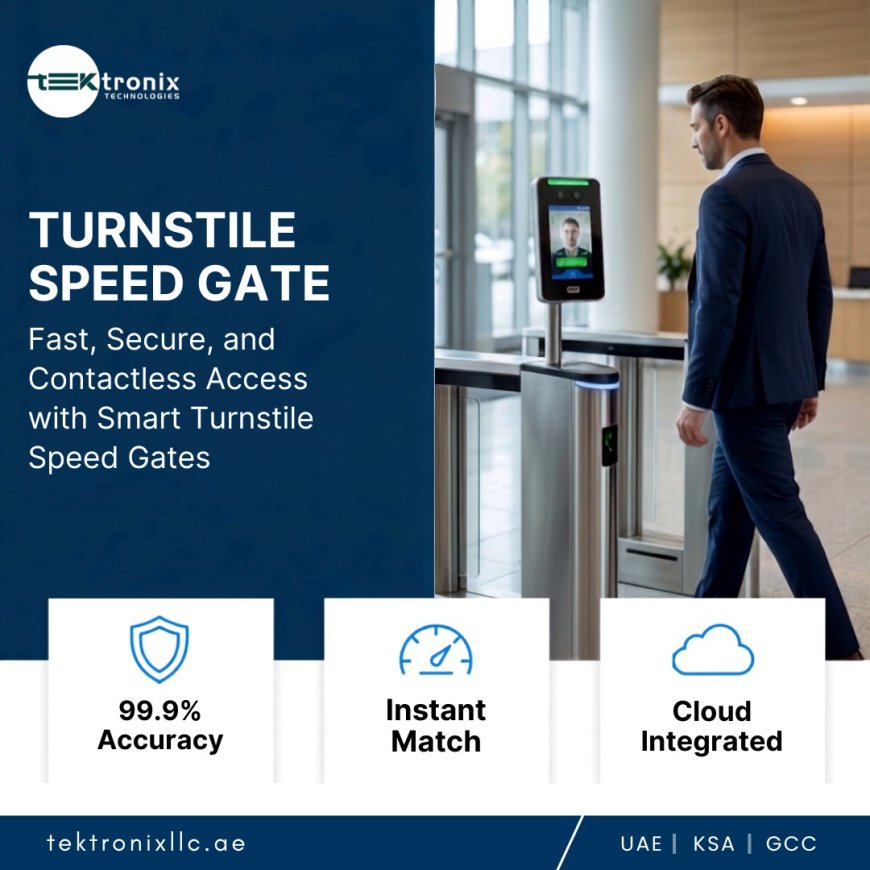
The newest generation of lobby security combines the barrier itself with onboard biometric matching. Intelligent Facial Recognition Turnstiles authenticate an approaching employee's face and release the barrier in the same motion, removing the badge tap entirely from the daily entry routine.
Integrated Cameras and Matching Engines
A camera mounted directly on the turnstile head captures and matches a face as the employee walks up, feeding a grant or deny decision to the barrier mechanism without a separate reader or a pause in the person's stride.
Touchless Entry for Tenant Experience
Beyond security, tenants increasingly view touchless, badge-free entry as a workplace amenity in its own right, one that building owners can market alongside other premium lobby features when attracting new corporate occupiers.
Biometric Turnstiles Beyond Facial Recognition
Facial matching is not the only biometric option available. Biometric Turnstiles can also incorporate fingerprint or multimodal verification, useful for sites where facial capture is impractical, such as staff wearing required protective equipment or masks in certain industrial settings.
Fingerprint and Multimodal Verification
Fingerprint readers remain a reliable fallback or primary method at sites where consistent lighting for facial cameras is difficult to guarantee, while multimodal systems combine two biometric factors for the small number of doors that warrant an extra layer of assurance.
Choosing the Right Modality for Your Site
Selecting between facial, fingerprint, or a combined approach depends on the site's environment, workforce habits, and the sensitivity of the area being protected, rather than defaulting to whichever modality is currently most fashionable in the market.
Selecting the Right Turnstile Configuration for Your Building
Lane width, barrier type, and biometric integration all need to be matched to a building's actual employee count, visitor volume, and peak-hour arrival pattern rather than chosen from a standard catalogue configuration applied uniformly across every project.
Lane Width and Throughput Planning
A short traffic count during the site assessment, covering typical and peak-hour volumes, determines how many lanes a lobby actually needs and whether a faster flap barrier justifies its higher cost over a simpler tripod configuration for that specific building.
Integration with Access Control and Visitor Management Software
Linking turnstile controllers to a central access control or visitor management platform allows security teams to manage tenant permissions, issue temporary visitor passes, and pull a unified entry report across every lane, rather than reconciling separate logs gate by gate.
Industry Use Cases Across Every UAE Sector
Multi-Tenant Office Towers
Landlords use turnstiles to segment access by floor and company without requiring a receptionist to manually verify every visitor, while giving building management a clear occupancy record for fire safety and compliance purposes.
Banking and Financial Institutions
Financial firms often specify full-height or biometric-enabled lanes for back-office and trading floor entrances, where an auditable, individually verified access record supports both internal policy and external regulatory review.
Data Centers and Government Facilities
Unmanned or lightly staffed critical sites lean on full-height, anti-climb configurations paired with CCTV and intrusion detection, treating the turnstile as a genuine physical control rather than a courtesy barrier.
Airports and Transportation Hubs
Terminal buildings and transit stations rely on high-throughput flap barrier or biometric lanes to process large passenger volumes quickly while still enforcing ticketed or credentialed access at every gate.
Healthcare Facilities
Hospitals and clinics use turnstiles to restrict staff-only wings, pharmacy stores, and record archives, supporting patient-data and controlled-substance security policies without slowing general visitor flow through public areas.
Education Campuses
Universities and schools deploy turnstiles at main gates and dormitory entrances to verify students and staff quickly during peak arrival windows while maintaining an accurate on-site roster for safety purposes.
Stadiums, Arenas, and Event Venues
Large event venues depend on rapid-cycling lanes to process thousands of ticketed attendees within a tight pre-event window, making throughput speed as critical a specification factor as security itself.
Industrial Plants and Logistics Facilities
Manufacturing sites and warehouses use ruggedized turnstiles at staff and contractor entrances, often paired with time-attendance integration to simplify shift-based workforce management alongside physical access control.
Business Parks and Free Zones
Multi-building business park campuses use a shared turnstile and credential platform across several lobbies, giving tenants a single access badge or biometric profile that works consistently throughout the entire development.
Compliance, Safety Standards, and Regional Regulatory Fit
SIRA-regulated facilities and master-developer communities across Dubai and Abu Dhabi increasingly expect documented proof that lobby access infrastructure meets defined safety interlocks, fire-egress requirements, and data-handling standards for any biometric information collected. Working with an integrator experienced in local approval processes, including coordination with civil defense authorities on emergency egress design, shortens the path from design to handover and avoids costly rework after a site inspection flags a non-compliant configuration.
Total Cost of Ownership: Turnstiles Versus Manned Reception Desks
A staffed reception desk carries an ongoing payroll cost around the clock, along with the inconsistency that comes from shift changes and the practical limits of a receptionist manually verifying dozens of unfamiliar faces during a busy morning. An automated turnstile, once commissioned, replaces the bulk of that routine screening workload with a consistent, logged process, while still allowing a reduced front-desk presence for visitor handling and exceptions. Facility teams comparing the two options typically find that automation pays back its installation cost within a reasonable period once reduced staffing hours and a stronger audit trail are factored into the calculation.
Deployment Roadmap: What to Expect
Site Assessment and Lobby Planning
Installers assess lobby footprint, ceiling height, power and network availability, and expected traffic volume before finalizing lane count and barrier type, ensuring the finished installation fits both the architectural design and the building's real occupancy pattern.
Installation and Commissioning
Physical installation is typically followed by sensor calibration, safety interlock testing, and integration with any connected access control, visitor management, or biometric enrollment platform before the lobby is handed over for live use. Facilities exploring a full upgrade can review Tektronix LLC's turnstile speed gate solutions to see how hardware, software, and biometric integration are typically packaged for a single, coordinated rollout.
Ongoing Maintenance and Support
Scheduled maintenance visits check motor wear, sensor alignment, and biometric camera calibration, since these components see continuous mechanical and environmental stress over months of daily cycling. A responsive local support contract keeps any single-lane fault from disrupting the entire lobby during peak hours.
Common Mistakes to Avoid When Specifying Turnstiles
The most frequent misstep is choosing a barrier type based on architectural appearance alone without confirming it matches the building's actual security requirement, leaving high-value floors protected by nothing sturdier than a waist-high arm. A second common issue is neglecting integration planning, resulting in a turnstile that operates in isolation from the building's existing access control and visitor management systems.
A third mistake is underestimating peak-hour traffic when sizing lane count, leading to lobby queues that undermine the very convenience the upgrade was meant to deliver. Finally, some projects skip fire-egress and civil defense coordination during design, creating compliance issues that are far more expensive to resolve after installation than during initial planning.
Enhancing Turnstile Security with Complementary Technologies
A turnstile alone only controls whether a barrier opens; it cannot always prevent a second person from slipping through immediately behind an authorized employee, a vulnerability commonly known as tailgating. Layering the right complementary sensors and integrations closes this gap without slowing down legitimate traffic.
Anti-Tailgating and Piggybacking Detection
Infrared sensor arrays mounted within the turnstile lane can detect when more than one person passes on a single verified credential, triggering an alarm or a locked barrier rather than silently allowing an unauthorized second entry. This is particularly valuable at full-height and flap barrier lanes handling higher security clearances, where a single tailgating incident could otherwise defeat the entire access control investment.
CCTV and Access Event Correlation
Tying turnstile access logs to nearby CCTV footage allows a security team to visually confirm any flagged event, whether a tailgating alarm or a denied-access attempt, without manually cross-referencing separate systems. Many modern platforms timestamp both data sources together, letting an operator pull the exact video clip associated with any specific access event in seconds.
Frequently Overlooked Operational Details
Beyond the barrier hardware itself, a handful of operational details determine whether a turnstile rollout actually improves lobby security or simply adds a new point of daily friction. Cleaning staff, couriers, and other short-visit personnel need a clear, low-friction credentialing path that does not require full employee-style enrollment, since forcing every occasional visitor through the same process as staff quickly generates front-desk complaints.
Battery backup and fail-safe versus fail-secure behaviour during a power outage also deserve early planning, since a turnstile that defaults to locked during an outage can create an unsafe bottleneck during an emergency evacuation if not configured correctly. Finally, seasonal and event-driven capacity planning matters for towers hosting frequent conferences or large tenant events, where a lobby sized comfortably for daily traffic can still create bottlenecks unless additional temporary lanes or staffed overflow procedures are planned in advance.
Regional Adoption: Turnstile Speed Gates UAE and Dubai Deployments
Demand for a properly integrated Turnstile Speed Gates UAE wide has grown alongside the country's continued commercial tower development, with new Grade-A office buildings increasingly specifying biometric-ready lobby infrastructure at the design stage rather than retrofitting it after tenant fit-out. A Turnstile Speed Gates Dubai landlord deploy frequently pairs flap barrier aesthetics with facial recognition to suit the emirate's premium commercial towers, while government-linked facilities in Abu Dhabi favour full-height, anti-climb configurations reflecting the more security-sensitive nature of those sites.
Conclusion
UAE facilities across every industry modernizing entry security increasingly specify Turnstile Speed Gates paired with layered Turnstile Access Control across every entry point. Budget-conscious lobbies often start with Tripod Turnstile Gates, while unmanned perimeters and data centers require Full Height Turnstile Gates for genuine anti-climb protection. Premium developments favour Flap Barrier Turnstile Gates for their aesthetics, increasingly paired with Intelligent Facial Recognition Turnstiles for touchless entry. Where facial capture is impractical, Biometric Turnstiles supporting fingerprint or multimodal verification keep security consistent across every workforce and environment. Businesses evaluating a Turnstile Speed Gates Dubai or wider Turnstile Speed Gates UAE project can review the full lineup on Tektronix LLC's turnstile speed gates service page.
FAQs
1. What is the difference between a tripod and a full-height turnstile?
A tripod turnstile is a waist-height barrier suited to staffed or lower-security lobbies, while a full-height turnstile is a floor-to-ceiling enclosure designed to physically prevent climbing or crawling under, making it the stronger choice for unmanned or high-security entrances.
2. Can facial recognition be added to an existing turnstile installation?
In many cases yes, provided the turnstile controller supports third-party reader integration. A site assessment confirms whether existing hardware can accept a camera and matching engine retrofit or whether a full turnstile replacement is more practical.
3. How many lanes does a typical office lobby need?
Lane count depends on peak-hour arrival volume rather than total employee headcount, since most staff arrive within a concentrated morning window. A short traffic study during site assessment is the most reliable way to size lane count correctly.
4. Do turnstiles create a safety issue during a fire evacuation?
Properly designed systems fail open during a fire alarm trigger, allowing free egress without requiring a credential check, and civil defense coordination during design ensures the installation meets local emergency egress requirements.
5. How long does a typical turnstile installation take?
A standard single or dual-lane lobby installation with civil works already prepared is usually completed within a few days, while multi-lane sites with biometric integration and custom architectural finishes can extend the timeline to several weeks.