HID Amico for Offices, Campuses, and Enterprises Across the UAE
 TekYousuf26
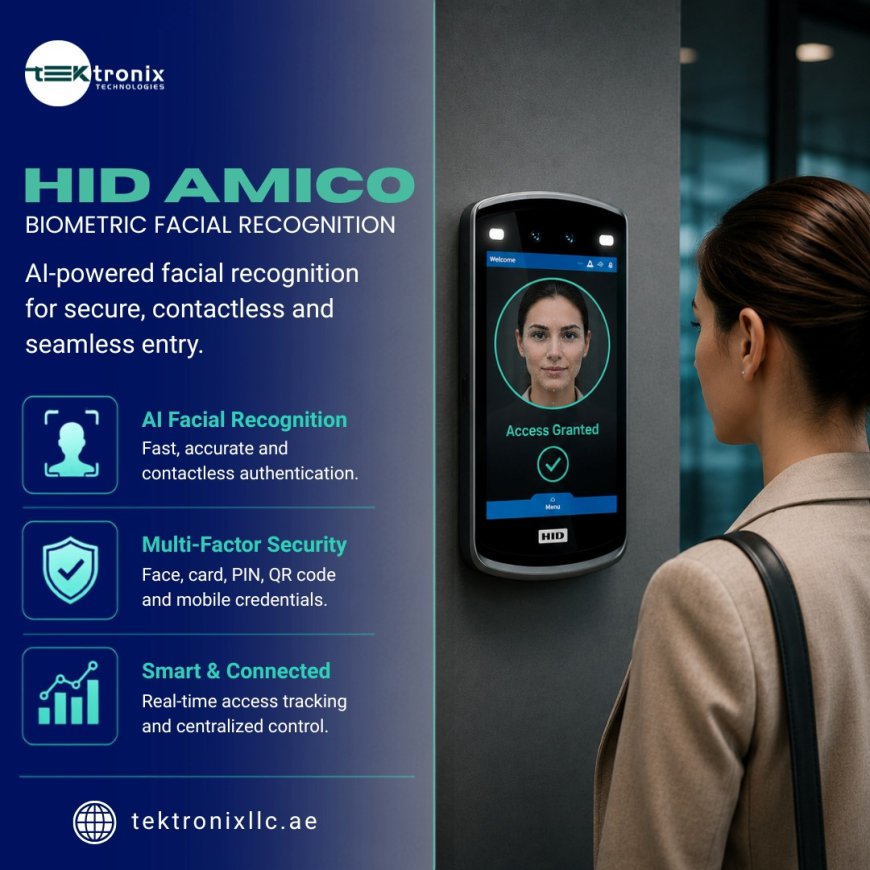
UAE enterprises, universities, and government-linked facilities are standardizing on HID Amico to secure entry points with biometric accuracy rather than cards that can be lost, cloned, or shared. As tenants and staff expect faster, touchless verification, this generation of facial authentication hardware is becoming the benchmark for offices, campuses, and enterprises modernizing their access control strategy.
Why UAE Enterprises Are Standardizing on HID Amico
Large office campuses, university buildings, and multi-tenant towers across Dubai and Abu Dhabi share a common set of pressures: rising scrutiny over who can reach sensitive zones, tenant demand for frictionless entry, and a genuine administrative cost tied to issuing, replacing, and revoking physical badges at scale. Biometric authentication addresses all three by tying every access event to a verified individual rather than an anonymous card number that could belong to anyone holding it.
Tektronix LLC has implemented this hardware across developments linked to G42, DIFC, RTA Dubai, and EXPO 2020, giving the company practical, on-the-ground experience with high-footfall public and corporate environments well before HID Amico became a dedicated service focus. That deployment history shapes how projects are specified today, weighing camera placement, network architecture, and enrollment workflow together rather than treating the reader as an isolated hardware purchase.
HID Amico Facial Recognition: Core Technology Overview
At the center of the platform is HID Amico Facial Recognition, an engine built to run both one-to-one verification and one-to-many identification workflows depending on how a specific door or lane is configured.
Matching Accuracy and Speed
Matching decisions typically complete in well under a second, even against enrolled databases numbering in the thousands, a critical requirement for lobby turnstiles processing a steady stream of staff during peak morning arrival.
Enrollment and Template Management
New users are enrolled in seconds through a guided capture process, with templates stored as encrypted mathematical representations rather than raw photographs, and administrators able to deactivate a template instantly the moment someone leaves the organization.
The HID Amico Facial Recognition Reader: Hardware Deep Dive
The physical unit installed at each door, the HID Amico Facial Recognition Reader, combines a camera, infrared sensors, and onboard processing power sufficient to make a match decision without depending on a constant connection to a distant server.
Camera and Sensor Specifications
Wide dynamic range optics compensate for challenging lighting conditions such as a glass-fronted lobby with strong backlighting, while infrared sensors support accurate recognition even in low ambient light or after dark.
Mounting and Environmental Ratings
Units destined for covered outdoor entrances or gatehouses typically carry IP65-rated enclosures protecting against dust and moisture, while indoor lobby installations can prioritize a slimmer form factor suited to a polished reception aesthetic.
HID Aero Controller Integration for Enterprise Access Control
Facial data alone doesn't secure a door; it needs a controller layer to enforce policy. The HID Aero Controller fills this role, communicating with Amico readers over secure OSDP channels and issuing real-time grant-or-deny decisions to electric strikes, maglocks, and turnstile mechanisms.
Communication Protocols and Door Hardware Compatibility
Because the controller supports both legacy Wiegand credentials and modern biometric templates side-by-side, buildings can migrate floor-by-floor rather than replacing an entire access control deployment in a single disruptive project.
Migrating from Legacy Credentials
A phased rollout typically runs badge and biometric credentials in parallel for a short transition window, giving latecomers and visiting staff a grace period before the organization fully retires its card-based system.
HID Access Control as a Unified Enterprise Platform
Beyond any single door, HID Access Control functions as the administrative layer tying every reader, controller, and credential type across a campus into one consistent policy engine, rather than a collection of independently managed devices.
Centralized Policy Management
Security administrators can define access schedules, floor restrictions, and emergency lockdown rules from a single console, pushing changes to every connected door instantly rather than reconfiguring hardware individually at each location.
Reporting and Compliance Logging
Every access event, granted or denied, is logged with a timestamp and identity, giving compliance teams an audit-ready record for internal policy reviews or external regulatory inspections without manually reconciling separate door logs.
HID Mobile Access for Credential-Free Convenience
For staff who prefer not to enroll biometrically at every location, HID Mobile Access turns a smartphone into a credential, using Bluetooth or NFC to communicate with a reader from a short distance without requiring a physical card at all.
Phone-Based Credentials and BLE/NFC
A mobile credential can be issued and revoked remotely the same way a facial template is, giving IT and security teams a fast, contactless option for visiting staff, contractors, or employees between full biometric enrollment.
Combining Mobile and Facial Authentication
Pairing a mobile credential with a facial check at especially sensitive doors creates a genuine two-factor control, since an intruder would need both the phone and a matching face to gain entry.
AI-Powered Anti-Spoofing: Defeating Presentation Attacks
A photograph, printed mask, or video replay is not enough to trick a properly configured reader. AI-Powered Anti-Spoofing analyzes subtle depth, texture, and motion cues to confirm a genuine three-dimensional face is present before any match attempt proceeds.
Depth Sensing and Infrared Analysis
Combining depth sensing with infrared imaging lets the reader distinguish a live face from a flat printed photo or a screen displaying a video, closing off the simplest presentation attacks that plague camera-only facial systems.
Photo, Video, and Mask Attack Resistance
More sophisticated attempts, including 3D printed masks or high-resolution video replay, are screened against texture and micro-movement patterns that are extremely difficult to replicate convincingly in real time.
Liveness Detection: Confirming a Real, Present Person
Closely related to anti-spoofing, Liveness Detection specifically verifies that a live, present individual, rather than any static or replayed representation, is standing in front of the camera at the moment of the access request.
How Liveness Checks Work in Real Time
The reader looks for natural micro-movements, subtle changes in skin texture under infrared light, and consistent depth response, all processed in the same fraction of a second as the matching decision itself.
Balancing Security and Speed
A well-tuned liveness check adds negligible delay to the overall transaction, meaning employees experience the same fast, touchless entry while the system quietly performs an additional layer of fraud prevention behind the scenes.
Selecting the Right HID Amico Configuration for Your Site
Not every door needs the same hardware or authentication combination. A busy lobby turnstile prioritizes speed and one-to-many identification, while a server room may warrant slower, more deliberate one-to-one verification paired with a mobile or badge credential.
Indoor Versus Outdoor Deployments
Covered drop-off canopies and open-air staff entrances need weatherproof, glare-resistant hardware, while interior lobby devices can prioritize a slimmer, more discreet form factor since they are shielded from direct sun and rain.
Vendor Evaluation Criteria
Procurement teams should weigh matching accuracy under real lobby conditions, anti-spoofing robustness, integration flexibility with existing building systems, and a vendor's demonstrated experience with comparable local deployments rather than selecting on hardware price alone.
Industry Use Cases Across UAE Enterprises
Corporate Office Towers
Landlords and tenant companies use biometric readers to segment floor access without issuing a fresh badge for every new hire, streamlining onboarding across fast-growing tenant rosters in multi-tenant towers.
Educational Campuses
Universities and international schools deploy facial verification at main gates and dormitory entrances to confirm students and staff quickly during peak arrival windows while maintaining a real-time roster of who is on site.
Government and Semi-Government Facilities
Ministries and government-linked entities favour biometric checkpoints for restricted floors and control rooms, where the risk of a shared or cloned badge represents an unacceptable exposure.
Data Centers and Critical Infrastructure
Data center operators combine facial verification with mantrap doors and CCTV to ensure only authorized personnel physically reach server racks, an increasingly standard expectation from enterprise clients auditing their colocation providers.
Data Privacy, Compliance, and Regional Regulatory Fit
Enterprises handling employee biometric data are expected to demonstrate reasonable safeguards: encrypted template storage rather than raw image retention, role-based administrative access, and clear policies on how long data is kept after an employee departs. As UAE data protection expectations continue to mature, facilities that can produce a documented data-handling policy alongside their access logs are better positioned to satisfy both internal audit committees and external regulatory reviews, particularly in SIRA-regulated sectors where structured reporting is already the norm.
Total Cost of Ownership: HID Amico Versus Traditional Card Systems
Card systems carry a recurring cost that is easy to overlook at procurement time: replacement cards for loss or damage, reception time spent issuing and deactivating credentials, and periodic reader upgrades as card technology ages. A biometric credential removes that consumable entirely, since the enrolled employee is the credential. Facility teams modeling the switch typically weigh eliminated card-stock spend and reduced administrative time against the incremental hardware and software cost, with many mid-size office towers reaching payback within two to three years once the stronger audit trail and reduced help-desk tickets are factored in.
Regional Adoption: HID Amico UAE and Dubai Deployments
Demand for a properly integrated HID Amico UAE wide has grown alongside the pace of new commercial towers and university campuses, with facility owners increasingly specifying biometric-ready infrastructure at the design stage rather than retrofitting it after tenant fit-out. A HID Amico Dubai enterprises deploy frequently pairs multi-tenant access segmentation with mobile credentialing, reflecting the emirate's dense concentration of multinational occupiers, while government-linked facilities in Abu Dhabi favour heavier compliance documentation and stricter data governance controls reflecting the more security-sensitive nature of those sites.
Conclusion
UAE enterprises seeking stronger workplace security increasingly standardize on HID Amico, combining HID Amico Facial Recognition with a purpose-built HID Amico Facial Recognition Reader at every entry point. Behind the scenes, the HID Aero Controller and a unified HID Access Control platform enforce consistent policy across every door. Staff increasingly rely on HID Mobile Access for credential-free entry, protected by AI-Powered Anti-Spoofing and continuous Liveness Detection against fraud. Businesses evaluating HID Amico Dubai or wider HID Amico UAE projects can review the full lineup on Tektronix LLC's HID readers and controllers service page.
FAQs
1. Can HID Amico work alongside an existing badge-based access control system?
Yes. Most deployments run facial recognition alongside existing card readers during a transition period, and many organizations continue using badges or mobile credentials as a secondary factor for their highest-security doors.
2. How does the system prevent someone from using a photo to trick the reader?
Combined anti-spoofing and liveness checks analyze depth, texture, and subtle movement in real time, confirming a live, three-dimensional face is present before any match attempt is made, which defeats printed photos, screen replays, and most mask-based attacks.
3. What happens to an employee's facial data if they leave the company?
A properly configured platform allows administrators to deactivate and delete an enrolled template immediately upon offboarding, so departing employees are removed from the system as part of the standard exit process.
4. Is mobile access as secure as a facial or badge credential?
Mobile credentials use encrypted Bluetooth or NFC communication and can be revoked instantly from a central platform, making them comparable in security to a badge while adding the convenience of not needing a physical card.
5. How long does a typical HID Amico rollout take for a mid-size office tower?
For a single building with a moderate number of doors, installation and enrollment is commonly completed within a few weeks, while larger multi-tower portfolios with deeper HR system integration can extend the timeline to a couple of months.