Video Analytics Fire & Smoke Detection for Offices & Corporate Towers in Oman & GCC
 TekYousuf26
A fire on the fortieth floor of a corporate tower behaves nothing like one in a single-storey warehouse, with smoke migration patterns and evacuation logistics that make early, precise detection considerably more valuable in a high-rise setting. Video Analytics gives office towers across Oman and the wider GCC a way to detect fire and smoke hazards earlier than conventional systems allow, and corporate facilities reviewing video analytics solutions for high-rise fire safety are finding that the earlier warning window matters disproportionately once a building reaches meaningful height.
Office towers and corporate headquarters across Muscat, Riyadh, Doha, and the wider GCC region increasingly specify fire detection infrastructure that accounts for the genuine complexity tall buildings introduce. Vertical smoke migration, phased evacuation logistics, and the sheer number of tenants and floors a single incident can affect all combine to make early detection more consequential in a high-rise corporate tower than in almost any other commercial building type.
Why High-Rise Corporate Towers Present Unique Fire Detection Challenges
A single-storey building's fire safety planning centres on a relatively straightforward evacuation to ground-level exits. A forty-storey office tower faces an entirely different logistical reality, where full simultaneous evacuation of every floor would create dangerous stairwell congestion, making phased, floor-by-floor evacuation the standard approach for genuinely tall buildings.
That phased approach depends heavily on knowing precisely where a hazard originated and how it's likely to spread, information that traditional point-sensor detection provides with meaningful delay compared to camera-based systems that identify a hazard's visual signature the moment it becomes visible within coverage.
Building height also affects fire service response logistics directly, since reaching upper floors takes considerably longer for responding firefighters than accessing a ground-level or low-rise incident, making the additional detection lead time video analytics provides genuinely valuable in narrowing the gap between ignition and the arrival of an effective emergency response.
How AI-Powered Video Analytics Detects Hazards in Office Towers
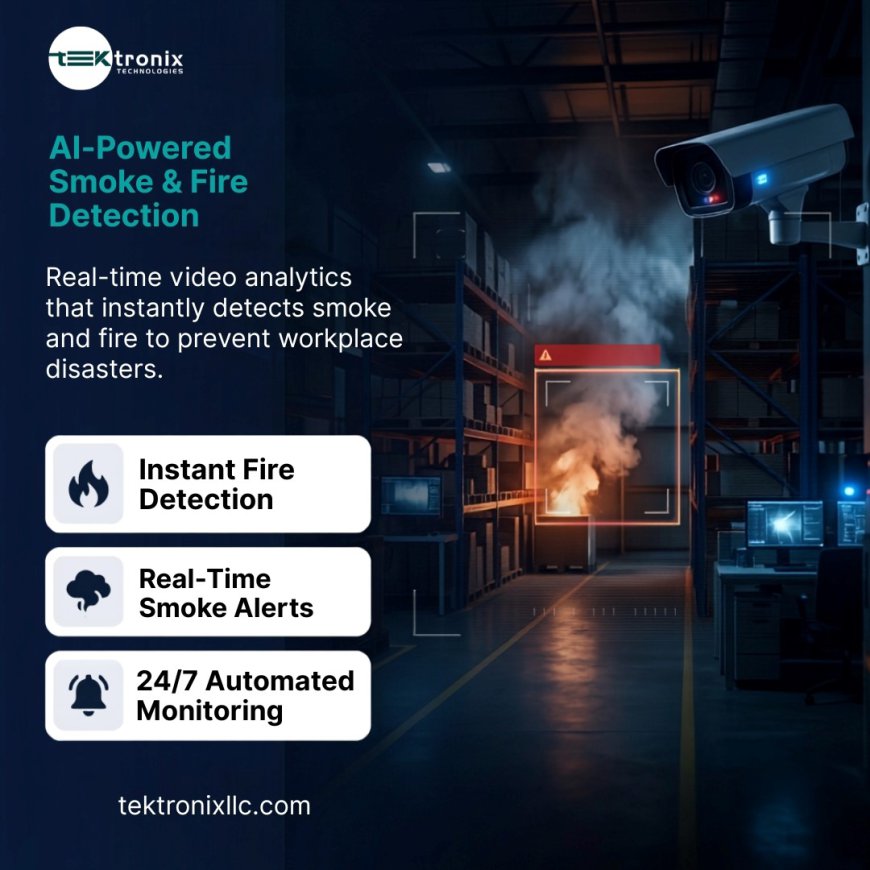
Modern AI-Powered Video Analytics identifies flame and smoke signatures directly within camera coverage across office floors, lobbies, and mechanical areas, offering detection speed advantages over point sensors that depend on smoke or heat physically reaching a fixed location, a delay that compounds across a tower's considerable floor-to-floor height.
Real-Time Hazard Detection Across Multi-Floor Office Environments
Continuous Real-Time Hazard Detection across open-plan office floors, shared lobbies, and back-of-house mechanical rooms gives building security teams unified coverage spanning a tower's full vertical footprint, considerably more practical than achieving equivalent coverage through point sensors alone across dozens of floors.
From Detection to Coordinated High-Rise Response
Automated Emergency Response for Phased High-Rise Evacuation
Once a hazard is confirmed, Automated Emergency Response can trigger the building's specific phased evacuation protocol for the affected floor and adjacent zones automatically, notifying building management with the exact location and floor, information central to executing a phased evacuation correctly rather than triggering a blanket, building-wide response that could itself create dangerous congestion.
Reduced False Alarms in Busy Corporate Office Environments
Busy corporate towers present genuine false-trigger conditions, from steam near pantry and kitchen areas to reflections and lighting changes across large glass-walled office floors. Reduced False Alarms through properly calibrated contextual analysis prevents these routine conditions from triggering unnecessary evacuations that would otherwise disrupt operations across an entire multi-tenant building.
Camera Placement Strategy for Tall Building Coverage
Achieving genuine floor-to-floor coverage across a high-rise tower requires deliberate camera placement strategy rather than simply replicating a low-rise building's approach at larger scale. Open-plan office floors typically need cameras positioned to cover the full floor plate without excessive blind spots created by structural columns or partition walls, while lobby and lift-lobby areas on each floor warrant dedicated coverage given their role as primary evacuation pathways during any incident.
Mechanical and back-of-house areas — plant rooms, electrical rooms, and storage areas — deserve particular attention despite typically lower occupancy, since these spaces often house genuine ignition sources like electrical equipment while receiving less routine human observation than occupied office space, making automated detection especially valuable in exactly the areas where a developing fire might otherwise go unnoticed longest.
Coordinating with Building Management and Facilities Teams
Successful high-rise fire detection deployment depends heavily on close coordination with building management and facilities teams throughout both installation and ongoing operation, since these teams hold the institutional knowledge of tenant layouts, typical office activity patterns, and existing life safety system configuration that shapes proper system calibration.
Ongoing communication between the detection system operator and building management also matters considerably after initial deployment, since tenant layouts and office configurations often change as companies renovate or new tenants move in, requiring periodic reassessment of camera coverage and detection tuning to maintain the system's original effectiveness as the building's internal environment evolves over time.
The Stack Effect and Smoke Migration in Tall Buildings
Tall buildings experience a physical phenomenon known as the stack effect, where temperature differences between indoor and outdoor air create vertical airflow through stairwells, elevator shafts, and other vertical openings, potentially drawing smoke upward through the building considerably faster than it would spread in a low-rise structure.
This dynamic makes early, precisely located detection particularly valuable in high-rise settings, since building management and life safety systems need accurate information about a hazard's origin point to properly manage stairwell pressurisation and smoke control systems designed specifically to counteract stack-effect smoke migration during an actual incident.
Multi-Tenant Tower Considerations
Corporate towers housing multiple independent tenant companies introduce coordination complexity a single-occupant building doesn't face, since an effective response requires clear communication across potentially dozens of separate organisations, each with their own staff unfamiliar with the building's broader evacuation plan beyond their own floor.
Video-confirmed detection with precise floor and location data helps building management communicate more effectively with individual tenant floor wardens during an incident, providing specific, actionable information rather than a generic building-wide alert that leaves each tenant's response team uncertain about the actual location and severity of the hazard.
Choosing the Right Platform for Corporate Tower Deployment
Video Analytics Software Tuned for High-Rise Conditions
High-rise deployments need Video Analytics Software specifically calibrated for large glass-walled office environments and the lighting variability tall buildings experience throughout the day, rather than software tuned only for the more consistent lighting conditions of a typical low-rise commercial space.
Video Analytics Solutions Scaled Across Multi-Tenant Towers
The right Video Analytics Solutions for a multi-tenant tower should integrate with the building's central life safety system and support floor-specific alerting suited to phased evacuation protocols, rather than a single building-wide configuration that doesn't account for tall-building evacuation logistics.
Video Analytics Oman: Corporate Tower Deployment Across the Sultanate
Adoption of Video Analytics Oman-wide for corporate tower fire safety spans Muscat's growing business district alongside emerging commercial hubs in Duqm and Sohar, reflecting the Sultanate's expanding office and mixed-use tower development as its economic diversification strategy continues advancing.
Video Analytics GCC: Regional Deployment Across the Gulf
Broader Video Analytics GCC adoption for high-rise fire safety spans corporate towers across Saudi Arabia, Qatar, Bahrain, and Kuwait alongside Oman and the UAE, reflecting a region-wide trend toward taller commercial development and correspondingly more sophisticated fire detection specification across the Gulf's major business districts.
Integration with Building Fire Alarm and Life Safety Systems
Video-based detection in a corporate tower should always complement, never replace, code-required fire alarm infrastructure, feeding confirmed detections directly into the building's certified fire alarm control panel and broader life safety system rather than operating as a disconnected standalone layer building management would need to monitor separately.
This integration extends usefully to smoke control and stairwell pressurisation systems, where a confirmed, precisely located detection can help trigger the correct pressurisation zones automatically, supporting the building's engineered smoke management strategy rather than requiring manual activation during a time-critical early response window.
Standards and Regulatory Alignment
Corporate tower fire detection deployments across Oman and the GCC must operate within the framework of each jurisdiction's civil defence authority requirements, alongside NFPA 101 life safety standards commonly referenced across the region's high-rise building codes. Video analytics should always be documented as a complementary layer within the building's formal fire safety plan rather than an informal, undocumented addition to existing certified infrastructure.
Why Corporate Towers Across Oman and the GCC Choose Tektronix
Tektronix deploys video-based fire and smoke detection analytics for office towers and corporate headquarters across Oman and the wider GCC, working with established technology partners including Axis Communications, Bosch, Hikvision, and Honeywell to configure detection sensitivity suited to high-rise conditions, glass-walled office environments, and multi-tenant coordination requirements. Every deployment includes integration with the building's existing fire alarm control panel and smoke control systems, along with documentation suited to regional civil defence compliance review.
Corporate towers looking to add an earlier detection layer to existing fire safety infrastructure can review Tektronix's AI-powered video analytics fire and smoke detection solutions to compare configurations suited to high-rise office and mixed-use developments.
Conclusion
High-rise towers across Oman and the Video Analytics GCC region need faster, more precise fire and smoke detection than a low-rise building requires, and Video Analytics delivers exactly that through AI-Powered Video Analytics, Real-Time Hazard Detection, Automated Emergency Response, and Reduced False Alarms. Properly configured Video Analytics Software and Video Analytics Solutions turn this technology into a genuinely dependable safety layer for busy corporate environments. As Video Analytics Oman adoption grows alongside the Sultanate's expanding skyline, towers investing early give occupants and responders the crucial minutes that matter most.
Frequently Asked Questions
1. Why does fire detection speed matter more in a high-rise tower than a low-rise building?
Tall buildings rely on phased, floor-by-floor evacuation rather than simultaneous full-building evacuation, meaning accurate, early hazard location information is essential for executing that phased response correctly and avoiding dangerous stairwell congestion.
2. What is the stack effect and how does it affect fire detection in tall buildings?
The stack effect describes vertical airflow through stairwells and shafts caused by temperature differences, which can draw smoke upward through a tall building faster than in a low-rise structure, making early detection and proper smoke control system activation particularly important.
3. Can video analytics help coordinate response across a multi-tenant office tower?
Yes, precise floor and location data from a confirmed detection helps building management communicate more effectively with individual tenant floor wardens, providing specific information rather than a generic building-wide alert.
4. Does video-based fire detection replace a building's required fire alarm system?
No, it functions as a complementary early-warning layer feeding into the building's existing certified fire alarm control panel, never replacing the code-required fire alarm infrastructure a corporate tower is mandated to maintain.
5. Is this technology relevant beyond Oman, across the wider GCC region?
Yes, the same high-rise fire detection considerations apply across corporate towers throughout Saudi Arabia, Qatar, Bahrain, Kuwait, and the UAE, reflecting a region-wide trend toward taller commercial development and more sophisticated fire safety specification.