What Is a Casino Back-Office System? A Complete Guide for Operators
 playagegaming
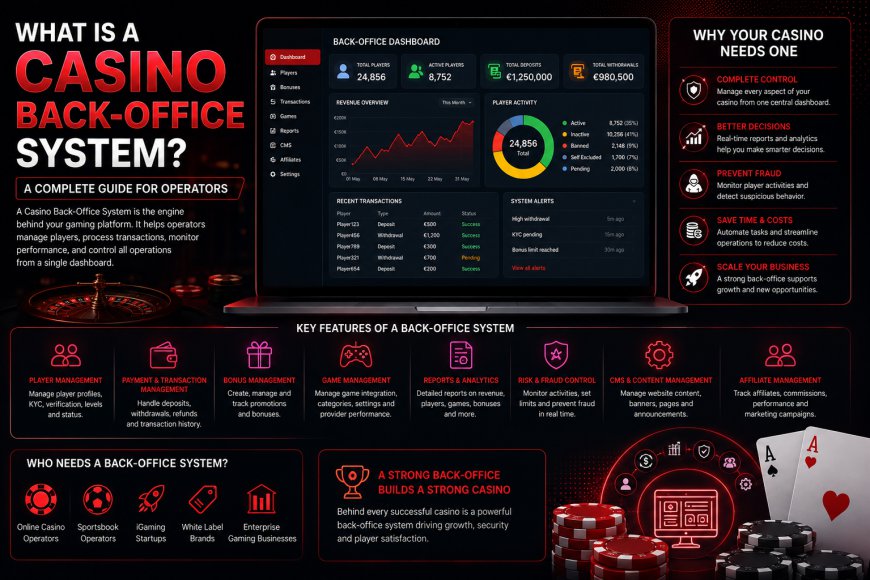
Running an online casino involves much more than displaying games and accepting deposits.
Behind the website is a system that allows the operator to manage players, payments, bonuses, games, customer support, risk, reports and daily operations.
This is the casino back-office system.
Players rarely see it, but the operator's team may use it throughout the working day.
For an iGaming business targeting Latin America, a capable back office becomes even more important. The operator may need to manage several countries, currencies, payment methods, languages and local requirements from one platform.
This guide explains what a casino back-office system is, how it works and what operators should look for before choosing one.
What Is a Casino Back-Office System?
A casino back-office system is the administrative control centre of an online casino.
It gives authorised employees access to the tools and information required to manage the business.
The player sees the casino website or mobile interface.
The operator sees the back office.
From there, staff can review player accounts, monitor transactions, manage bonuses, check gaming activity, respond to customer issues and analyse business performance.
Modern iGaming platforms commonly bring player management, payments, bonuses, reporting and risk controls into a central operating environment.
A simple way to understand it is:
Casino website = what the player uses.
Casino back office = what the operator uses to manage the casino.
How Does a Casino Back Office Work?
The back office connects information from different parts of the casino platform.
Imagine that a player registers, deposits money and starts playing slots.
Several things happen behind the scenes.
The player account system records the registration. The payment system processes the deposit. The casino wallet updates the balance. The game system records activity. The risk tools may check unusual behaviour. The customer relationship system may place the player into a relevant customer group.
The back office gives authorised teams access to this information.
Instead of opening several unrelated systems, the operator can manage important functions through one central environment.
This is one reason integrated iGaming platforms increasingly combine player accounts, payments, customer management, bonuses, compliance and reporting.
What Can Operators Manage From a Casino Back Office?
A strong casino back office can cover a large part of daily casino management.
Common functions include:
-
Player account management.
-
Deposits and withdrawals.
-
Casino wallet activity.
-
Customer verification.
-
Bonus and promotion management.
-
Game management.
-
Customer relationship management.
-
Player segmentation.
-
Risk and fraud monitoring.
-
Responsible gambling controls.
-
Customer support.
-
Financial reporting.
-
Marketing information.
-
User permissions.
-
Operational reports.
-
Performance analytics.
The exact tools depend on the platform provider and the operator's setup.
The important point is integration.
A useful back office should not simply display information. It should help teams understand what is happening and take the correct action.
What Is Player Account Management?
Player account management is one of the most important parts of a casino back office.
Every registered customer has a player account containing information needed to operate the service.
Depending on the platform, authorised staff may be able to review registration information, verification status, account activity, deposits, withdrawals, gaming history and account restrictions.
A Player Account Management system, often shortened to PAM, acts as a central layer connecting player accounts with games, payments and other platform functions.
Operators do not need to use the technical term in every conversation.
In simple terms, it is the system that helps the casino understand and manage each player's account.
How Does the Back Office Manage Casino Payments?
Payments are another major part of back-office operations.
When players deposit or withdraw money, the operator needs visibility over what is happening.
The back office may show whether a payment was successful, declined, pending or under review.
Teams can also use payment information to investigate customer enquiries.
For example, imagine a player contacts support and says:
"My deposit left my bank account, but my casino balance did not update."
The support team needs more than the player's message.
They need to find the transaction, check its status and understand whether the issue occurred at the casino, payment provider or another stage.
A central back office makes this easier because payment information can be connected with the player's account.
Some iGaming back offices also provide direct monitoring of deposits, withdrawals and transaction flows.
How Are Withdrawals Managed?
Withdrawals generally require more operational attention than deposits.
Before releasing funds, the casino may need to complete required identity, account or transaction checks according to its procedures and applicable rules.
The back office gives authorised teams a place to review the relevant information.
A withdrawal may move through several stages before completion.
The exact process depends on the casino, payment method and operating jurisdiction.
What matters is visibility.
Staff should be able to understand why a transaction is waiting rather than simply seeing that the customer has requested money.
This helps reduce unnecessary delays and makes customer support more effective.
What Is the Role of CRM in the Casino Back Office?
Customer Relationship Management, usually called CRM, focuses on managing the operator's relationship with players.
It can use player behaviour to create customer groups, manage communications and support retention campaigns.
CRM and back-office software are closely connected, but they are not exactly the same thing.
The back office is the wider operational environment.
CRM is one important part of that environment.
For example, the back office may contain information about a player's deposits, games and account status.
The CRM can use that information to decide whether the player should enter a particular customer group or communication journey.
Our detailed guide to what a casino CRM is explains how playe
r behaviour, segmentation, bonuses and retention work together inside an iGaming environment.
How Does Player Segmentation Work?
Not every casino customer behaves in the same way.
One player may prefer slots.
Another may mainly play live casino games.
Another may be highly active during weekends but rarely play during the week.
Player segmentation separates customers into useful groups based on selected characteristics or behaviour.
This allows the operator to manage communications more intelligently.
A casino-specific CRM can update player groups as behaviour changes instead of relying only on static customer lists.
However, segmentation should not be used without appropriate controls.
Responsible gambling requirements and customer communication preferences must remain part of the decision-making process.
How Does a Back Office Manage Bonuses?
Bonuses may look simple to the customer, but managing them can be complicated.
An operator needs to decide who receives an offer, when it starts, when it ends and which conditions apply.
The back office may allow teams to configure welcome offers, free spins, cashback, promotional codes and other campaigns.
It may also provide information about how players use those offers.
Casino bonus systems can include rules covering eligible games, time restrictions and conditions that must be completed before certain bonus-related funds can be withdrawn. PlayAge Gaming's CRM guide explains why casino bonuses require deeper platform integration than ordinary retail discount codes.
Good bonus management also helps operators identify repeated misuse or technical problems before they become expensive.
What Does Game Management Look Like?
An online casino may contain hundreds or thousands of games.
Managing that catalogue manually through the customer-facing website would be impractical.
Back-office tools can help operators organise game content.
Depending on the platform, teams may be able to activate or deactivate games, organise categories, manage providers and review game performance from a central interface.
Large casino platforms commonly use a single back office to manage content from multiple game providers.
This is especially useful for operators serving different markets.
A game that is available or commercially relevant in one country may not necessarily be suitable for another.
Operators therefore need control over what appears to each target audience.
How Does a Casino Back Office Help With Fraud Detection?
Online casinos process account registrations, financial transactions and gaming activity every day.
This creates a need for effective risk monitoring.
Back-office tools can help teams identify unusual activity and investigate it.
One unusual event does not always mean fraud.
Context matters.
For example, a login from a new device may be completely legitimate.
However, a new device combined with unusual account changes, different payment behaviour and a sudden withdrawal request may deserve closer review.
Modern casino management systems can combine player, payment and risk information to help teams investigate suspicious patterns.
Artificial intelligence can provide an additional layer by analysing behaviour at scale.
For more context, this article on AI in online casinos and its role in player retention and fraud detection explores how automated analysis can support these areas.
Does AI Replace the Back-Office Team?
No.
Artificial intelligence can help back-office teams process information more efficiently, but it does not remove the need for experienced staff.
AI may identify unusual player behaviour, detect changes in deposit patterns or highlight accounts that require attention.
A person may still need to understand what happened and decide what action is appropriate.
This distinction is particularly important when a decision affects a player's money, account status or responsible gambling controls.
The practical role of AI is to help the team identify what deserves attention.
Human judgement remains important for sensitive decisions.
How Does the Back Office Support Responsible Gambling?
Responsible gambling should form part of normal casino operations rather than being treated as a separate task.
The back office can help authorised teams view account restrictions and other relevant player protection information.
Depending on the platform and jurisdiction, responsible gambling functions may include deposit limits, time-outs, self-exclusion controls and activity monitoring.
These controls need to connect properly with other casino systems.
For example, a player who is not eligible to receive marketing communication should not accidentally receive a promotional campaign simply because another system has outdated information.
This is why integrated systems matter.
PlayAge Gaming's casino CRM guide also highlights the importance of connecting responsible gambling controls directly with player management and communication processes.
Why Is Reporting Important?
Operators cannot manage a casino effectively if they do not understand what is happening.
Back-office reporting helps turn activity into useful business information.
An operator may want to understand how deposits are performing, which games are popular, whether withdrawals are being processed efficiently or how a particular promotion performed.
Modern casino platforms commonly provide reporting and analytics alongside player and payment management.
Good reporting helps different departments work from the same information.
Management can review performance.
Finance teams can examine transactions.
Marketing teams can review campaigns.
Support teams can investigate customer issues.
Risk teams can look for unusual patterns.
The goal is not to generate the largest number of reports.
The goal is to provide information that helps people make better decisions.
Why Does a Back Office Matter for Customer Support?
Customer support teams need quick access to accurate information.
Imagine that a player says a bonus disappeared from their account.
The support agent needs to understand which bonus was activated, when it was activated and what happened afterwards.
If all this information is stored across separate systems, solving the issue becomes slower.
A well-connected back office gives support teams a clearer view of the account.
This can reduce unnecessary transfers between departments and help resolve straightforward issues faster.
Access should still be controlled.
A customer service employee does not necessarily need permission to change financial or high-risk account settings.
What Are Back-Office User Permissions?
Not every employee should have access to every casino function.
User permissions control what individual employees can see or change.
For example, a customer support agent may need to view basic account information but should not necessarily have permission to approve large financial adjustments.
A finance manager may require access to transaction information.
A marketing employee may need campaign and segmentation tools but not sensitive risk controls.
Clear permission levels can help operators reduce mistakes and limit unnecessary access to sensitive information.
They also create clearer accountability inside larger teams.
Why Is a Casino Back Office Important in LATAM?
Latin America presents significant operational variety.
An operator may target Brazil, Mexico, Colombia and other markets from the same wider business.
However, those markets should not automatically be managed as if they are identical.
Player preferences can differ.
Payment systems can differ.
Languages can differ.
Currencies can differ.
Marketing requirements and gambling regulations can also differ by jurisdiction.
A suitable back office gives the operator a central operating environment while still allowing important differences between markets to be managed.
This balance is important.
Centralisation helps the company operate efficiently.
Localisation helps the casino remain relevant to each market.
Can One Back Office Manage Several Casino Brands?
Some platforms are designed to support more than one brand or market from a shared infrastructure.
This can be useful for larger operators.
Instead of building completely separate operational systems for each brand, the business may be able to manage several properties through one central platform.
However, shared infrastructure should not mean that everything is mixed together.
Operators still need clear controls over brands, markets, user permissions, payments, reports and customer information.
The ability to scale cleanly becomes increasingly important as the business grows.
What Is the Difference Between a Casino Back Office and a Casino CRM?
The easiest way to understand the difference is through scope.
A casino CRM focuses mainly on players, communication, segmentation, retention and related customer activity.
A casino back office has a wider purpose.
It may include CRM, but it can also cover player accounts, payments, withdrawals, games, bonuses, risk, customer support and reporting.
Think of it this way:
CRM manages the relationship with the player.
The back office helps manage the wider casino operation.
The two systems work best when they are connected.
What Is the Difference Between a Back Office and a Turnkey Casino Platform?
A back office is part of the operating technology.
A turnkey casino platform is a broader solution designed to provide many of the components needed to launch and operate an online casino.
Depending on the provider, a turnkey solution may include the website, player account system, wallet, payments, game integrations, CRM, bonus tools, reporting and back-office controls.
The back office is therefore the operator-facing management environment within the wider technology setup.
This distinction matters when comparing providers.
An attractive front-end casino is not enough.
Operators also need to understand the technology they will use every day after launch.
What Should LATAM Operators Look for in a Casino Back-Office System?
Choosing a back office should be based on operational needs rather than a long list of features.
An operator should ask whether the system makes daily work easier.
Can staff find player information quickly?
Can teams review deposits and withdrawals clearly?
Can bonuses be controlled without constant technical support?
Can the operator manage different markets separately?
Are reports understandable?
Can employee permissions be controlled?
Can CRM, payments and games exchange information correctly?
Can the platform grow as player numbers increase?
Does it support the operator's required compliance processes?
Can important actions be reviewed and traced?
A system may have many features and still be difficult to use.
The best back office is one that gives teams meaningful control without turning routine tasks into complicated technical work.
Why Does Integration Matter So Much?
An online casino is made up of connected systems.
Payments affect player balances.
Player balances affect gaming activity.
Gaming behaviour can affect CRM segmentation.
CRM activity can affect bonuses.
Risk controls may need information from all of these areas.
If every system operates independently, teams can end up working with different versions of the same customer information.
Integrated platforms reduce this problem by connecting key operational functions.
This is why leading iGaming platforms commonly combine player management, payments, CRM, bonuses, compliance and reporting within a wider technology stack.
For operators, integration is not simply a technical benefit.
It affects how efficiently the entire company can work.
Can a Good Back Office Help an Operator Scale?
Yes.
When a casino is small, teams may be able to complete many tasks manually.
That becomes increasingly difficult as the number of players, transactions, games and markets grows.
A scalable back office helps organise this complexity.
Instead of adding more manual processes every time the casino grows, the operator can use automation, reporting and centralised management.
This does not mean growth becomes automatic.
It means the technology is less likely to become a barrier to growth.
For LATAM operators planning expansion into several countries, this can be particularly important.
Common Casino Back-Office Mistakes
One common mistake is choosing a platform based mainly on the appearance of the player-facing casino.
The front end matters, but employees may spend thousands of hours working inside the back office.
Poor internal software can create slow customer support, confusing reporting and unnecessary manual work.
Another mistake is giving too many employees unrestricted access.
Permissions should match job responsibilities.
Operators can also create problems when important systems are poorly connected. A CRM that cannot access accurate game or payment information will have limited value.
Finally, operators should avoid collecting large amounts of information simply because the system allows it.
Useful data should support a clear operational, customer, security or compliance purpose.
Is a Casino Back-Office System Necessary?
For a serious online casino operation, effective back-office functionality is essential.
An operator needs a practical way to manage customers, money, games, promotions, risk and performance.
Trying to control these areas through disconnected tools and manual spreadsheets becomes increasingly difficult as the business grows.
A central back office creates structure.
It gives teams one environment where they can understand what is happening and carry out authorised actions.
For operators targeting several LATAM markets, that central control can become even more valuable.
Final Thoughts
A casino back-office system is the operational control centre behind an online casino.
Players may never see it, but almost every part of their experience can connect with it.
Registrations, deposits, withdrawals, bonuses, gaming activity, customer support, risk controls and reports all create information that casino teams need to manage.
The best back-office systems bring this information together in a way that is clear, secure and practical.
For LATAM operators, the system should also support the realities of managing different markets rather than forcing every country into one identical setup.
When comparing casino technology, do not look only at what the player sees.
Look carefully at what your team will use every day.
That is where the back office becomes one of the most important parts of the platform.
For a deeper look at the player management side, read our guide to casino CRM systems and why operators need them.
Frequently Asked Questions
What is a casino back-office system?
A casino back-office system is the operator-facing software used to manage important parts of an online casino, including players, payments, bonuses, games, risk and reporting.
Who uses an online casino back office?
It can be used by authorised employees across customer support, finance, marketing, risk, compliance and management teams. Access normally depends on each employee's responsibilities.
Is a casino CRM the same as a back office?
No. A CRM mainly focuses on player relationships, segmentation, communication and retention. The back office has a wider role and can include CRM alongside payments, player accounts, games, risk and reporting.
What does PAM mean in iGaming?
PAM means Player Account Management. It is the technology used to manage player accounts and connect them with important platform functions such as games and payments.
Can a casino back office manage payments?
Yes. Depending on the platform, authorised teams can monitor deposits, withdrawals and other transaction information through back-office tools.
Can operators manage bonuses from the back office?
Many iGaming back offices include bonus management tools. These can allow operators to configure promotions, conditions and eligibility rules and monitor how offers are used.
Does a casino back office include fraud detection?
It can include risk monitoring and tools that help teams investigate unusual player or transaction behaviour. The exact capabilities depend on the platform.
Why is reporting important in a casino back office?
Reporting helps operators understand player activity, payments, game performance and other business information. This allows teams to identify problems and make better operational decisions.
Is a casino back-office system important for LATAM operators?
Yes. Operators working across LATAM may need to manage different markets, currencies, payment methods, player preferences and regulatory requirements. A suitable back office can centralise operations while allowing market-specific management.
What should I check before choosing a casino back office?
Focus on player management, payments, game control, CRM integration, bonus management, risk tools, reporting, user permissions, localisation and scalability. The system should also be easy for your operational teams to use.