3D Printing in Australia: Driving the Future of Smart Manufacturing
 forgelabs
Introductionhttps://forgelabs.com.au/
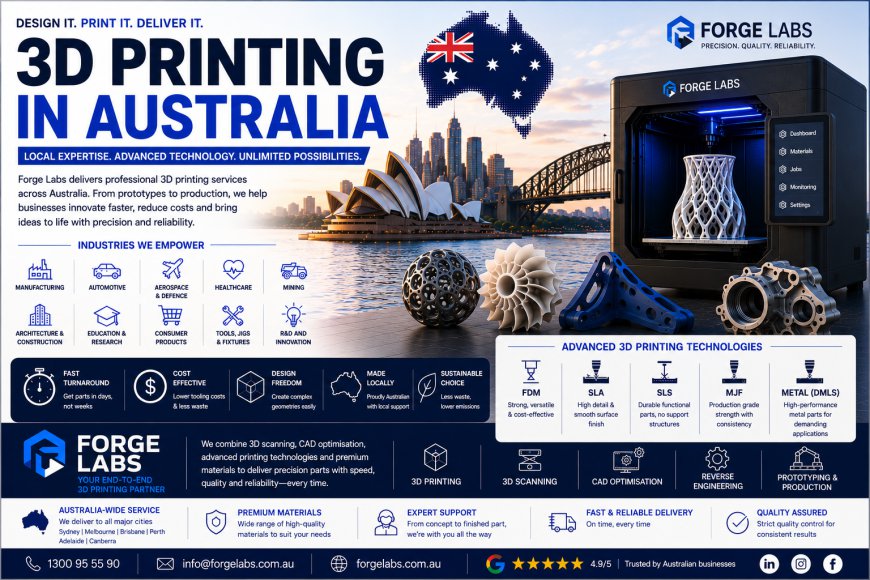
Innovation has become the cornerstone of modern manufacturing, and 3D printing in Australia is helping businesses achieve faster development cycles, improved product quality, and greater manufacturing flexibility. By converting digital designs directly into physical objects, additive manufacturing removes the need for complex tooling and significantly reduces production timelines. Whether developing prototypes or manufacturing end-use components, businesses across Australia are embracing this technology to stay competitive in rapidly changing markets.
Forge Labs provides professional 3D printing in Australia, delivering advanced manufacturing solutions backed by industrial-grade equipment, experienced engineers, and a wide range of engineering materials. From startups launching their first product to established manufacturers improving production efficiency, Forge Labs supports every stage of the product development journey.
The Rise of Digital Manufacturing in Australia
Australian businesses are increasingly adopting digital manufacturing technologies to improve productivity and reduce dependence on traditional production methods. Conventional manufacturing often involves lengthy setup processes, expensive moulds, and significant material waste, making it difficult to respond quickly to changing customer demands.
With 3D printing in Australia, companies can manufacture directly from CAD files, allowing rapid design modifications and faster production without additional tooling. This agility helps businesses shorten development cycles, improve product performance, and reduce overall manufacturing costs.
As industries continue investing in local production capabilities, additive manufacturing is becoming an essential part of Australia's advanced manufacturing ecosystem.
How Additive Manufacturing Works
The process begins with a three-dimensional digital model created using CAD software. Once finalised, slicing software converts the model into thin layers that guide the printer during production.
Industrial 3D printers then build the component layer by layer using carefully selected materials such as thermoplastics, engineering resins, nylon powders, or metal alloys. Depending on the project's requirements, finished parts may undergo machining, polishing, vapour smoothing, media blasting, coating, or painting to achieve the desired finish and performance.
This highly efficient workflow reduces production delays while delivering excellent dimensional accuracy.
Benefits of 3D Printing
Faster Product Development
Rapid prototyping enables businesses to evaluate ideas, improve designs, and launch products much faster than traditional manufacturing methods.
Reduced Production Costs
Without the need for tooling or moulds, additive manufacturing lowers upfront investment and makes low-volume production economically viable.
Exceptional Design Freedom
Complex internal geometries, lightweight structures, and customised components can be manufactured with precision that would be difficult using conventional methods.
On-Demand Manufacturing
Businesses can produce parts only when needed, reducing inventory costs and improving supply chain flexibility.
Environmentally Friendly Production
By using material only where necessary, additive manufacturing reduces waste and supports more sustainable manufacturing practices.
Industry Applications
Manufacturing
Factories use additive manufacturing to produce jigs, fixtures, machine components, production tooling, and replacement parts.
Aerospace
Aircraft manufacturers develop lightweight structural components, testing equipment, and precision-engineered prototypes.
Healthcare
Medical organisations produce prosthetics, dental models, orthopaedic devices, surgical guides, and patient-specific anatomical models.
Mining
Mining companies manufacture maintenance tools and replacement parts that reduce operational downtime.
Architecture
Architects and property developers create accurate scale models that improve project presentations and client communication.
Consumer Product Development
Designers rapidly prototype electronics, sporting equipment, household products, and innovative consumer goods before commercial production.
Industrial 3D Printing Technologies
FDM (Fused Deposition Modelling)
Ideal for engineering prototypes, manufacturing fixtures, and durable functional components.
SLA (Stereolithography)
Produces highly detailed parts with exceptional surface quality for medical, dental, jewellery, and design applications.
SLS (Selective Laser Sintering)
Creates durable nylon components capable of performing in demanding industrial environments.
Multi Jet Fusion (MJF)
Manufactures production-grade nylon parts with excellent repeatability, strength, and dimensional accuracy.
Metal Additive Manufacturing
Supports advanced engineering projects using stainless steel, aluminium, titanium, and high-performance industrial alloys.
Engineering Materials
Forge Labs provides an extensive selection of industrial materials to suit virtually every manufacturing application.
Available materials include:
- PLA
- ABS
- PETG
- ASA
- Nylon PA11
- Nylon PA12
- TPU
- Polycarbonate
- Carbon Fibre Reinforced Nylon
- Engineering Resins
- Stainless Steel
- Aluminium
- Titanium
Each project is matched with the most suitable material based on strength, flexibility, durability, heat resistance, and environmental requirements.
Why Forge Labs?
Forge Labs delivers complete 3D printing in Australia services designed to support businesses throughout the entire product development process.
Services include:
- Rapid prototyping
- Functional prototype manufacturing
- Low-volume production
- End-use component manufacturing
- Reverse engineering
- CAD optimisation
- Material selection support
- Engineering consultation
- Australia-wide delivery
With advanced manufacturing technology and experienced technical specialists, Forge Labs helps businesses reduce development risks while improving production quality.
Tips for Successful 3D Printing Projects
A successful additive manufacturing project starts with an optimised CAD model and a clear understanding of the component's functional requirements. Selecting the correct printing technology and engineering material ensures improved performance while reducing production costs.
Collaborating with experienced additive manufacturing engineers early in the design process can also minimise redesigns and improve manufacturing efficiency.
The Future of 3D Printing in Australia
The future of 3D printing in Australia will continue to evolve through artificial intelligence, automated manufacturing systems, advanced materials, and cloud-based engineering workflows. Industrial printers will become faster, more accurate, and capable of producing increasingly sophisticated products for commercial manufacturing.
As Australian businesses continue investing in advanced manufacturing technologies, additive manufacturing will strengthen local supply chains, encourage innovation, and support sustainable industrial growth.
Conclusion
The increasing adoption of 3D printing in Australia demonstrates its value as a modern manufacturing solution capable of delivering speed, flexibility, and precision. From concept development and rapid prototyping to production-ready components, additive manufacturing enables businesses to innovate more efficiently while reducing manufacturing costs.
Forge Labs combines advanced industrial equipment, premium engineering materials, and experienced technical professionals to provide dependable additive manufacturing services across Australia. Whether you're developing a prototype, manufacturing custom components, or producing low-volume commercial parts, Forge Labs delivers the expertise needed to turn innovative ideas into successful products.
Frequently Asked Questions
What industries benefit from 3D printing in Australia?
Manufacturing, aerospace, healthcare, mining, architecture, automotive, education, defence, engineering, and consumer product companies all use additive manufacturing.
Can 3D printing be used for production parts?
Yes. Industrial 3D printing is widely used for prototypes, tooling, bridge manufacturing, customised components, and low-volume production.
What materials does Forge Labs offer?
Forge Labs supports PLA, ABS, PETG, ASA, Nylon, TPU, Polycarbonate, Carbon Fibre Reinforced Nylon, engineering resins, stainless steel, aluminium, titanium, and additional industrial-grade materials.
Why is additive manufacturing becoming more popular?
It offers faster development, lower production costs, improved design flexibility, local manufacturing capabilities, and reduced material waste.
Why choose Forge Labs?
Forge Labs provides trusted 3D printing in Australia with advanced manufacturing technology, engineering expertise, premium materials, fast turnaround times, and customised solutions that help Australian businesses innovate and manufacture with confidence.