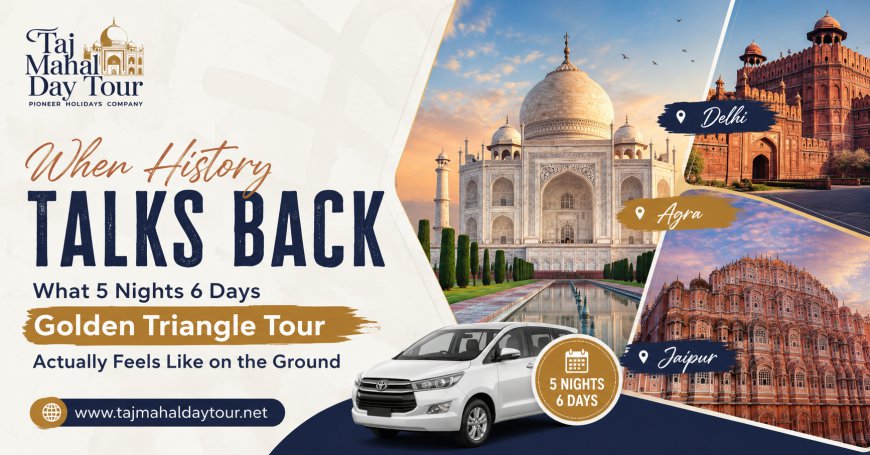
When History Talks Back — What 5 Nights 6 Days Golden Triangle Tour Actually Feels Like on the Ground
Planning a 5 nights 6 days Golden Triangle tour? Read this real travel experience covering Delhi, Agra & Jaipur — day-by-day itinerary, tips, and FAQs included.
 tajmahaldaytour
A Journey That Gets Under Your Skin
There are some trips you plan. And then there are trips that plan you.
I had been reading about the Golden Triangle for years — Delhi, Agra, Jaipur — three cities, three completely different energies, one road that ties them together. But reading about it and actually standing inside it are two very different things. This blog is not about hotel star ratings or bus departure times. This is about what it really feels like to do a 5 nights 6 days Golden Triangle tour from start to finish — the smells, the chaos, the quiet moments, and the parts no itinerary ever mentions.
Day 1 — Delhi: The City That Hits You First
I landed in Delhi on a Tuesday morning. The air was thick, the roads were loud, and within ten minutes of stepping outside, I understood why people say Delhi is not for the faint-hearted.
Our first stop was Jama Masjid. Nothing prepares you for the scale of it. You climb those steps and suddenly the entire old city opens up below you — pigeons, vendors, the sound of Urdu drifting from somewhere close. I stood there for longer than planned.
From there we moved to Chandni Chowk. This is where food tourism becomes real. Paranthe Wali Gali — a narrow lane where families have been making stuffed flatbreads for generations. I had one with aloo filling and one with paneer. Both were ridiculous in the best possible way.
In the afternoon, we drove through New Delhi — Rajpath, India Gate, the Rashtrapati Bhavan viewed from the distance. There is something strange about seeing a colonial structure in a post-colonial country and feeling both awe and complicated emotions at the same time. Delhi does that to you. It layers history on top of history until you stop trying to sort it out.
We ended the evening at Humayun's Tomb. Most people rush past it because the Taj Mughal comes later — but do not make that mistake. The garden, the symmetry, the quiet — it is stunning on its own terms.
Tip: Wear comfortable shoes. Old Delhi is not a place for sandals.
Day 2 — Delhi to Agra: The Road Changes Everything
We left Delhi early — around six in the morning — and took the Yamuna Expressway toward Agra. The expressway is smooth and fast, but the real India appears in the stretches in between. Sugarcane fields. Tea stalls with plastic chairs. Trucks painted with god imagery and philosophy.
The drive takes about three to three and a half hours depending on traffic.
Our first stop in Agra was not the Taj Mahal. It was Agra Fort.
This was the right call. The Fort gives you context. You understand the Mughal empire — its scale, its paranoia, its beauty — before you arrive at its most famous creation. Shah Jahan was imprisoned here by his own son. From the fort's tower, he could see the Taj Mahal in the distance. He spent his last years staring at the tomb he had built for his wife. That detail hit differently standing there in person.
We reached the Taj Mahal in the late afternoon. I want to be honest with you: I expected to be slightly underwhelmed, because I had seen it in photographs a thousand times.
I was not underwhelmed.
The moment the main gateway frames the Taj in full — white marble, four minarets, the long reflecting pool running toward it — something happens that photographs genuinely cannot capture. It is not just beautiful. It is quiet in a way that feels impossible for something that receives millions of visitors a year. We stayed until the light turned golden and the marble shifted from white to pale peach.
I sat on the bench where Princess Diana sat for that famous photograph. I did not feel famous. I felt very small and very grateful.
Day 3 — Agra: Fatehpur Sikri and the Dust of a Lost Empire
Day three in Agra starts with a lesser-known gem — Mehtab Bagh, the garden directly across the Yamuna River from the Taj Mahal. If you go at sunrise, you get the full silhouette of the Taj reflecting in the river with almost no one around you. This is one of those moments you will not stop talking about for years.
After breakfast, we drove about forty kilometers outside Agra to Fatehpur Sikri — the abandoned Mughal capital built by Emperor Akbar and then deserted within two decades, possibly due to water shortage.
Walking through it feels strange. The architecture is enormous and impeccably preserved. The Buland Darwaza — the gateway — is one of the tallest gateways in the world. And yet the city is empty. It was built for hundreds of thousands of people and now it holds only wind and pigeons and tourists.
The Dargah of Salim Chishti sits inside the complex. Devotees tie threads to the marble lattice screens and make wishes. I watched an old woman do this with complete stillness and faith. No one was performing for anyone. That kind of faith is humbling to witness.
We returned to Agra in the afternoon. The evening was free — some people from our group went back to the Taj for sunset, others explored the local marble inlay shops. Agra is famous for pietra dura work, the same stone-inlay craft used on the Taj itself. The workshops here are genuine, the craftsmanship extraordinary. I bought a small marble box. I could not afford a table.
Day 4 — Agra to Jaipur: The Pink City Arrival
The drive from Agra to Jaipur runs through Rajasthan's edge. The landscape shifts noticeably — less green, more rust-colored earth, longer distances between towns. It takes around five hours, and along the way we stopped at Abhaneri.
Abhaneri is one of those places that exists in a different category of beautiful. The Chand Baori stepwell — built over a thousand years ago — is a geometric marvel. There are 3,500 steps arranged in perfect symmetry descending thirteen stories underground. It was built to collect water. It looks like mathematics made visible. The light bounces off the stone at certain angles in a way that is almost surreal. Almost no one is there. You walk around the edge trying to understand how people built this without computers or cranes.
We arrived in Jaipur by late afternoon. The city announces itself. The old walled city is painted in varying shades of terracotta pink — a color that was applied in 1876 to welcome the Prince of Wales. It stuck. The whole city kept it.
Dinner that night was at a rooftop restaurant near Hawa Mahal. Rajasthani dal baati churma — lentils, baked dough balls, and a sweet crumbled wheat dish. It is the kind of meal that makes you understand why regional Indian food is an entirely separate education from "Indian food."
Day 5 — Jaipur: Forts, Palaces, and a Conversation with an Elephant
Jaipur has more to see than one day allows. We prioritized ruthlessly.
Amber Fort was first. It sits on a ridge above a lake, reached either by jeep or by elephant — the elephant ride is slow and touristy and I took it without apology. The elephant was named Champa. The mahout was nineteen years old and had been working with elephants since he was ten. We talked in broken Hindi and gestures. He was proud of Champa in the way you would be proud of a family member.
Amber Fort itself is layered — defensive walls on the outside, intricate mirror-work interiors, the Sheesh Mahal where a single candle flame reflects in thousands of tiny mirrors to create what looks like a sky full of stars. Mughal influence met Rajput aesthetics here, and the result is something neither tradition could have produced alone.
After Amber, we drove through the city — Hawa Mahal from the front (it photographs better than it experiences from inside, honestly), the City Palace museum, Jantar Mantar. The Jantar Mantar is an eighteenth-century astronomical observatory built by Maharaja Jai Singh II. The instruments are enormous — one sundial is twenty-seven meters tall and accurate to two seconds. This man built a giant sundial in the 1700s to track the stars. That kind of ambition and curiosity across centuries is what this entire tour keeps reminding you of.
The afternoon was for the bazaars. Johari Bazaar for jewelry, Bapu Bazaar for textiles, Tripolia Bazaar for lac bangles and handicrafts. Jaipur is where you buy things. I bought a block-printed bedsheet, a pair of juttis (traditional Rajasthani shoes), and a miniature painting the size of my palm that took an artist three days to make.
Day 6 — Jaipur to Delhi: The Last Morning
We drove back to Delhi on the final day. The Jaipur-Delhi highway is fast — NH 48, about five to six hours including a stop. People got quiet in the van. That particular silence of a trip ending.
I kept thinking about the totality of it. Six days. Three cities. Hundreds of years of history compressed into a route that most tourists complete in a week or less. The 5 nights 6 days Golden Triangle tour sounds like a package. On the ground, it feels like three completely separate countries that happen to share a border.
Delhi is ancient and modern and chaotic and confident. Agra is melancholic — a city living in the shadow of something so beautiful that everything else feels like a footnote. Jaipur is theatrical and alive, a city that knows it is spectacular and leans into it without embarrassment.
What surprised me most was not any single monument. It was the human continuity. The fact that people have been worshipping, trading, eating, marrying, and mourning in these places for thousands of years without pause. You are not visiting ruins. You are visiting living cities that happen to have very old bones.
tajmahaldaytour.net helped us plan this itinerary down to the last detail — transfers, skip-the-line entries, the morning slot at Mehtab Bagh, the Amber Fort elephant booking. What looked overwhelming on paper became manageable because someone had figured out the sequencing in advance. Booking with tajmahaldaytour.net meant we arrived at each place at the right time of day, with the right context, and without the logistical headaches that ruin so many first-time visits to India.
Practical Things Worth Knowing
Best time to go: October to March. Summers are brutal, monsoon is unpredictable.
Getting around: A private cab for the full circuit is the most comfortable option. Shared tours work but lose flexibility.
What to carry: Sunscreen, a scarf (required for some religious sites), a small daypack, and cash for smaller markets.
Photography: The Taj Mahal prohibits tripods inside. Come during the golden hour — either early morning or late afternoon — for the best light.
Food safety: Stick to cooked food at established places. Street food is wonderful but start slowly if your stomach is not used to Indian spices.
Entry fees: Foreigners pay higher entry at most monuments — carry your passport for verification.
FAQs — 5 Nights 6 Days Golden Triangle Tour
Q1. Is 5 nights 6 days enough for the Golden Triangle?
Yes, it is the ideal duration. Shorter trips (3–4 days) rush through the cities without giving you enough time at each place. Six days allows you to explore Agra Fort, Fatehpur Sikri, Amber Fort, and Old Delhi without feeling like you are racing a clock.
Q2. What is the best route for the Golden Triangle tour?
The most efficient route is Delhi → Agra → Jaipur → Delhi. This avoids backtracking and the drives between cities are comfortable. Some people reverse it (Delhi → Jaipur → Agra → Delhi), which also works well depending on your arrival point.
Q3. How do I get between Delhi, Agra, and Jaipur?
Private car hire is the most convenient option. Trains are available — the Gatimaan Express from Delhi to Agra is excellent. For budget travelers, RSRTC buses run between Jaipur and Agra reliably.
Q4. Is the Golden Triangle tour safe for solo travelers?
Yes, especially if you book with a reputable operator. Solo female travelers should take extra care in crowded markets — follow standard urban travel precautions, use registered cabs, and avoid isolated areas after dark.
Q5. What should I not miss on this tour?
Fatehpur Sikri and Mehtab Bagh at sunrise are the two most underrated stops on the circuit. Most people focus entirely on the Taj Mahal and Amber Fort — which you should absolutely see — but these two will surprise you the most.
Q6. What is the average cost of a 5 nights 6 days Golden Triangle tour?
Costs vary widely based on hotel category and travel style. Budget travelers can complete the circuit for around $300–400 USD. Mid-range trips (comfortable hotels, private transfers) typically run $600–900 USD. Luxury tours with heritage hotels can go above $1,500 USD.
Q7. Do I need a visa for India?
Most nationalities require a visa. India's e-Visa (available online) is valid for most tourism purposes and is straightforward to apply for. Check the official Indian government visa portal for your country's specific requirements.
Q8. Can I visit the Taj Mahal at sunrise?
Yes, and it is highly recommended. The Taj Mahal opens at sunrise (approximately 6 AM) and the early morning light on the white marble is extraordinary. The crowds are also significantly lighter in the first hour. The site is closed on Fridays.
Q9. How physically demanding is this tour?
Moderate. Most monuments involve a fair amount of walking on uneven stone surfaces. Amber Fort has a steep incline. People with mobility concerns should check accessibility options in advance. Overall, if you can walk comfortably for two to three hours a day, the tour is very manageable.
Q10. Is it better to book a private tour or join a group tour?
Private tours give you flexibility — you set the pace, stop where you want, and spend more time at places that interest you. Group tours are more economical and good for solo travelers who want company. For families or couples, private is almost always worth the added cost.