Acetonitrile Prices: Global Market Trends, Supply Dynamics, and Forecast Outlook
The global chemical industry continues to experience rapid changes driven by industrial demand, technological advancements, and shifting supply chains
 cheminfo
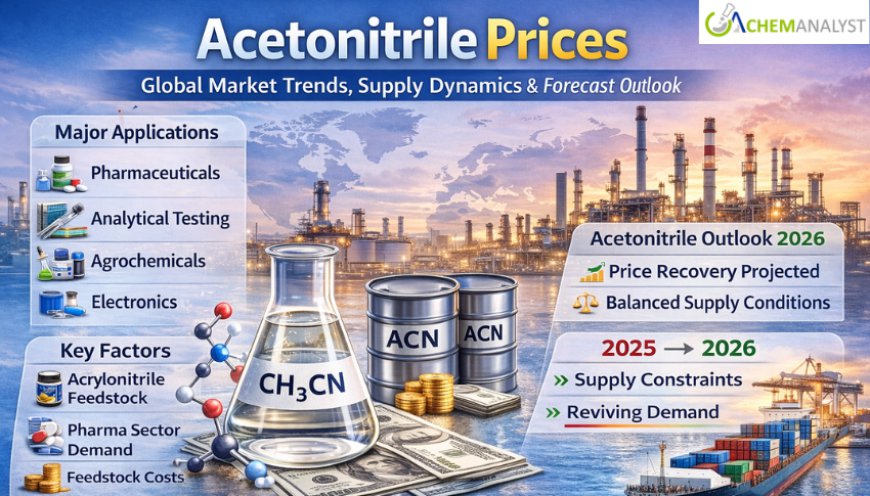
The global chemical industry continues to experience rapid changes driven by industrial demand, technological advancements, and shifting supply chains. Among specialty solvents, acetonitrile holds a critical position due to its wide application in pharmaceuticals, agrochemicals, laboratory testing, and electronics manufacturing. As a result, Acetonitrile Prices have become an important indicator of broader industrial and chemical market performance.
The latest market data highlights fluctuations in price movements during 2025, influenced by supply availability, feedstock cost dynamics, and downstream consumption trends. Moving into 2026, the market outlook remains cautiously optimistic, supported by improving demand from pharmaceuticals, diagnostics, and high-purity solvent applications.
Market Overview
Acetonitrile is primarily produced as a by-product during acrylonitrile manufacturing, making its supply closely tied to petrochemical industry cycles. The compound is widely used as a high-performance solvent in drug production, analytical testing, and agrochemical synthesis.
According to recent market data, the North American market experienced a slight decline in late 2025. Prices averaged around USD 3,410 per metric ton FOB Texas, reflecting subdued demand and increased inventories.
The market trend showed that the Acetonitrile Price Index softened due to reduced spot buying and stable supply conditions, while steady plant operations ensured smooth logistics and balanced inventories.
Despite short-term weakness, analysts anticipate modest recovery in early 2026 driven by seasonal restocking and stable industrial demand.
Key Factors Influencing Acetonitrile Prices
1. Feedstock Dependency
One of the most important factors influencing Acetonitrile Prices is the availability of acrylonitrile, the primary feedstock. Since more than half of global supply is linked to acrylonitrile production, any fluctuation in crude oil prices directly impacts solvent pricing.
The volatility in petroleum markets between 2021 and 2023, where crude oil prices fluctuated by over 40%, significantly affected raw material costs and price stability.
2. Pharmaceutical Industry Demand
The pharmaceutical sector is the largest consumer of acetonitrile, accounting for a major share of global consumption. The solvent plays a vital role in drug purification, synthesis of active pharmaceutical ingredients, and laboratory testing.
Rising global healthcare demand and growing investments in pharmaceutical R&D are driving long-term consumption growth. Additionally, the adoption of high-performance liquid chromatography (HPLC) continues to strengthen demand for high-purity acetonitrile.
3. Laboratory and Analytical Testing Growth
The expansion of analytical laboratories worldwide has significantly increased solvent consumption. Over 30,000 laboratories globally use acetonitrile-based solvents for analytical processes, particularly in pharmaceutical and environmental testing.
This growing laboratory infrastructure contributes to steady price support in the long term.
4. Agrochemical Industry Expansion
The agrochemical sector is another major demand driver, as acetonitrile is widely used in pesticide and herbicide production. Rising global agricultural productivity requirements have accelerated solvent consumption.
In emerging economies, strong growth in agrochemical production continues to support steady market demand.
Track Real Time Prices Of Acetonitrile
https://www.chemanalyst.com/ChemAnalyst/PricingForm?Product=Acetonitrile
Latest Acetonitrile Prices Trends in 2025
Early 2025
During the first half of 2025, prices showed upward momentum due to tightening supply conditions and strong downstream demand. Market data indicates that prices rose from around USD 2,500 per metric ton in April to nearly USD 3,050 by June.
The increase was largely driven by robust pharmaceutical consumption and favorable production costs.
Late 2025
In the latter half of the year, prices softened due to increased inventories and slower global demand. Spot market activity remained subdued, leading to a moderate decline in the Acetonitrile Price Index.
Despite this temporary dip, market fundamentals remained stable, supported by balanced supply and steady plant operations.
Supply Dynamics
Production Constraints
Acetonitrile supply is inherently limited because it is produced as a by-product rather than a primary chemical. This makes the market vulnerable to changes in acrylonitrile production rates.
Any reduction in acrylonitrile output can lead to sudden supply shortages and price spikes.
Regional Production Patterns
Asia-Pacific dominates global production, particularly China, which is a major supplier. Supply disruptions in China have historically caused price surges due to global dependency on regional exports.
North America and Europe maintain stable supply through established petrochemical infrastructure.
Logistics and Storage Costs
Handling and transportation costs also influence pricing trends. Due to acetonitrile’s hazardous classification, specialized storage and transport systems are required, increasing overall production costs.
These additional expenses contribute to price volatility during supply chain disruptions.
Demand Dynamics
Pharmaceutical Sector
The pharmaceutical industry remains the primary growth driver, supported by increasing global drug production and regulatory requirements for high-purity solvents.
Rising demand for oncology drugs, vaccines, and biologics continues to increase acetonitrile consumption globally.
Analytical Instrumentation
High-performance chromatography applications account for a significant share of global consumption, with steady growth expected due to stricter quality standards in pharmaceuticals and food safety testing.
Electronics and Battery Sector
The expansion of lithium-ion battery production for electric vehicles is creating new demand for acetonitrile as a specialty solvent.
This emerging application area is expected to support long-term price growth.
Regional Price Analysis
North America
The North American market experienced moderate price fluctuations due to stable supply and variable demand. Seasonal demand patterns heavily influence quarterly price movements.
Asia-Pacific
Asia-Pacific remains the largest market due to strong pharmaceutical manufacturing and agrochemical production. Rising industrialization continues to support regional consumption.
Europe
European prices are influenced by environmental regulations and production costs. Strict compliance standards often lead to higher operational expenses, impacting price levels.
Market Challenges
Environmental Regulations
Strict environmental policies governing solvent emissions and waste management are increasing compliance costs for manufacturers.
These regulatory pressures may limit market growth in certain regions.
Supply Chain Vulnerability
Since acetonitrile supply depends on acrylonitrile production, any disruptions in the petrochemical sector can significantly impact availability and prices.
This structural limitation creates ongoing volatility in the market.
Competition from Alternative Solvents
Substitutes such as methanol and ethanol are being explored in some applications, particularly where environmental concerns are significant.
Acetonitrile Prices Forecast for 2026
The outlook for Acetonitrile Prices in 2026 remains cautiously positive. Several factors are expected to support gradual price recovery:
-
Increasing pharmaceutical production
-
Growth in analytical testing demand
-
Expansion of agrochemical manufacturing
-
Stable feedstock costs
Market analysts predict modest price increases driven by seasonal restocking and balanced supply conditions.
Long-Term Market Outlook
Over the long term, the market is expected to experience steady growth due to:
-
Rising healthcare demand
-
Expansion of laboratory infrastructure
-
Growth in specialty chemical production
-
Increasing electric vehicle battery manufacturing
These factors will continue to shape Acetonitrile Prices Trends globally.
Strategic Insights for Market Participants
To navigate market fluctuations effectively, stakeholders should:
-
Monitor acrylonitrile production trends
-
Track pharmaceutical industry demand
-
Analyze regional supply conditions
-
Maintain diversified sourcing strategies
Proactive procurement planning can help mitigate price volatility.
Conclusion
The global acetonitrile market remains dynamic, influenced by feedstock dependency, supply constraints, and strong industrial demand. While prices experienced fluctuations during 2025 due to changing supply-demand conditions, the outlook for 2026 remains positive.
Growing pharmaceutical production, expanding analytical applications, and stable supply conditions are expected to support gradual price recovery. As a result, Acetonitrile Prices Trends will continue to reflect the evolving dynamics of global chemical and industrial markets.
About Us:
Welcome to ChemAnalyst, a next–generation platform for chemical and petrochemical intelligence where innovation meets practical insight. Recognized as “Product Innovator of the Year 2023” and ranked among the “Top 100 Digital Procurement Solutions Companies,” we lead the digital transformation of the global chemical sector. Our online platform helps companies handle price volatility with structured analysis, real-time pricing, and reliable news and deal updates from across the world. Tracking over 500 chemical prices in more than 40 countries becomes simple and efficient with us.
Contact Us:
ChemAnalyst
Email: sales@chemanalyst.com
Website: https://www.chemanalyst.com/
LinkedIn: https://www.linkedin.com/company/chemanalyst/
Facebook: https://www.facebook.com/ChemAnalysts/
Twitter: https://x.com/chemanalysts
YouTube: https://www.youtube.com/@chemanalyst
Instagram: https://www.instagram.com/chemanalyst_