Transforming Financial Reporting with GenAI and Snowflake Cortex AI
Discover how GenAI and Snowflake Cortex AI are revolutionizing financial reporting through conversational analytics, automation, and intelligent
 NucotBangalore
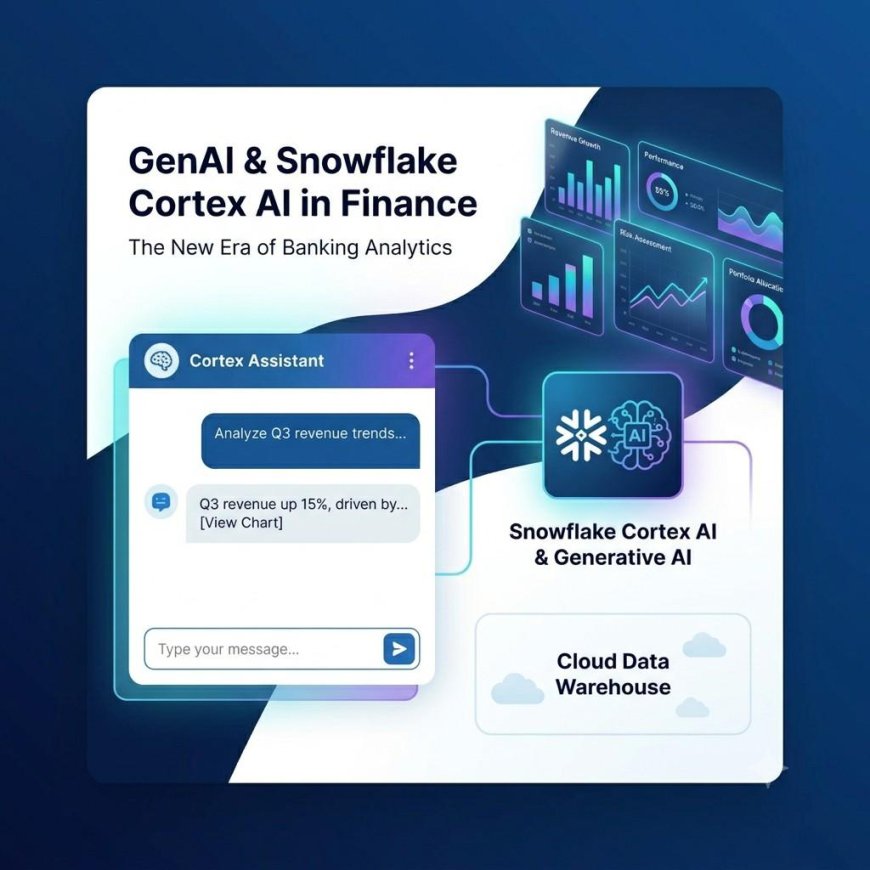
Transformation driven by Artificial Intelligence (AI), cloud computing, and advanced analytics. Traditional financial reporting methods often require extensive manual effort, multiple software systems, and significant time spent analyzing data before meaningful insights can be generated. As organizations continue to generate massive amounts of financial data, there is an increasing need for intelligent solutions that can simplify reporting, improve accuracy, and support faster decision-making.
Generative AI (GenAI) is emerging as one of the most influential technologies in this transformation. Combined with modern cloud data platforms such as Snowflake Cortex AI, organizations can now move beyond static dashboards and reports toward conversational reporting systems that allow users to interact with data using natural language.
This shift is redefining how finance teams, analysts, auditors, and executives access information and make business decisions.
Understanding Conversational Reporting
Conversational reporting refers to the ability to interact with data through natural language queries rather than relying solely on traditional dashboards or SQL queries.
Instead of searching through spreadsheets and complex reports, users can ask questions such as:
- What was the revenue growth during the previous quarter?
- Which business unit generated the highest profit margin?
- What factors contributed to increased operational expenses?
The system then interprets the request, retrieves relevant data, performs analysis, and generates meaningful responses.
This capability significantly reduces the gap between business users and technical teams while enabling faster access to actionable insights.
The Role of Snowflake Cortex AI
Snowflake Cortex AI provides built-in AI capabilities directly within the Snowflake ecosystem. Organizations can leverage large language models, machine learning workflows, and natural language processing features without moving sensitive financial data outside their secure environment.
Some key capabilities include:
- Natural language querying
- Automated report generation
- AI-powered summarization
- Predictive analytics
- Intelligent anomaly detection
- Secure enterprise-grade AI deployment
By integrating these capabilities into financial workflows, organizations can automate repetitive reporting tasks while maintaining governance and compliance standards.
How GenAI is Transforming Financial Reporting
1. Automated Financial Summaries
Financial analysts often spend hours creating executive summaries from detailed reports. GenAI can automatically generate concise explanations of financial performance, highlighting key trends, risks, and opportunities.
This reduces reporting cycles and allows analysts to focus on strategic initiatives rather than manual documentation.
2. Enhanced Decision-Making
Executives require immediate access to critical information. Conversational reporting enables leaders to obtain insights instantly through natural language interactions.
Instead of waiting for custom reports, decision-makers can receive answers in real time, improving responsiveness and business agility.
3. Improved Risk Management
Financial institutions must continuously monitor risks related to investments, fraud, compliance, and operational activities.
AI-powered reporting systems can identify unusual patterns, detect anomalies, and generate alerts before issues become significant business concerns.
4. Increased Accessibility
Traditional business intelligence platforms often require technical expertise. Conversational AI democratizes access to analytics by allowing non-technical users to interact directly with data.
This improves collaboration between finance teams, business stakeholders, and executives.
The Growing Importance of Data Science and ML
The success of GenAI applications depends heavily on strong foundations in data science and ML. Organizations require professionals who understand data preparation, statistical analysis, machine learning algorithms, and AI model deployment.
Modern financial reporting systems combine multiple technologies including:
- Data Engineering
- Machine Learning
- Natural Language Processing
- Generative AI
- Business Intelligence
- Cloud Computing
Professionals who develop expertise across these domains are becoming increasingly valuable in today's job market.
As industries continue adopting AI-powered solutions, learning data science with generative AI has become an essential career pathway for aspiring technology professionals.
Applications Beyond Financial Services
While conversational reporting is transforming finance, similar technologies are creating impact across various sectors.
Healthcare Analytics
Healthcare organizations use AI-driven analytics to improve patient outcomes, optimize operations, and identify treatment trends. Modern healthcare analytics solutions leverage machine learning models and large datasets to support evidence-based decision-making.
Retail and E-Commerce
Businesses use GenAI tools for data analysis to understand customer behavior, forecast demand, and personalize user experiences.
Manufacturing
Predictive maintenance systems powered by AI help organisations reduce downtime and improve operational efficiency.
Banking and Insurance
Conversational AI enables customer service automation, fraud detection, credit risk assessment, and regulatory reporting.
The Rise of AI-Powered Careers
The growing adoption of AI technologies has created significant demand for skilled professionals.
Organizations are actively seeking candidates with expertise in:
- Artificial Intelligence
- Data Science
- Machine Learning
- Data Engineering
- Cloud Platforms
- Generative AI Applications
As a result, many students and working professionals are enrolling in machine learning courses and advanced AI programs to stay competitive in the evolving job market.
The industry is no longer looking only for theoretical knowledge. Employers seek professionals with practical experience in real-world projects, cloud-based analytics, and enterprise AI solutions.
Essential Skills for Future AI Professionals
Individuals aspiring to work in AI-driven industries should focus on developing the following competencies:
Programming and Analytics
Python remains one of the most important programming languages for AI, data science, and analytics.
Data Engineering
Organizations rely on scalable data pipelines to support AI initiatives. Data engineering certification courses help learners understand data architecture, ETL processes, and cloud infrastructure.
Generative AI
Professionals must learn how large language models operate and how GenAI solutions can be integrated into business processes.
Automation Testing Skills
As AI systems become more sophisticated, automation testing skills are increasingly important for validating models, ensuring system reliability, and maintaining software quality.
Cloud Technologies
Platforms such as Snowflake, AWS, Azure, and Google Cloud are becoming standard components of enterprise AI ecosystems.
Why Learning Data Science with Gen AI Matters
The future of analytics lies in combining traditional data science methodologies with advanced generative AI capabilities.
Professionals trained in data science with Gen AI can:
- Build intelligent reporting systems
- Develop AI-powered business applications
- Create predictive analytics solutions
- Automate data-driven decision-making
- Support digital transformation initiatives
This combination provides a significant competitive advantage in today's technology-driven marketplace.
Building Industry-Ready AI Talent with NUCOT
As AI adoption accelerates across industries, quality training becomes essential for career success.
At NUCOT, learners gain exposure to modern technologies through structured programs covering:
- Data Science
- Machine Learning
- Python Programming
- Business Analytics
- Generative AI
- Data Engineering
- Cloud Technologies
- Real-Time Projects
The curriculum is designed to bridge the gap between academic learning and industry requirements.
Students receive hands-on experience working with modern data science AI tools and practical business use cases that reflect real-world challenges faced by organizations today.
For individuals seeking AI job training and placement support, practical project experience and mentorship play a critical role in improving employability and preparing candidates for technical interviews.
Professionals looking for a comprehensive data analytics course can benefit from learning not only analytical techniques but also how AI is transforming modern business operations.
As demand continues to rise for AI professionals, choosing a training program that combines technical depth with practical implementation becomes increasingly important.
Conclusion
Generative AI and Snowflake Cortex AI are revolutionizing financial reporting by enabling conversational interactions with enterprise data. Organizations can now automate report generation, accelerate decision-making, improve operational efficiency, and unlock deeper business insights through AI-powered analytics.
The transformation extends far beyond finance, influencing healthcare analytics, banking, retail, manufacturing, and numerous other industries.
As businesses continue investing in AI technologies, professionals with expertise in data science and ML, data engineering, machine learning, and generative AI will remain highly sought after.
The future belongs to individuals who can combine analytical thinking, technical expertise, and AI innovation to solve real-world business challenges. Investing in artificial intelligence training today can open the door to some of the most exciting and rewarding career opportunities of the coming decade.