Acrylic Resins Market on Track to Surpass US$ 37.2 Billion by 2033 Amid Growing Demand for Coatings, Adhesives, and Construction Materials
Acrylic Resins Market
 raajblog
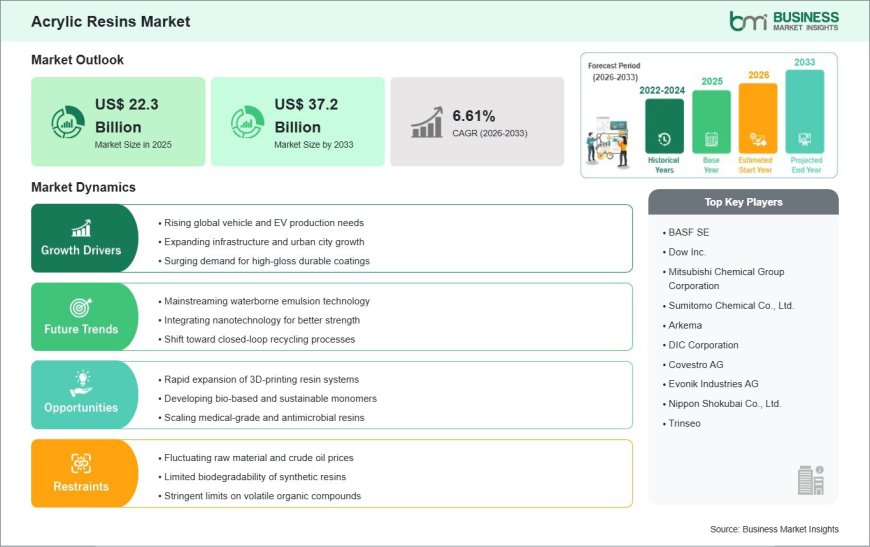
The Acrylic Resins Industry is experiencing steady growth worldwide, supported by rapid industrialization, increasing infrastructure development, and the rising demand for high-performance coatings and adhesives.
According to Business Market Insights, the global Acrylic Resins Market size is expected to reach US$ 37.2 Billion by 2033 from US$ 22.3 Billion in 2025, registering a CAGR of 6.61% from 2026 to 2033.
Download Sample Report : https://www.businessmarketinsights.com/sample/BMIPUB00032491
What Are Acrylic Resins?
Acrylic resins are specialized thermoplastic or thermosetting synthetic polymers derived from acrylic acid, methacrylic acid, or related compounds. These resins are engineered for exceptional transparency, weather resistance, and color stability, and they are heavily deployed across architectural coatings, industrial adhesives, sealants, and elastomeric products. They feature highly customizable cross-linking structures that allow them to be formulated for extreme durability, gloss retention, and chemical resistance.
Common applications for acrylic resins include architectural paints, automotive topcoats, industrial adhesives, DIY coatings, and specialty elastomers. Modern formulations increasingly feature water-borne and high-solids technologies to support more sustainable manufacturing operations. The inclusion of these advanced chemistries ensures that the materials can safely be used within densely populated municipal zones and indoor environments where emission minimization and air quality control are legally enforced parameters.
Industry Drivers
A major driver of the Acrylic Resins Industry is the surge in global building and construction activities. Developers are funding residential housing, commercial complexes, and public infrastructure projects to support economic growth and improve urban living standards. These large-scale projects require substantial volumes of acrylic resins for weather-resistant exterior paints, interior decorative coatings, waterproofing solutions, and structural adhesives, directly translating into robust bulk procurement orders for chemical manufacturing entities.
The expanding automotive industry is another important growth factor. Modern vehicle manufacturing requires highly durable, lightweight, and chemically resistant coatings to protect automotive bodies from harsh environmental conditions, all of which increase the need for premium acrylic topcoats and refinishes. Growing demand in the packaging sector is also supporting industry expansion, as global e-commerce and food safety regulations call for reliable, fast-curing acrylic adhesives and sealants that provide high bonding strength without compromising product integrity.
Sustainability and regulatory pressures are further boosting demand. The strict enforcement of environmental regulations regarding VOC emissions is helping drive the rapid transition from traditional solvent-based resins to water-based and powder alternatives. The rising adoption of bio-based acrylic resins is also creating new opportunities as green building initiatives gain importance across corporate and state supply chains, transforming environmental compliance into a core financial asset for raw material suppliers.
Industry Segmentation
By Chemistry
By Solvency
By Application
The water-based segment dominated the industry in 2025 due to its extensive use in architectural paints and tightening global environmental regulations. Paints and coatings remained the leading application segment because of the immense volume of material required for global construction and infrastructure projects. The building and construction sector accounted for the largest end-user share, supported by continuous investments in residential housing, commercial renovations, and smart city infrastructure.
Regional Insights
Top Players in the Acrylic Resins Industry
The industry is highly competitive, with leading chemical manufacturers focusing on polymer innovation, sustainable formulations, production capacity expansion, and strategic acquisitions to strengthen their global positions.
These companies continue to invest in advanced polymer science, alternative bio-based feedstocks, fast-curing technologies, and hybrid resin platforms to improve formulation efficiency and address evolving customer requirements.
Technological Innovations
Technological innovation is transforming the Acrylic Resins Industry. The development of advanced water-borne acrylic emulsions allows manufacturers to achieve the exact performance metrics of traditional solvent-based resins—such as high gloss, corrosion resistance, and fast drying times—without the associated toxic emissions. Chemical research teams can now instantly optimize molecular cross-linking parameters to customize resins for highly specific industrial applications.
Manufacturers are also developing sophisticated bio-based acrylic resins derived from renewable biomass rather than petroleum feedstocks. Artificial intelligence and machine learning are increasingly being integrated into chemical R&D processes, allowing formulators to predict polymer behavior and accelerate the discovery of high-performance, eco-friendly resin variations with minimal trial-and-error.
The growing adoption of UV-curable acrylic resins is another major trend. High-speed manufacturing and energy reduction goals are encouraging consumer electronics and packaging companies to invest in radiation-curing solutions for the future, replacing historical thermal-curing ovens with highly efficient, instant-drying optical systems.
Future Industry Outlook
The future outlook for the Acrylic Resins Industry remains highly positive. Rising construction spending, automotive production, packaging demands, and continuous polymer innovation are expected to support steady growth through 2033. The integration of advanced nanotechnology into acrylic matrices will further allow manufacturers to produce ultra-durable, scratch-resistant, and self-cleaning coatings safely and at scale.
As green chemistry, smart coatings, and high-efficiency formulations continue to advance, acrylic resins will become more versatile, durable, and environmentally sustainable. Chemical companies that focus on sustainability and material science transformation are likely to capture the strongest growth opportunities in the coming years, positioning themselves at the center of the next generation of industrial manufacturing.
Frequently Asked Questions (FAQs)
What is the projected size of the Acrylic Resins Market by 2033?
The market is projected to reach US$ 37.2 Billion by 2033, rising from US$ 22.3 Billion in 2025.
What factors are driving industry growth?
Key drivers include rapid infrastructure development, expansion in automotive manufacturing, stringent environmental regulations favoring water-based products, and technological advancements in polymer science.
Which application segment dominates the industry?
Paints & coatings currently hold the largest market share because of their widespread necessity in building construction, automotive finishes, and industrial protection.
Which region leads the industry?
Asia-Pacific dominates the industry due to booming construction sectors, massive industrialization, and strong demand from the packaging and automotive sectors.
Browse More Reports:
https://www.businessmarketinsights.com/reports/coronary-artery-bypass-grafts-market
https://www.businessmarketinsights.com/reports/industrial-explosives-market
https://www.businessmarketinsights.com/reports/polyethylene-glycol-market
About Us
Business Market Insights is a market research platform that provides subscription service for industry and company reports. Our research team has extensive professional expertise in domains such as Electronics & Semiconductor; Aerospace & Defense; Automotive & Transportation; Energy & Power; Healthcare; Manufacturing & Construction; Food & Beverages; Chemicals & Materials; and Technology, Media, & Telecommunications.
Contact Us
If you have any questions about this report or would like further information, please contact us:
Contact person: Ankit Mathur
Email: sales@businessmarketinsights.com
Phone: +16467917070