AI for Tax Consultants: The Complete Guide in Pakistan
At the Institute of Corporate and Taxation (ICT), we've watched this shift closely while training thousands of students who now combine AI-powered tools with solid tax knowledge to serve clients faster and more accurately.
 Ehtisham
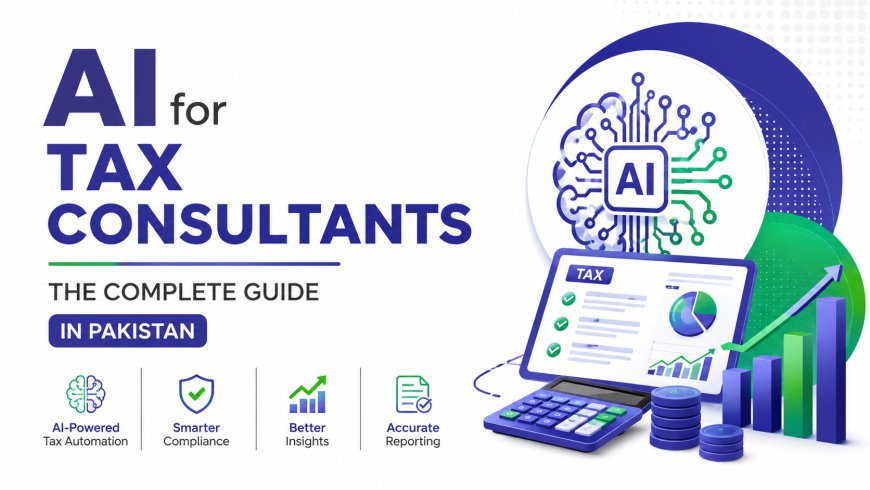
If you're a tax consultant in Pakistan wondering whether artificial intelligence will replace your job or simply make it easier, you're asking the right question at the right time. AI for tax consultants is no longer a futuristic idea — it's already reshaping how professionals handle tax filing, compliance checks, and client advisory work across firms in Karachi, Lahore, and Islamabad. At the Institute of Corporate and Taxation (ICT), we've watched this shift closely while training thousands of students who now combine AI-powered tools with solid tax knowledge to serve clients faster and more accurately. Whether you're preparing FBR returns, handling international taxation, or advising businesses on VAT and GST, tools like ChatGPT, Microsoft Copilot, and specialized tax software are changing the daily workflow of every tax professional. This guide breaks down what AI actually means for tax consultants, how it's transforming tax planning and compliance, and why pairing AI awareness with a strong foundation — like the one you build in ICT's Certified Tax Advisor (CTA) course — has become essential for career growth in 2026. We'll also look at real tools, salary trends, and how programs like Advance Taxation and Litigation (ATL) and Master Sales Tax help students combine traditional expertise with modern technology. And if you've been asking whether AI will replace tax consultants, the honest answer is more nuanced than a simple yes or no — by the end of this article, you'll know exactly where you stand.
What Is AI for Tax Consultants?
AI for tax consultants refers to the use of artificial intelligence tools — like large language models (ChatGPT, Claude, Gemini), machine learning-based tax software, and automation platforms — to speed up tax preparation, reduce compliance errors, analyze financial documents, and support tax planning decisions. It doesn't replace the tax consultant's judgment; it replaces repetitive, manual work like data entry, document review, and first-draft calculations, freeing consultants to focus on strategy, client relationships, and complex advisory work.
In simple terms: AI handles the heavy lifting of data processing, while the human consultant still makes the final call on interpretation, compliance strategy, and client-specific advice.
How AI Actually Works in Tax Practice: A Step-by-Step Guide
Step 1: Document Collection and OCR Processing
AI-powered OCR (Optical Character Recognition) tools scan invoices, bank statements, and receipts, automatically extracting figures instead of a human typing them manually. This is the foundation of AI-powered bookkeeping and AI invoice processing.
Step 2: Data Categorization and Cleaning
Machine learning models sort transactions into categories — income, expenses, VAT, withholding tax — using pattern recognition trained on historical data. This is where AI expense categorization and AI financial reporting tools save the most time.
Step 3: Compliance Cross-Checking
AI tax compliance automation tools compare the categorized data against current tax laws (like the Income Tax Ordinance or FBR regulations) to flag inconsistencies before filing. Consultants who understand how FBR audit notices work know how valuable this early-warning system can be.
Step 4: Draft Preparation
The AI generates a first draft of the tax return or financial report. It's fast — but it's a draft, not a final answer. Tools like Thomson Reuters and Wolters Kluwer platforms are widely used for this in international tax practices.
Step 5: Human Review and Client Advisory
This is where the tax consultant's real value shows up. AI can't understand a client's business context, negotiate settlements, represent someone during an FBR audit, or make judgment calls on gray areas of tax law. That's still 100% human work.
Tips for Using AI Effectively in Tax Practice
- Always verify AI-generated numbers against source documents before filing.
- Never share unmasked client financial data with public AI tools without checking data privacy policies.
- Use AI for first drafts, not final submissions.
- Keep learning — AI tools update constantly, and so do tax laws.
Why AI Matters for Tax Consultants — Especially in Pakistan
Pakistan's tax landscape is going digital fast. The FBR's digital transformation initiative, the rollout of e-invoicing, and the shift toward digital tax audits mean tax authorities themselves are using AI to detect discrepancies and flag non-compliant filers. If tax consultants don't understand how these systems work, they risk falling behind — both in efficiency and in client trust.
Here's why this matters right now:
- FBR's IRIS 2.0 system already uses automated risk-scoring to flag returns for review, something covered in detail in our FBR IRIS 2.0 survival guide.
- Freelancers and small firms are adopting AI tools faster than large corporations because the cost of entry is low — see our breakdown of AI tools every freelance tax consultant will use in 2026.
- Clients expect faster turnaround. A manual process that used to take three days can now take three hours with the right AI-assisted workflow, as explored in our manual vs AI-assisted tax filing comparison.
- Global firms (Deloitte, PwC, EY, KPMG) already use AI for tax research, transfer pricing analysis, and audit preparation — and Pakistani consultants working with international clients need to speak the same language.
According to IBM's overview of artificial intelligence, AI systems are best understood as tools that simulate human reasoning to process data faster than manual methods — which is exactly why tax and accounting functions, built on massive volumes of structured data, are among the fastest-growing use cases for AI adoption globally.
Key AI Tools, Skills, and Benefits for Tax Professionals
Popular AI Tools Tax Consultants Should Know
| Tool | Best Used For |
|---|---|
| ChatGPT | Drafting client communication, explaining tax rules, brainstorming tax strategies |
| Microsoft Copilot | Excel-based tax calculations, automating spreadsheets |
| Google Gemini | Research and document summarization |
| Claude AI | Long document analysis, reviewing lengthy tax circulars |
| Perplexity AI | Quick tax research with cited sources |
| Thomson Reuters (Checkpoint) | Professional tax research and compliance databases |
| Wolters Kluwer (CCH) | Tax and accounting workflow automation |
Understanding the software tax professionals actually use day to day gives you a real edge over consultants who only know theory.
Skills Every Modern Tax Consultant Needs
- Core tax knowledge — income tax, sales tax, VAT, GST, corporate tax, and international taxation fundamentals.
- Prompt engineering basics — knowing how to ask AI tools the right questions to get accurate, usable answers.
- Data analysis — understanding spreadsheets, financial statements, and pivot tables. Our Master Advanced Excel course is a strong starting point.
- AI literacy — recognizing when AI output is wrong (AI hallucination is real, especially with tax law citations).
- Client communication — the human skill AI simply cannot replicate.
- Compliance awareness — knowing FBR rules well enough to catch AI mistakes before they cost a client money.

Benefits of AI Adoption for Tax Consultants
- Faster turnaround on routine filings, freeing up time for higher-value advisory work.
- Fewer manual calculation errors, especially in repetitive bulk filings.
- Better client capacity — one consultant can now serve more clients without sacrificing quality.
- Improved audit readiness through continuous, automated compliance checks.
- A stronger competitive position against firms still relying entirely on manual processes.
AI in Tax Compliance and Tax Planning
AI tax compliance tools don't just speed up filing — they actively reduce risk. By cross-referencing transaction data against current tax codes, these systems catch mismatches that a tired human reviewer might miss during a busy filing season, such as the run-up to FBR's income tax deadline.
On the planning side, AI-powered predictive analytics can model different tax scenarios — for example, showing a business owner how restructuring their company or timing a transaction differently could legally reduce their tax liability. This is especially valuable in areas like corporate tax planning and cross-border transactions, where consultants trained through courses like UK Taxation, USA Taxation, UAE Taxation, Saudi Taxation, and Canadian Taxation are increasingly using AI to handle the technical complexity of multiple tax jurisdictions at once.
It's worth being clear-eyed here too: AI-generated tax calculations still carry legal risk if used without professional oversight. Our detailed piece on AI tax calculation and legal risk in 2026 explains exactly where the liability lines are drawn — a must-read before relying too heavily on any automated tool.
Job Scope, Salary, and Demand for AI-Skilled Tax Consultants in Pakistan
Demand for tax professionals who understand both taxation fundamentals and AI tools is climbing fast. Firms — local and international — are actively looking for consultants who can work faster without sacrificing accuracy.
Current trends worth knowing:
- Tax consultants who combine AI fluency with core certifications are commanding noticeably higher pay than those relying on manual methods alone, as shown in our detailed tax advisor salary and scope guide for Pakistan (2026).
- International remote work is growing — Pakistani consultants are increasingly serving US, UK, UAE, and Canadian clients, a trend covered in tax skills salary comparison across USA, UK, UAE, and Saudi Arabia.
- New job titles are emerging entirely because of AI — compliance automation specialists, tax technology consultants, and AI-assisted audit preparers, explored in new tax careers for 2026 in digital compliance roles.
- The broader profession itself is evolving quickly — see our full breakdown in taxation careers evolution 2026: technology and AI.
The takeaway: AI isn't shrinking the job market for tax consultants — it's shifting what "valuable" looks like. Consultants who can operate AI tools confidently, on top of real tax knowledge, are the ones seeing the strongest demand and salary growth.
Why Choose ICT to Learn AI + Taxation (Free and Paid Resources)
Learning taxation and AI separately only gets you halfway there. What actually builds a career is combining both — and that's exactly the gap ICT was built to fill.
Here's why students consistently choose ICT over other options, as detailed in our guide on why choose ICT:
- Practical, hands-on training — not just theory, but real FBR portals, real case studies, and real client scenarios.
- Certified Tax Advisor (CTA) and Advance Taxation and Litigation (ATL) programs that build a strong compliance foundation before layering on AI tools.
- Technology-forward courses like the AI-Driven CFO Course, Certified AI Automation, and Certified Data Analyst course that teach students how to actually use AI tools in a professional workflow.
- International taxation specializations across UK, USA, UAE, Saudi, and Canadian systems — rare among local institutes.
- Support for entrepreneurs and consultants through courses like Certified Business Advisor, Company Secretary Course, and LLC Formation Course.
Free and Paid Ways to Start Learning
Free resources to explore first:
- YouTube tutorials on ChatGPT and Excel Copilot basics.
- Free introductory courses on platforms like Coursera covering AI fundamentals.
- ICT's blog library, including guides like AI in taxation: tools, risks, and opportunities.
Paid, structured learning (recommended for career-building):
- ICT's Master Advanced Excel course for data-handling skills.
- The Certified Tax Advisor course for a strong compliance base.
- The AI-Driven CFO Course for finance leaders wanting to integrate AI into decision-making.
Tips for Choosing the Right Path
- Start with a core taxation certification before layering on AI tools — you need to know what "correct" looks like to catch AI mistakes.
- Choose an institute with hands-on labs, not just video lectures.
- Look for programs that update their curriculum yearly, since both tax law and AI tools change fast.
Real-World Examples of AI in Tax Practice
Example 1 — Small Firm Efficiency: A two-person tax consultancy in Lahore used AI-powered OCR to process 200+ client invoices in a single afternoon — work that previously took three full days of manual data entry.
Example 2 — Corporate Compliance: A mid-sized manufacturing company used AI-assisted compliance software to flag a sales tax mismatch before an FBR audit, avoiding a potential penalty — a scenario very similar to what's discussed in our guide on FBR non-filer penalties in 2026.
Example 3 — Freelance Consultant Scaling: A freelance tax consultant working with US clients used ChatGPT to draft first responses to routine IRS-related client questions, then reviewed and finalized each response personally — cutting response time in half while maintaining accuracy, a strategy covered in our piece on how to prepare IRS tax returns professionally.
Example 4 — Global Firms Setting the Standard: Large firms like Deloitte, PwC, EY, and KPMG already use AI-powered platforms for transfer pricing analysis and large-scale compliance monitoring — proof that this isn't a trend limited to small firms, but the direction the entire industry is heading.
Future Career Opportunities: AI + Taxation in 2026 and Beyond
The consultants who thrive over the next five years will be the ones who treat AI as a colleague, not a threat. Here's where the profession is heading, based on trends covered in our future of tax advisory in Pakistan 2026–2030:
- AI Tax Copilots — dedicated AI assistants built specifically for tax research and drafting.
- Agentic AI for tax workflows — AI systems that can handle multi-step tasks like gathering documents, categorizing them, and drafting a return with minimal human input.
- Real-time compliance monitoring — instead of quarterly reviews, AI systems will flag issues as they happen.
- Hybrid consultant roles — professionals who blend tax advisory, data analysis, and light AI-tool management into one job title.
- Growing demand for freelance and remote tax consulting, as covered in how Pakistanis are building global tax careers.
For students exploring related tech-and-business hybrid skills, courses like Master Import & Export, the Odoo ERP Course, and Master Intellectual Property Law open doors into adjacent, high-demand fields that increasingly overlap with tax and compliance work.
Frequently Asked Questions
Q: Will AI replace tax consultants?
No. AI automates repetitive tasks like data entry and draft calculations, but tax consultants are still needed for judgment calls, client relationships, audit representation, and interpreting gray areas of tax law.
Q: What is the best AI tool for tax consultants?
There's no single "best" tool — ChatGPT and Claude work well for research and drafting, Microsoft Copilot excels in Excel-based tasks, and specialized platforms like Thomson Reuters or Wolters Kluwer are better for formal compliance work.
Q: Can AI prepare tax returns accurately on its own?
AI can generate a strong first draft, but it should always be reviewed by a qualified tax professional before submission, since AI tools can make factual errors or misapply tax rules.
Q: Do I need to learn coding to use AI in tax consulting?
No. Most AI tools used in tax practice — like ChatGPT, Copilot, and tax automation software — are designed for non-technical users. Basic prompt-writing skills are usually enough.
Q: Is it worth learning AI skills alongside a taxation course?
Yes. Consultants who combine strong tax knowledge with AI tool fluency are seeing faster career growth and higher demand, especially for international and freelance work.
Q: How can I start learning both taxation and AI together?
Start with a structured taxation certification to build your foundation, then layer on AI-focused courses. ICT's combination of tax certifications and AI-driven courses is designed exactly for this path.
Conclusion: Your Next Step Starts Here
AI for tax consultants isn't about replacing human expertise — it's about upgrading it. The consultants who combine deep tax knowledge with confident use of AI tools are the ones building faster, more profitable, and more future-proof careers in 2026 and beyond. Whether you're just starting out or looking to modernize an existing practice, the path forward is clear: build a strong tax foundation, then layer AI skills on top of it.
At ICT, that's exactly the combination we've built our programs around — from the Certified Tax Advisor course to the AI-Driven CFO Course and everything in between. Don't wait until AI becomes an industry standard everyone else has already mastered — get ahead of the curve now.
Book a seat at ICT and start building a tax career that's ready for the AI-driven future.