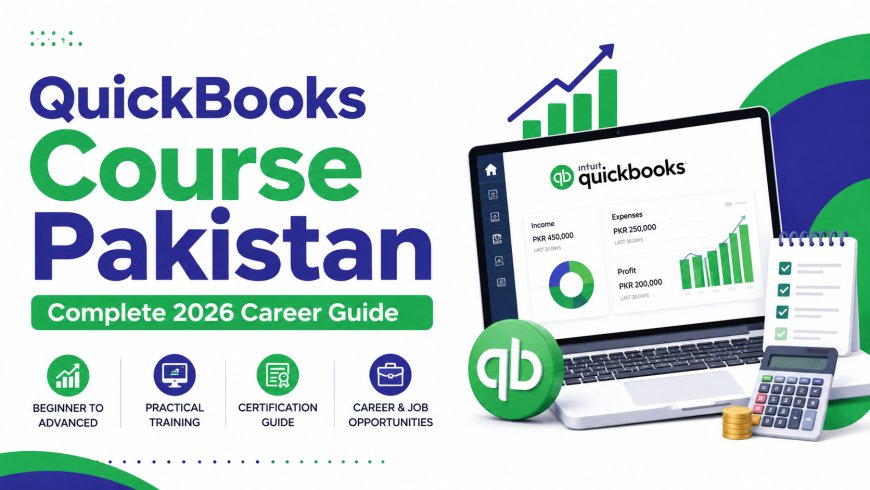
QuickBooks Course Pakistan: Complete 2026 Career Guide
At the Institute of Corporate and Taxation (ICT), we've trained hundreds of students who now work as bookkeepers, remote accountants, and financial analysts for local and international clients — many of them starting with zero accounting background.
 Ehtisham
If you have ever typed "QuickBooks course Pakistan" into Google late at night, wondering whether it's actually worth your time and money, you're not alone. Thousands of students, freelancers, and small business owners across Karachi, Lahore, and Islamabad ask the same question every month. The short answer is yes — QuickBooks is one of the fastest-growing skills in Pakistan's accounting job market right now, and learning it properly can genuinely change your career trajectory.
At the Institute of Corporate and Taxation (ICT), we've trained hundreds of students who now work as bookkeepers, remote accountants, and financial analysts for local and international clients — many of them starting with zero accounting background. This guide walks you through everything: what QuickBooks actually is, why it matters so much in Pakistan's economy, what skills you'll gain, real salary numbers, and how to get certified without wasting time on the wrong resources. If you're also curious about complementary skills, you can explore our Certified Data Analyst course or check out why students choose ICT for practical, job-focused training.
By the end of this article, you'll know exactly what a QuickBooks Course Pakistan program should cover, how much it costs, what jobs it opens up, and how to start — whether you're a student, a working professional, or a freelancer trying to add a high-demand skill to your resume.
Is QuickBooks Course Worth It in Pakistan?
Yes. QuickBooks is the world's most widely used small-business accounting software, and Pakistani accountants, bookkeepers, and freelancers who learn it can work for clients in the USA, UK, UAE, Canada, and Australia — often earning in dollars while living in Pakistan. A structured QuickBooks course usually takes 4–8 weeks, costs a fraction of a university semester, and leads directly to roles like bookkeeper, accounts assistant, or remote financial analyst.
What Is QuickBooks? A Simple Explanation
QuickBooks is cloud-based and desktop accounting software developed by Intuit, used by millions of small and medium businesses worldwide to manage their day-to-day finances. Think of it as a digital ledger, invoice generator, payroll processor, and financial reporting tool — all rolled into one dashboard.
Instead of manually writing journal entries in a register or juggling complicated Excel sheets, QuickBooks automates most of the accounting cycle:
- Recording sales, purchases, and expenses
- Generating and sending invoices
- Managing accounts payable and accounts receivable
- Running payroll
- Reconciling bank transactions automatically
- Producing financial statements like the balance sheet, income statement, and cash flow statement
There are two main versions people learn: QuickBooks Online, which is cloud-based and accessible from anywhere, and QuickBooks Desktop, which is installed locally and often preferred by larger or more traditional businesses. Most modern QuickBooks courses in Pakistan focus heavily on QuickBooks Online because that's what international clients and remote employers are now using.
Why QuickBooks Matters — Especially in Pakistan
H3: The Local Job Market Reality
Pakistan's accounting and bookkeeping job market has changed dramatically over the last five years. Manual bookkeeping is disappearing, and businesses — both local SMEs and international clients hiring Pakistani freelancers — expect candidates to already know at least one accounting software platform. QuickBooks tops that list globally, followed by Xero and TallyPrime.
H3: The Freelance and Remote Work Angle
Platforms like Upwork and Fiverr are flooded with QuickBooks bookkeeping gigs from US and UK small businesses. Because QuickBooks is the standard software in those markets, a Pakistani freelancer who's certified in it has a real competitive advantage — you can bill in USD or GBP while working from home. This mirrors what we've seen in taxation freelancing too; our blog on freelancer to tax consultant roadmap covers a similar international freelancing path.
H3: Small Business Growth
Pakistan's SME sector is expanding fast, and most small business owners can't afford a full-time CFO. They need affordable, skilled people who can manage their books using QuickBooks — creating steady local demand for certified professionals in Islamabad, Lahore, Karachi, and beyond.
Key Skills, Tools, and Benefits You'll Gain
A well-structured QuickBooks Course Pakistan program (like the one at ICT) should cover both software mechanics and real accounting logic. Here's what a complete curriculum typically includes:
Core Skills:
- Setting up a company file and chart of accounts
- Recording sales, purchases, and journal entries
- Invoice creation and automation
- Bank feeds and reconciliation
- Payroll processing basics
- Inventory tracking for product-based businesses
- Generating financial reports (P&L, balance sheet, cash flow)
- Multi-currency and multi-user handling
Practical Benefits:
- Faster, error-free bookkeeping compared to manual methods
- Real-time financial visibility for business owners
- Easier tax preparation and compliance
- Strong foundation for advanced accounting software like Xero, SAP, or Odoo ERP
If you want to build a broader accounting toolkit, pairing QuickBooks with Master Advanced Excel is a smart move — most employers expect both. Students planning to work with UK or Australian clients often go further and combine this with our UK Accountant Course or Australian Accounting Course, since many international firms use QuickBooks alongside Xero.
Step-by-Step Guide: How to Learn QuickBooks in Pakistan
H3: Step 1 — Learn the Fundamentals of Accounting First
You don't need a commerce degree, but understanding basic concepts like debit/credit, journal entries, and the accounting cycle makes QuickBooks click much faster. Even a short primer helps.
H3: Step 2 — Choose the Right Learning Path (Free vs Paid)
- Free resources: Intuit's own QuickBooks tutorials and YouTube channels are good for casual exploration, but they lack structure, certification, and hands-on practice with real business scenarios.
- Paid, certified courses: A structured institute program gives you a guided curriculum, practical case studies, instructor support, and a certificate that employers actually recognize — which matters a lot in Pakistan's competitive job market.

H3: Step 3 — Practice on Real Company Files
Theory alone won't get you hired. Practical QuickBooks training should involve working on simulated or real business files — recording actual transactions, generating actual invoices, and reconciling actual bank statements.
H3: Step 4 — Get Certified
A recognized certificate — ideally from an institute with strong industry connections — signals to employers and freelance clients that your skills are verified, not self-taught guesswork.
H3: Step 5 — Build a Portfolio or Take On Small Freelance Projects
Once certified, take on a few small bookkeeping projects (even unpaid or discounted ones initially) to build real-world proof of your skills before pitching bigger clients.
H4: Quick Tips for Faster Learning
- Practice daily for at least 30 minutes rather than cramming once a week
- Learn keyboard shortcuts early — they save serious time
- Study real invoices and bank statements, not just sample data
- Join QuickBooks ProAdvisor communities for updates and networking
- Combine QuickBooks with basic Excel skills for reporting flexibility
Job Scope, Salary, and Demand in Pakistan
QuickBooks-certified professionals in Pakistan typically find opportunities in three categories:
- Local Employment: Bookkeeper, accounts executive, or junior accountant roles at SMEs, retail businesses, and service companies.
- Remote/International Roles: Many US and UK small businesses hire Pakistani bookkeepers remotely, often paying in USD.
- Freelancing: Platforms like Upwork, Fiverr, and LinkedIn are active marketplaces for QuickBooks bookkeeping gigs.
Salary Range (approximate, varies by experience and client type):
- Entry-level local bookkeeping roles: PKR 35,000 – 60,000/month
- Mid-level accounts roles with QuickBooks + Excel skills: PKR 60,000 – 100,000/month
- Remote/international freelance work: Often $8–$25/hour depending on complexity and client location
Demand is rising steadily because more Pakistani accountants are now targeting international clients — a trend we've also tracked closely in our taxation programs, including the USA Taxation course and UK Taxation course, both popular among students building cross-border finance careers.
Why Choose ICT for Your QuickBooks Course in Pakistan
There's no shortage of institutes claiming to teach accounting software in Pakistan, but not all of them offer practical, job-ready training. Here's why choose ICT for your QuickBooks journey:
- Practical, hands-on curriculum built around real business scenarios, not just theory
- Experienced instructors who've worked in real accounting and finance roles
- Certification that employers and freelance clients recognize
- Career support including guidance on freelancing, resume building, and interview prep
- Complementary courses available in the same ecosystem — from Master Advanced Excel to Certified Data Analyst to the Odoo ERP course, so you can build a full accounting and finance skillset in one place
Students who want to widen their career options later often go on to explore our Advance Taxation courses at ICT or the Certified Tax Advisor program, since bookkeeping and taxation skills naturally complement each other in real accounting jobs. You can browse our complete list of programs on the ICT courses page.
Real-World Examples
Example 1: A Lahore-based commerce graduate with no prior software experience completed a QuickBooks course and landed a remote bookkeeping contract with a US-based e-commerce store within two months of certification, handling their monthly reconciliations and financial reports.
Example 2: A small textile business in Faisalabad switched from manual ledgers to QuickBooks after hiring a certified bookkeeper. Within six months, the owner reported faster invoicing, fewer payment delays, and clearer visibility into cash flow — a common outcome for SMEs adopting cloud accounting software.
Example 3: A freelancer already offering tax filing services (similar to the paths described in our tax freelancing guide) added QuickBooks bookkeeping as a second service line, effectively doubling monthly freelance income by offering a combined bookkeeping-plus-tax-filing package to small business clients.
Future Career Opportunities
Learning QuickBooks isn't a dead-end skill — it's a launchpad. Once you're comfortable with it, natural next steps include:
- Advanced accounting software: Xero, Sage, TallyPrime, or Odoo ERP
- Data analysis: Many bookkeepers move into financial analytics roles; our AI Data Analyst course is a popular next step
- Taxation specialization: Combining bookkeeping with tax knowledge (UK, USA, UAE, Saudi, or Canadian taxation) significantly increases earning potential
- CFO-level roles: Long-term, some professionals progress toward strategic finance roles — our AI-Driven CFO Course is designed exactly for that trajectory
- Starting your own bookkeeping firm: Many ICT graduates eventually build their own small bookkeeping or accounting consultancy serving multiple SME clients
According to industry research from sources like Coursera's finance career insights, accounting and bookkeeping skills paired with software proficiency remain among the most in-demand hybrid skills globally — a trend expected to continue through 2026 and beyond as more businesses digitize their finances.
Frequently Asked Questions
1. Is QuickBooks hard to learn for beginners?
No. QuickBooks is designed to be user-friendly, and most students with no accounting background can become comfortable with core functions within 4–6 weeks of structured, practical training.
2. How much does a QuickBooks course cost in Pakistan?
Course fees vary by institute, but a certified QuickBooks program in Pakistan typically costs significantly less than a university semester, with flexible payment options at most training centers, including ICT.
3. Can I get a job with just a QuickBooks certification?
Yes, especially for entry-level bookkeeping or accounts assistant roles. Combining it with Excel or basic taxation knowledge further improves your job prospects.
4. Is QuickBooks Online better than QuickBooks Desktop?
For most beginners and freelancers, QuickBooks Online is preferable because it's cloud-based, accessible from anywhere, and the version most international clients currently use.
5. Can I work with international clients using QuickBooks skills from Pakistan?
Absolutely. Many Pakistani freelancers already do this successfully through Upwork and Fiverr, offering remote bookkeeping services to US, UK, and Canadian small businesses.
6. Does QuickBooks help with tax filing too?
Yes, QuickBooks generates the financial reports needed for accurate tax filing, and pairing it with a taxation course — such as our Master Sales Tax course — makes you far more valuable to small business clients.
Conclusion: Your Next Step Starts Here
QuickBooks isn't just software — it's a career accelerator for anyone serious about accounting, bookkeeping, or freelance finance work in Pakistan. Whether you're a student exploring your first career move, a professional wanting to add a high-demand skill, or a freelancer looking to serve international clients, a certified QuickBooks Course Pakistan program gives you a practical, fast, and affordable path forward.
At ICT, we've built our training around real business scenarios, not just theory — because that's what actually gets our students hired. If you're ready to take the next step, don't wait for the "perfect time."
Book a seat at ICT today and start building the accounting career you've been thinking about.