Airport Lighting Market Growth Story Driven by 175.0% Revenue Increase Through 2033
Airport lighting constitutes a complex network of visual aids and illumination systems installed across airfields to ensure the safe and efficient navigation of aircraft during takeoff, landing, and ground taxiing operations.
 raajblog
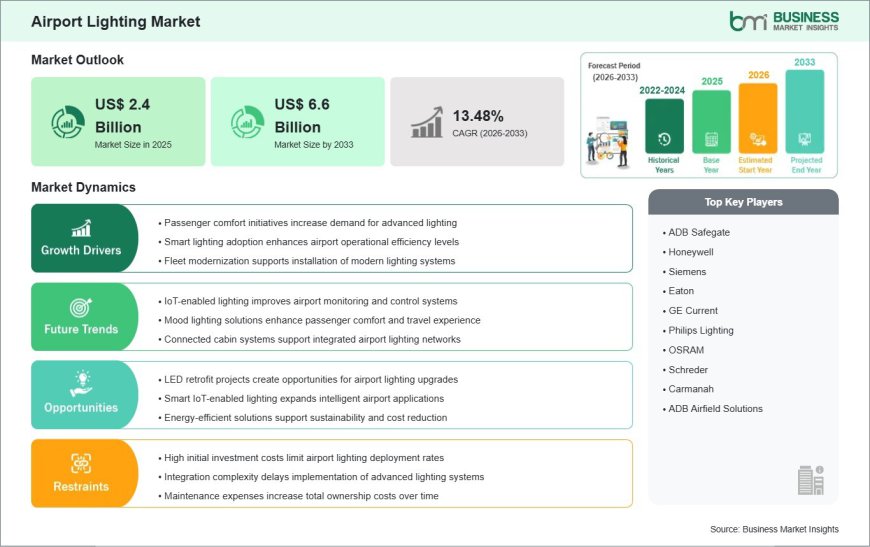
As modern commercial hubs and regional airports increasingly prioritize advanced LED architectures, smart airfield lighting control and monitoring systems (ALCMS), and solar-powered fixtures to minimize carbon footprints, a wave of infrastructure modernization is driving rapid growth across the airport lighting sector.
This steady expansion is substantiated by Business Market Insights, which highlights that the global Airport Lighting Market is on track to record a 13.48% CAGR between 2026 and 2033, rising significantly from US$ 2.4 billion in 2025 to US$ 6.6 billion by 2033.
Technological advancements in solar-powered configurations, LED transitions, and smart airfield lighting control and monitoring systems (ALCMS) are profoundly reshaping the airport lighting industry. Manufacturers are increasingly focusing on delivering IoT-enabled, long-lasting LED fixtures equipped with automated intensity adjustment, real-time predictive maintenance sensors, and seamless integration with broader smart-airport ecosystems. This strategic shift allows global operators to achieve highly optimized energy consumption and lower total cost of ownership while comfortably meeting strict ICAO and FAA safety compliance mandates.
Download Sample Report : https://www.businessmarketinsights.com/sample/BMIPUB00035534
What Is Airport Lighting?
Airport lighting constitutes a complex network of visual aids and illumination systems installed across airfields to ensure the safe and efficient navigation of aircraft during takeoff, landing, and ground taxiing operations. These highly specialized lighting setups are critical for maintaining continuous airport operations during the night, heavy rainfall, fog, and other low-visibility conditions. They provide pilots with essential visual references regarding alignment, descent angles, and runway boundaries.
Common airport lighting configurations include runway edge lights, approach lighting systems (ALS), taxiway centerline lights, precision approach path indicators (PAPI), and obstruction lights. Modern airport lighting infrastructure is increasingly migrating from traditional halogen and incandescent lamps to high-intensity LED systems. These state-of-the-art visual aids are strictly regulated by aviation authorities like the FAA and ICAO, ensuring that flight crews can navigate challenging weather and complex airspace while maintaining the highest standard of safety.
Industry Drivers
A major driver of the Airport Lighting Industry is the unprecedented surge in global air passenger traffic and the resulting expansion of aviation infrastructure. As airports worldwide operate closer to their maximum capacity, authorities are investing heavily in terminal expansions, new runway constructions, and CAT II/III operational upgrades. The need to accommodate higher flight frequencies safely, particularly during nighttime and adverse weather, necessitates robust investments in advanced airfield lighting.
The strict regulatory mandates for enhanced operational safety and energy efficiency are also crucial growth factors. Traditional halogen and high-intensity discharge (HID) fixtures consume substantial power and require frequent, costly maintenance. Airport operators facing strict environmental sustainability targets and high operational expenses are actively retrofitting legacy lighting grids in favor of long-lasting, eco-friendly LED technology.
Furthermore, the rising integration of smart airport concepts and digitalization provides a sustained boost to leading lighting manufacturers. The transition toward intelligent Advanced Surface Movement Guidance and Control Systems (A-SMGCS), which link individual lighting fixtures to real-time air traffic control data, optimizes ground routing, prevents runway incursions, and ensures seamless overall airfield management.
Industry Segmentation
By Light Type
By Technology
By Airport Type
The runway lighting segment dominates the industry due to its critical safety function and strict regulatory standards that demand frequent quality upgrades. LED technology remains the fastest-growing technology segment because it fundamentally reduces the operational carbon footprint and maintenance overhead. Commercial airports account for the largest end-user share, supported by rising infrastructure investments by public and private airport authorities.
Regional Insights
Top Players in the Airport Lighting Industry
The industry is highly competitive, with leading global infrastructure and aerospace manufacturers focusing on LED innovation, automated control software, and strategic contracts with global transit authorities.
These companies continue to invest heavily in specialized R&D, aiming to develop solar-powered airfield alternatives, intelligent sensor integration, and fully automated lighting management platforms.
Technological Innovations
Technological innovation is transforming the Airport Lighting Industry. The rapid shift toward centralized Airport Lighting Control and Monitoring Systems (ALCMS) allows air traffic controllers to digitally manage thousands of individual light fixtures across an airfield from a single interface. By projecting real-time status updates and automated fault detection, these systems dramatically reduce the time it takes maintenance crews to locate and replace malfunctioning units.
Manufacturers are also rapidly advancing autonomous and off-grid solutions. The development of solar-powered LED runway and taxiway lights provides a highly reliable, trench-free installation alternative, which is particularly revolutionary for remote regional airports or temporary military airstrips where complex underground wiring is economically or logistically unfeasible.
Additionally, the integration of IoT-enabled sensors within the lighting fixtures themselves represents a major trend. These smart lights can collect data on surrounding weather conditions, surface temperature, and passing aircraft weight, feeding critical predictive analytics back to airport operators to ensure safe landings in near-zero visibility conditions and minimize operational disruptions.
Future Industry Outlook
The future outlook for the Airport Lighting Market remains highly positive. Rising global air passenger volumes, continuous technological breakthroughs in LED efficiency, and an industry-wide commitment to carbon-neutral aviation infrastructure are expected to support robust demand through 2033. The ongoing shift toward smart, connected airfields will further secure the long-term operational resilience of global airports.
As automated ground control, enhanced weather-adaptive illumination, and sustainable energy-harvesting models continue to advance, airport lighting will become even more responsive, cost-effective, and critical to global commercial operations. Companies that focus on expanding IoT software integrations, durable low-profile fixture designs, and comprehensive global maintenance networks are likely to capture the strongest growth opportunities in the coming years.
Frequently Asked Questions (FAQs)
What is the projected size of the Airport Lighting Market by 2033?
The market is projected to reach US$ 6.6 billion by 2033, rising from US$ 2.4 billion in 2025.
What factors are driving industry growth?
Key drivers include the global expansion of airport infrastructure to handle rising air traffic, strict aviation safety regulations, and a widespread shift toward energy-efficient LED and smart lighting systems.
Which segment dominates the industry?
Runway Lighting currently holds the largest market share due to its essential role in providing critical visual guidance during takeoff and landing, coupled with the dominance of Commercial Airports as the primary end users.
Which region leads the industry?
North America maintains a dominant position due to its extensive network of existing airports undergoing modernization, while the Asia-Pacific region is the fastest-growing market fueled by new airport construction.
Browse More Reports:
https://www.businessmarketinsights.com/reports/middle-east-microwave-ablation-market
Business Market Insights is a market research platform that provides subscription service for industry and company reports. Our research team has extensive professional expertise in domains such as Electronics & Semiconductor; Aerospace & Defense; Automotive & Transportation; Energy & Power; Healthcare; Manufacturing & Construction; Food & Beverages; Chemicals & Materials; and Technology, Media, & Telecommunications.
Contact Us
If you have any questions about this report or would like further information, please contact us:
About Us
Contact person: Ankit Mathur
Email: sales@businessmarketinsights.com
Phone: +16467917070