Automotive LiDAR Sensor Market Opportunities in Next-Generation Driver Assistance Systems
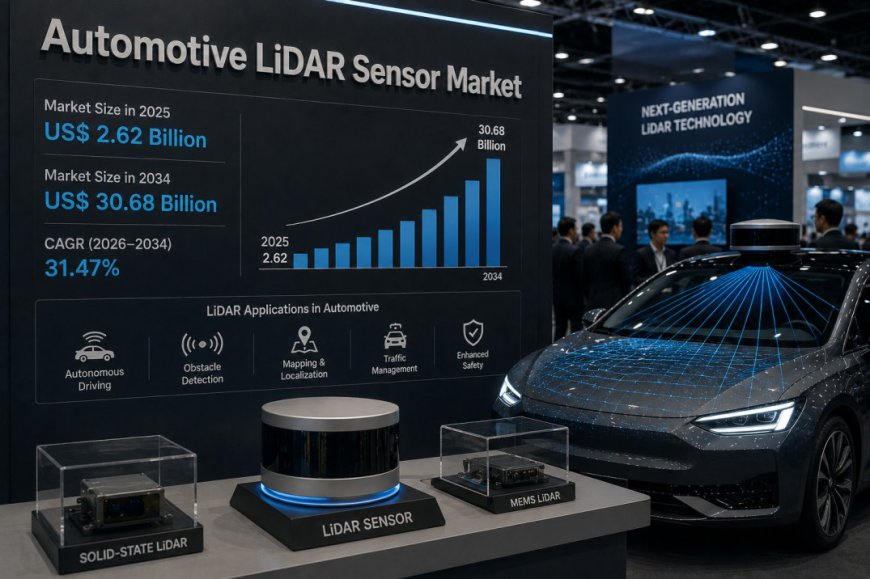
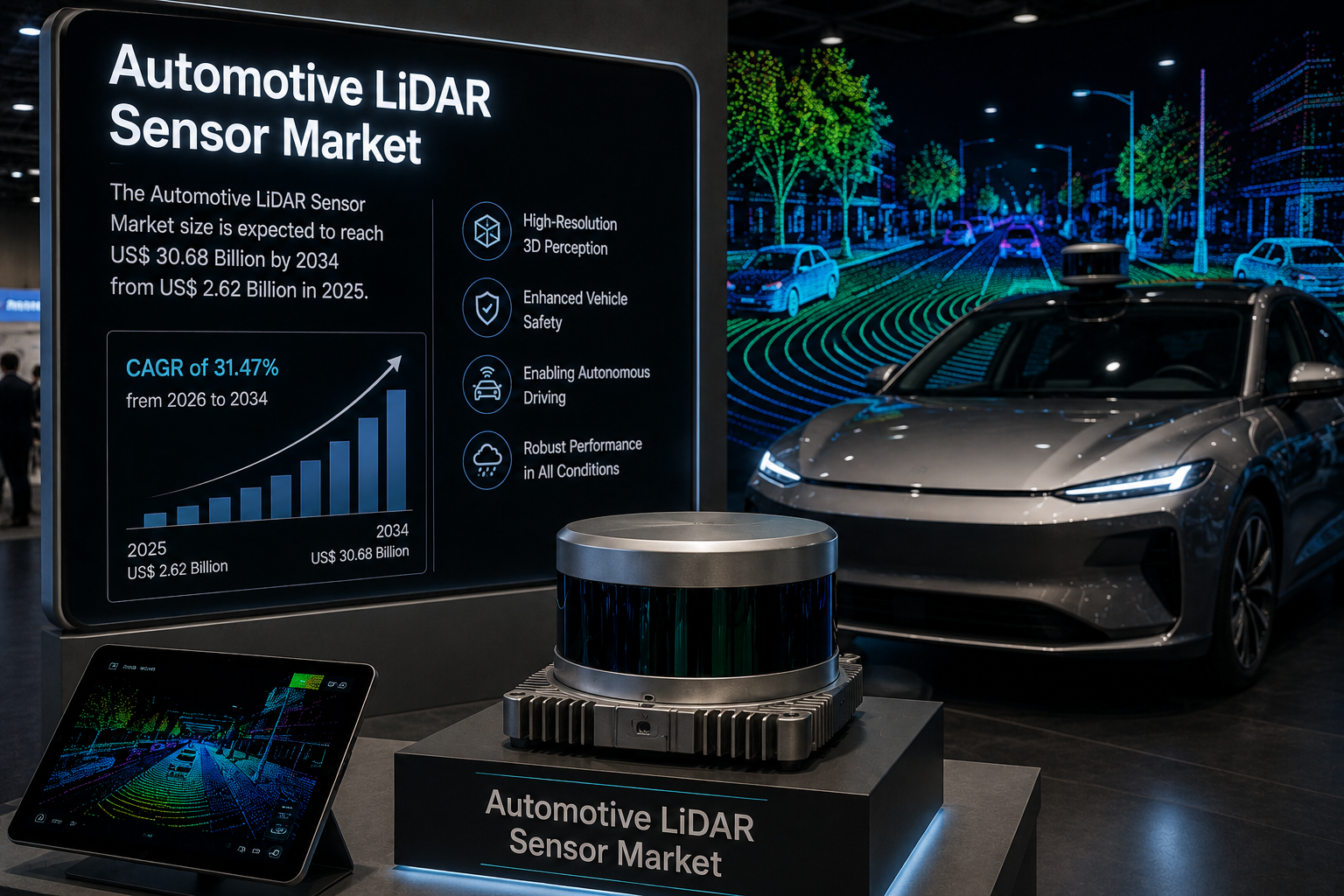
The Automotive LiDAR Sensor Market size is expected to reach US$ 30.68 Billion by 2034 from US$ 2.62 Billion in 2025. The market is estimated to record a CAGR of 31.47% from 2026 to 2034.
 newswires
Advanced sensing technologies are transforming the automotive industry by improving vehicle safety, automation, and driving intelligence. LiDAR sensors are becoming a critical component in modern vehicles due to their ability to provide precise environmental mapping, object detection, and real-time navigation capabilities. Automotive manufacturers are increasingly integrating LiDAR systems into advanced driver assistance systems (ADAS) and autonomous driving platforms to improve vehicle perception and collision avoidance. The growing focus on road safety, connected mobility, and intelligent transportation systems is significantly accelerating demand for high-performance automotive sensing technologies worldwide.
Automotive Lidar Sensor Market Overview
The Automotive Lidar Sensor Market is experiencing rapid growth due to increasing adoption of autonomous driving technologies and smart vehicle systems. According to The Insight Partners, the Automotive LiDAR Sensor Market size is expected to reach US$ 30.68 billion by 2034 from US$ 2.62 billion in 2025. The market is estimated to record a CAGR of 31.47% from 2026 to 2034. Rising deployment of ADAS technologies, increasing investments in autonomous vehicles, and growing government focus on vehicle safety standards are among the major factors driving market expansion. Technological advancements in sensor miniaturization, solid-state LiDAR systems, and AI-based vehicle perception are further supporting industry growth globally.
Key Drivers Accelerating Market Growth
One of the major growth drivers in the Automotive Lidar Sensor Market is the increasing adoption of autonomous and semi-autonomous vehicles. LiDAR sensors provide high-resolution 3D mapping and accurate object detection capabilities, enabling vehicles to navigate complex driving environments safely. Automotive manufacturers and technology companies are investing heavily in advanced sensor technologies to improve vehicle automation and operational reliability.
The growing implementation of advanced driver assistance systems is also contributing significantly to market growth. Features such as adaptive cruise control, lane departure warning, emergency braking, and pedestrian detection increasingly rely on LiDAR-based sensing technologies to enhance vehicle safety and driver awareness.
Another important factor driving the Automotive Lidar Sensor Market is the expansion of electric vehicle production. EV manufacturers are integrating advanced sensing systems to support intelligent mobility solutions and improve overall driving experiences. Increasing consumer demand for safer and smarter vehicles is expected to create strong opportunities for LiDAR sensor providers.
Get a Sample PDF Report: https://www.theinsightpartners.com/sample/TIPRE00013787
Segmentation Analysis of the Automotive Lidar Sensor Market
The Automotive Lidar Sensor Market is segmented based on type, vehicle type, application, and geography. By type, the market includes mechanical LiDAR and solid-state LiDAR systems. Solid-state LiDAR is witnessing substantial growth due to its compact design, lower manufacturing costs, and improved durability compared to traditional mechanical systems.
Based on vehicle type, the market includes passenger vehicles and commercial vehicles. Passenger vehicles account for a major share due to increasing integration of ADAS technologies and rising consumer preference for advanced safety features.
By application, the market is segmented into autonomous driving, collision avoidance, adaptive cruise control, parking assistance, and navigation systems. Autonomous driving applications represent a significant growth segment as automotive companies continue investing in fully autonomous mobility platforms.
Technological advancements in AI-powered image processing and sensor fusion technologies are further enhancing the performance and reliability of automotive LiDAR systems.
North America and US Automotive Lidar Sensor Market Analysis
North America represents a leading region in the Automotive Lidar Sensor Market due to strong technological innovation, rapid adoption of autonomous driving technologies, and increasing investments in connected vehicle infrastructure. The United States plays a dominant role in regional market growth, supported by the presence of major automotive manufacturers, technology companies, and autonomous vehicle developers.
The growing deployment of robotaxis, autonomous delivery vehicles, and smart mobility solutions in the US is driving demand for advanced LiDAR sensing technologies. Automotive companies are increasingly collaborating with sensor manufacturers and AI technology providers to improve vehicle automation and safety performance.
Additionally, government regulations promoting vehicle safety and investments in intelligent transportation systems are supporting market expansion across North America. The region is also witnessing increasing testing and deployment of autonomous vehicles in urban and commercial transportation environments.
Emerging Opportunities and Technological Advancements
Technological innovation continues to reshape the Automotive Lidar Sensor Market. The development of solid-state LiDAR technology is improving sensor reliability, reducing production costs, and enabling broader adoption across mass-market vehicles. Companies are increasingly focusing on compact and energy-efficient sensor designs suitable for large-scale automotive integration.
The integration of artificial intelligence and machine learning technologies into LiDAR systems is another major trend driving industry growth. AI-powered perception systems improve real-time object classification, environmental mapping, and decision-making capabilities in autonomous vehicles.
Another important opportunity lies in the expansion of smart city infrastructure and connected transportation ecosystems. LiDAR sensors are increasingly being integrated into intelligent traffic management systems, connected road infrastructure, and advanced mobility platforms to support safer and more efficient transportation networks.
Competitive Landscape and Industry Trends
The Automotive Lidar Sensor Market is highly competitive, with companies focusing on technological innovation, strategic partnerships, and expansion of autonomous driving capabilities. Market participants are investing heavily in research and development to improve sensor accuracy, detection range, and system integration efficiency.
Industry trends indicate growing demand for low-cost and scalable LiDAR solutions suitable for mass-market vehicle deployment. Companies are also focusing on improving software integration, sensor fusion capabilities, and AI-driven analytics to strengthen autonomous driving performance.
The market is expected to witness continued collaboration between automotive manufacturers, semiconductor companies, and autonomous technology providers to accelerate commercialization of next-generation LiDAR systems.
Key Companies in the Automotive Lidar Sensor Market
Some of the major companies operating in the Automotive Lidar Sensor Market include:
-
Velodyne Lidar Inc.
-
Luminar Technologies Inc.
-
Innoviz Technologies Ltd.
-
Ouster Inc.
-
Hesai Technology Co. Ltd.
-
Valeo SA
-
Continental AG
-
RoboSense Technology Co. Ltd.
-
Aeva Technologies Inc.
-
Quanergy Systems Inc.
These companies are focusing on advanced LiDAR innovations, AI-powered sensing technologies, and strategic automotive partnerships to strengthen their competitive positions globally.
Future Outlook
The Automotive Lidar Sensor Market is expected to witness exceptional growth during the forecast period due to increasing adoption of autonomous vehicles, rising deployment of ADAS technologies, and growing investments in intelligent transportation systems. North America and the US are anticipated to remain key growth regions owing to rapid advancements in connected mobility and autonomous driving technologies.
The integration of AI, machine learning, sensor fusion, and smart transportation infrastructure is expected to create substantial opportunities for market participants. Companies focusing on cost-efficient LiDAR systems, enhanced sensing performance, and scalable automotive integration solutions are likely to achieve long-term competitive advantages in the evolving automotive technology landscape.
Related Market Research Reports
Fiber Optics Testing Market Trends, Size & Growth by 2034
Commercial Water Heater Market Share, Size & Demand by 2034
About The Partners
The Insight Partners is a Insight global leader in market research, delivering comprehensive analysis and actionable insights across diverse industries. The company empowers decision-makers with data-driven intelligence to navigate evolving markets and accelerate growth.
Contact Us:
- Contact Person: Ankit Mathur
- E-mail: ankit.mathur@theinsightpartners.com
- Phone: +1-646-491-9876