Best Video Analytics Fire and Smoke Detection Solutions in Bahrain & GCC
 TekYousuf26
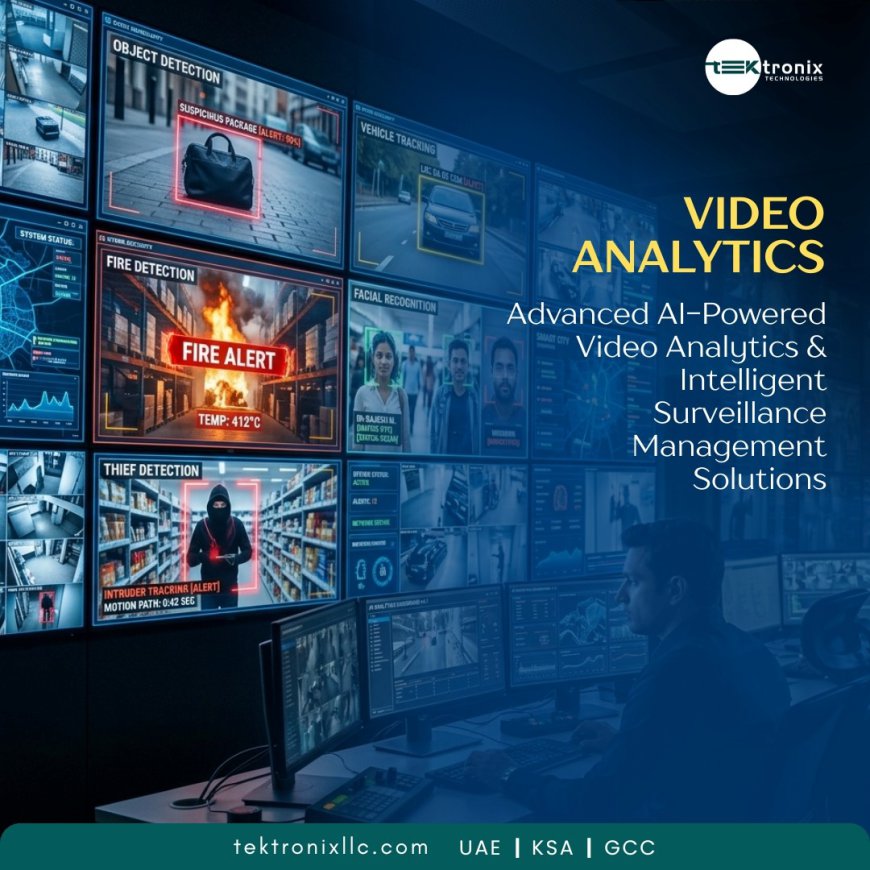
Every second counts when fire breaks out in a facility. Traditional smoke detectors and heat sensors respond only after combustion products have already accumulated — by which point evacuation windows may have narrowed critically. Video Analytics powered by deep-learning AI changes this equation entirely, detecting the first visible traces of smoke or flame through existing camera infrastructure and triggering protective protocols in real time — often minutes before a conventional detector would register an alarm. Across Bahrain's industrial corridors, Manama's commercial districts, and the broader Gulf Cooperation Council region, Tektronix LLC is deploying this technology to protect lives, assets, and business continuity at the highest level ever achieved in the region's fire safety history.
The Fire Risk Landscape in Bahrain and the GCC
Bahrain and its GCC neighbours face a convergence of fire risk factors that make advanced detection technology not merely beneficial but operationally essential. The region's petrochemical industry — centred on Bapco Energies, GPIC, Gulf Petrochemical Industries Company, and downstream facilities across Sitra Island — handles flammable hydrocarbons at enormous scale. Meanwhile, rapid urban expansion in Manama, Riffa, and the Bahrain Bay development has concentrated high-occupancy residential towers, hospitality assets, and retail complexes in dense footprints where fire spread risk is magnified.
Critical fire risk drivers unique to the GCC environment:
- Extreme heat — ambient temperatures above 48 °C accelerate fire spread rates and reduce evacuation response windows
- Shamal winds creating rapid fire propagation pathways across open industrial sites and construction zones
- High concentrations of LPG, natural gas, and petrochemical vapours in Bahrain's industrial zones
- Legacy building stock in Manama's commercial core with limited built-in suppression infrastructure
- Large-scale public gatherings at Bahrain International Circuit, Bahrain World Trade Centre, and shopping centres demanding crowd-aware fire detection
- Bahrain Civil Defence mandate requiring fire detection systems across all Category B and above commercial and industrial occupancies
AI-Powered Video Analytics: How Deep Learning Sees Fire Before You Do
AI-Powered Video Analytics applies convolutional neural networks (CNNs) and temporal pattern recognition algorithms trained on millions of fire and smoke incident frames to identify the characteristic pixel-level signatures of combustion — colour gradients, motion vectors, texture patterns, and temporal flicker profiles — that are invisible to the naked eye at early ignition stages and undetectable by particle-based sensors at distance.
The technology operates as a software intelligence layer applied to standard IP camera streams — no specialist thermal camera is required for most deployment scenarios, making it both technically accessible and commercially scalable across existing CCTV infrastructure. Tektronix LLC's AI fire detection engine:
Multi-Class Combustion Recognition
The detection model classifies combustion events across multiple visual classes simultaneously: open flame (slow-burning, fast-burning), dense black smoke (hydrocarbon combustion), light grey smoke (electrical fire), and white vapour plumes (steam, chemical vapour) — applying context filters to eliminate steam from cooking equipment or water spray systems that would cause false positives in conventional deployments.
Spatial and Temporal Fusion Analysis
Rather than analysing individual video frames in isolation, the AI engine tracks how candidate fire and smoke signatures evolve across 3–10 consecutive frames, confirming that the motion, spread, and luminosity patterns are consistent with real combustion physics rather than lighting changes, camera lens flare, or reflective surface movement. This multi-frame temporal fusion is the primary mechanism through which the system achieves high detection accuracy while minimising nuisance alarms.
Camera-Agnostic Deployment
The analytics engine is compatible with ONVIF-compliant IP cameras from all major manufacturers — Hikvision, Dahua, Axis, Bosch, Sony, and Hanwha — and integrates with existing video management systems (VMS) including Milestone XProtect, Genetec Security Center, Avigilon Control Center, and Exacq Vision. This means Bahrain facilities with existing camera infrastructure can deploy AI fire detection as a software upgrade without hardware replacement.
Real-Time Hazard Detection: The Speed Advantage That Saves Lives
Real-Time Hazard Detection through AI video analytics provides an average early warning lead time of 3 to 8 minutes ahead of conventional point detectors in large-volume spaces such as warehouses, aircraft hangars, petrochemical process areas, and atrium lobbies. In a fire scenario, 3 additional minutes of warning time can mean the difference between a controlled evacuation and a mass-casualty event.
The detection-to-alert pipeline in Tektronix LLC's system operates as follows:
- Camera streams are processed at the edge (on-camera AI processing) or at a local server appliance at 15–30 frames per second
- The AI engine analyses each frame for combustion signatures within 200–400 milliseconds of capture
- When a high-confidence detection event is confirmed across multiple consecutive frames, an alert is generated within 2–5 seconds of initial smoke or flame appearance
- The alert is simultaneously transmitted to: the facility security operations centre (SOC), the Bahrain Civil Defence command system (via API integration), designated safety officers' mobile phones via push notification and SMS, and the building automation system (BAS) for automatic activation of suppression, ventilation, and access control responses
- A video clip of the detection event is automatically archived with timestamp, camera ID, and GPS coordinates for incident investigation and insurance documentation
For comparison, NFPA 72-compliant conventional smoke detectors installed in high-bay industrial spaces typically require 4–12 minutes of smoke accumulation before reaching the particle density threshold that triggers an alarm — by which time a fire may have spread to adjacent fuel loads.
Automated Emergency Response: From Detection to Action Without Human Delay
Automated Emergency Response integration transforms AI fire detection from a passive alerting tool into an active safety orchestration system. When Tektronix LLC's analytics platform confirms a fire event, it can simultaneously trigger a fully programmable response protocol without waiting for human acknowledgement — compressing the time between detection and protective action to under 10 seconds.
Automated response actions configurable within the Tektronix LLC platform:
- Fire suppression activation: Trigger zone-specific sprinkler heads, gaseous suppression systems (FM-200, CO₂, NOVEC 1230), or deluge systems via dry-contact relay output
- Smoke control and ventilation: Open smoke exhaust dampers, activate stairwell pressurisation fans, and shut down HVAC systems to prevent smoke migration via ductwork — critical in Bahrain's air-conditioned high-rise environments
- Access control integration: Automatically unlock all fire escape routes and mag-lock doors on the affected floor while securing server rooms and asset vaults from potential post-fire theft
- Public address and mass notification: Trigger zone-specific pre-recorded evacuation announcements in Arabic and English via the building PA system
- Elevator recall: Send fire service recall commands to all elevators on the affected floor, preventing occupants from using lifts during evacuation
- Civil Defence API notification: Transmit structured incident data including location coordinates, camera evidence, and fire classification to Bahrain Civil Defence dispatch — accelerating emergency services response time
Reduced False Alarms: Protecting Productivity and Civil Defence Resources
Reduced False Alarms is one of the most commercially compelling benefits of AI video-based fire detection — and one of the most consistently cited pain points among Bahrain facility managers operating conventional detector arrays. Studies across GCC facility management sectors indicate that between 70% and 92% of all fire alarm activations are false alarms, caused by cooking vapours, steam, dust, insects, and HVAC airflow anomalies triggering particle-based detectors.
The operational cost of a false alarm in a commercial Bahrain facility includes:
- Civil Defence response mobilisation costs and potential regulatory penalty for repeat false alarm offences under Bahrain's National Fire Safety Code
- Operational disruption — evacuating a 500-person office building costs an estimated BHD 8,000–15,000 in lost productivity per event
- Occupant desensitisation — staff who experience repeated false alarms statistically respond more slowly and with less compliance to genuine emergency evacuations ('cry-wolf' effect)
- Reputational impact for hospitality, healthcare, and education sector facilities where repeated false evacuations undermine stakeholder confidence
Tektronix LLC's AI analytics engine reduces nuisance alarm rates by over 90% compared to conventional detectors in controlled GCC deployment comparisons, achieved through the temporal fusion analysis, context filtering, and multi-class discrimination described in Section 2. A kitchen generating steam, a forklift creating dust in a warehouse, or a cleaning team using a steam mop — all scenarios that would activate a conventional detector — are correctly classified by the AI as non-combustion events.
Detailed Incident Reporting: Compliance, Investigation, and Insurance
Detailed Incident Reporting generated automatically by the AI fire detection platform provides a structured, tamper-evident record of every detection event — from the initial frame in which smoke or flame was first identified through to the completion of the automated response protocol. This documentation serves multiple regulatory, operational, and commercial purposes across Bahrain and GCC jurisdictions:
Regulatory Compliance Documentation
Bahrain's Civil Defence Law No. 7 of 2021 and the National Fire Safety Code require facility operators to maintain records of all fire alarm activations, detector performance logs, and emergency response actions. The AI platform auto-generates PDF compliance reports capturing: detection timestamp, camera reference, event classification, response actions triggered, acknowledgement times, and resolution notes — formatted for direct submission to the General Directorate of Civil Defence (GDCD).
Insurance Claims and Forensic Investigation
When a fire event occurs, insurers and investigators require precise documentation of ignition origin, propagation timeline, and suppression response. AI video analytics provides frame-accurate visual evidence — timestamped video clips showing the exact location and time of first flame or smoke detection — that conventional detector log data alone cannot provide. Facilities with AI-generated incident evidence consistently achieve faster insurance claim resolution and, in many GCC cases, demonstrate suppression system performance that qualifies for premium reductions.
Performance Analytics and Audit Trails
Monthly and quarterly performance dashboards track system health metrics including: detection confidence scores per camera zone, alarm-to-response time averages, false alarm frequency trends, camera uptime, and AI model version history. These audit trails demonstrate due diligence to facility auditors, insurance underwriters, and Bahrain Civil Defence inspectors conducting annual fire safety compliance reviews.
Video Analytics Bahrain: Sector-Specific Deployment Applications
Video Analytics Bahrain deployments span every major economic sector in the Kingdom, each with fire detection requirements shaped by the specific hazards, occupancy profiles, and regulatory obligations of that industry:
Oil, Gas, and Petrochemical Facilities
Bapco Energies' refinery at Awali, GPIC's fertiliser complex in Sitra, and the downstream chemical processing facilities in Hidd Industrial Area operate with flammable hydrocarbon inventories that make a seconds-early fire warning of enormous consequence. AI video detection monitors process areas, tank farms, loading bays, and compressor stations that are too hazardous for regular human inspection — providing continuous remote surveillance with ATEX-certified camera hardware in Zone 1 and Zone 2 classified areas.
Healthcare and Life Sciences
King Hamad University Hospital, Salmaniya Medical Complex, and private hospital networks across Manama require fire detection systems that minimise patient evacuation disruption while providing absolute protection for operating theatres, intensive care units, pharmaceutical stores, and medical gas manifold rooms. AI-based detection dramatically reduces the false alarm rate that conventional systems generate in clinical environments where cooking vapours, anaesthetic gases, and autoclave steam are routine.
Hospitality and Entertainment
The Ritz-Carlton Bahrain, Four Seasons Hotel Bahrain Bay, and the hospitality cluster around Al Areen Palace require fire protection that operates with complete discretion — no unsightly detector arrays on heritage ceilings, no frequent false alarm evacuations that damage guest experience. AI analytics delivered through architecturally invisible PTZ cameras provides premium-grade protection without compromising the aesthetic or operational integrity of luxury guest environments.
Logistics, Warehousing, and Free Zones
Bahrain Logistics Zone (BLZ) and Khalifa Bin Salman Port's bonded warehousing facilities store mixed combustible inventories across high-bay spaces where point detectors are ineffective due to ceiling heights exceeding 12 metres. AI video analytics provides continuous wide-area surveillance of large floor areas from a small number of high-mounted cameras, detecting incipient fires in racking systems before they can spread laterally across adjacent pallet bays.
Video Analytics GCC: Regional Expansion Across the Gulf
Video Analytics GCC deployments by Tektronix LLC extend the same platform architecture across Saudi Arabia, the UAE, Qatar, Kuwait, and Oman — with country-specific configuration to meet each nation's civil defence regulations, building codes, and operational language requirements. The pan-GCC deployment model delivers significant advantages for regional enterprises and government entities operating across multiple jurisdictions:
- Unified management dashboard — a single cloud platform monitors all sites across all GCC countries from one login, with per-country regulatory report generation
- Centralised AI model updates — fire detection algorithm improvements trained on new GCC-specific combustion scenarios are pushed automatically to all deployed cameras
- Arabic-language operator interface — full platform localisation in Arabic for GCC Civil Defence and facility management operators
- Regional compliance mapping — automated report templates formatted for NFPA 72, EN 54, BS 5839, and country-specific civil defence standards applied simultaneously
- Cross-border incident escalation — for enterprise clients with operations in multiple GCC states, detection events at any site automatically alert the regional security operations centre regardless of location
Key GCC markets served by Tektronix LLC's AI fire detection platform beyond Bahrain include high-demand sectors in Saudi Arabia (Aramco supply chain facilities, NEOM construction sites, Vision 2030 mega-project campuses), UAE (JAFZA industrial warehouses, Dubai Healthcare City, Abu Dhabi nuclear facility perimeter), Qatar (LNG plant support facilities, FIFA World Cup 2022 legacy venues), and Kuwait (KOC upstream production sites).
Why Tektronix LLC Is the GCC's Leading AI Fire Detection Partner
Tektronix LLC's position as the region's most trusted AI-powered fire safety technology provider is built on four verifiable pillars of excellence:
- Experience: Over 15 years delivering critical safety and surveillance technology across Bahrain, Saudi Arabia, UAE, Qatar, and Oman — with dedicated in-country engineering teams in each major GCC market
- Expertise: Certified fire safety engineers (CFPS), CCTV design specialists (CSPM), and AI systems integration architects on staff; annual training certification with leading AI analytics platform vendors including Avigilon, BriefCam, Genetec, and Bosch BVMS
- Authoritativeness: Approved contractor with Bahrain's General Directorate of Civil Defence (GDCD); solutions compliant with NFPA 72, EN 54-10 (flame detector standard), EN 54-12 (line detector standard), and BS 5839 Part 1; integration partner with Milestone, Genetec, and Avigilon
- Trustworthiness: ISO 9001:2015-certified project delivery; 24/7/365 NOC monitoring support with Arabic and English response capability; annual system health certification reports delivered to client safety officers and regulatory bodies; transparent SLA commitments with financial performance guarantees
Integrated Safety Technology Ecosystem
AI fire and smoke detection does not operate as a standalone system in a mature safety architecture. Tektronix LLC integrates fire detection analytics with a full ecosystem of complementary intelligent safety technologies to create a unified critical facility protection platform:
- Perimeter intrusion detection analytics: AI-powered detection of unauthorised access attempts near high-hazard areas before human-caused fire incidents occur
- PPE compliance monitoring: Video analytics verifying that workers in high-fire-risk industrial zones are wearing fire-retardant PPE, hard hats, and hi-vis vests at all times
- Crowd density analytics: Real-time occupancy monitoring enabling pre-emptive evacuation route management before a fire event occurs in a high-density public assembly area
- Hazardous material spill detection: Computer vision detection of liquid spills in petrochemical and industrial environments that represent potential fire ignition precursors
- Building management system (BMS) integration: Bidirectional data exchange with Honeywell, Siemens, and Johnson Controls BMS platforms for unified facility safety orchestration
Conclusion
Fire does not wait for a detector to catch up. In Bahrain's petrochemical plants, high-rise hotels, hospital wards, and logistics hubs — and across every critical facility throughout the GCC — the margin between early detection and catastrophic loss is measured in seconds, not minutes. Conventional detection technology, designed for slower-moving industrial environments of a previous era, cannot bridge that margin in today's high-density, high-value built environment.
Tektronix LLC's AI fire and smoke detection platform — anchored by the deep-learning intelligence of AI-Powered Video Analytics — closes that gap permanently. By seeing fire and smoke at their earliest visible stage, automating the emergency response sequence, and generating the detailed compliance evidence that regulators, insurers, and safety managers require, our solution does not merely meet the standard — it redefines it. Contact Tektronix LLC today to commission a site assessment and discover how AI video intelligence can protect your people, assets, and operations across Bahrain and the wider GCC.
FAQs
FAQ 1: How does AI-Powered Video Analytics detect fire faster than conventional smoke detectors?
Conventional point detectors require combustion particles to physically reach the detector's sensing chamber — a process that in large open spaces or high-bay environments can take 4 to 12 minutes. AI video analytics detects fire and smoke visually, identifying the characteristic pixel signatures of early-stage combustion in the camera's field of view within 2 to 5 seconds of first appearance. The AI analyses motion vectors, colour gradients, luminosity flicker, and temporal spread patterns across consecutive video frames using convolutional neural networks trained on millions of real fire incident recordings. This visual detection mechanism operates at the speed of light — literally — and is independent of air circulation, ceiling height, or particle density thresholds.
FAQ 2: Can the system be deployed on our existing CCTV cameras in Bahrain?
In the majority of cases, yes. Tektronix LLC's AI fire detection engine is compatible with any ONVIF-compliant IP camera operating at a minimum resolution of 1080p and providing an RTSP video stream. This covers cameras from Hikvision, Dahua, Axis, Bosch, Hanwha, Sony, Pelco, and most other mainstream manufacturers. Tektronix LLC's implementation engineers conduct a camera suitability assessment during the pre-deployment site survey, evaluating field of view coverage, image quality under Bahrain's variable lighting conditions (particularly in outdoor areas with intense sun glare), frame rate, and night vision capability. Where existing cameras are unsuitable — typically in outdoor areas with extreme lighting contrast or in high-bay spaces requiring wide-angle coverage — targeted hardware upgrades are specified for only the affected zones, minimising overall project cost.
FAQ 3: What is the false alarm rate compared to conventional detectors?
Tektronix LLC's AI platform consistently achieves false alarm rates below 2% in GCC operational deployments, compared to the 70–92% false alarm rate documented across conventional detector arrays in the region's commercial and industrial facilities. This improvement is achieved through multi-class combustion discrimination (distinguishing real flame and smoke from steam, dust, reflections, and lighting changes), temporal fusion analysis across multiple consecutive frames (requiring sustained combustion signatures before confirming an alert), and facility-specific exclusion zone configuration (defining areas such as kitchen exhaust vents or steam cleaning stations where non-fire vapours are routinely present). The result is a system that operators trust implicitly — responding immediately when the alarm sounds because they know it represents a genuine threat.
FAQ 4: How does Automated Emergency Response integration work with Bahrain Civil Defence?
Tektronix LLC's platform integrates with the Bahrain General Directorate of Civil Defence (GDCD) notification framework through a combination of direct API connection (where GDCD's digital command system supports structured data ingestion) and automated voice/SMS notification to registered Civil Defence contact numbers. When the AI confirms a fire event, the platform transmits: the facility name and address, the specific zone and camera reference, the detection timestamp, the event classification (flame, dense smoke, light smoke), and a direct link to the live camera stream and recorded detection clip. This pre-structured incident data enables Civil Defence dispatch to mobilise the correct resource type (tanker, aerial platform, hazmat unit) from the moment of the call — rather than waiting for first-responder scene assessment.
FAQ 5: What Detailed Incident Reporting is produced for compliance with Bahrain's fire safety regulations?
The platform auto-generates structured compliance documentation for every alarm event, including: a PDF incident report showing detection timestamp, camera ID, AI confidence score, event classification, automated response actions triggered, and human acknowledgement time; a timestamped video clip of the detection event archived in tamper-evident cloud storage; a system performance log showing detector uptime, camera health, and AI model version for the reporting period; and a regulatory summary report formatted for submission to the GDCD in compliance with Bahrain's National Fire Safety Code record-keeping requirements. For clients operating under ISO 45001 (Occupational Health and Safety Management), OHSAS 18001, or NFPA 72 audit regimes, the platform generates additional report formats aligned with each standard's documentation requirements. All records are retained for a minimum of five years in encrypted cloud storage with access controls and audit trails that meet both Bahrain's PDPL data protection requirements and international insurance documentation standards.