Commercial Avionic Systems Market Outlook 2033: US$ 121.08 Billion Size Backed by Strong 9.07% CAGR
Commercial avionic systems are integrated electronic technologies used in aircraft to support safe, efficient, and reliable operation.
 raajblog
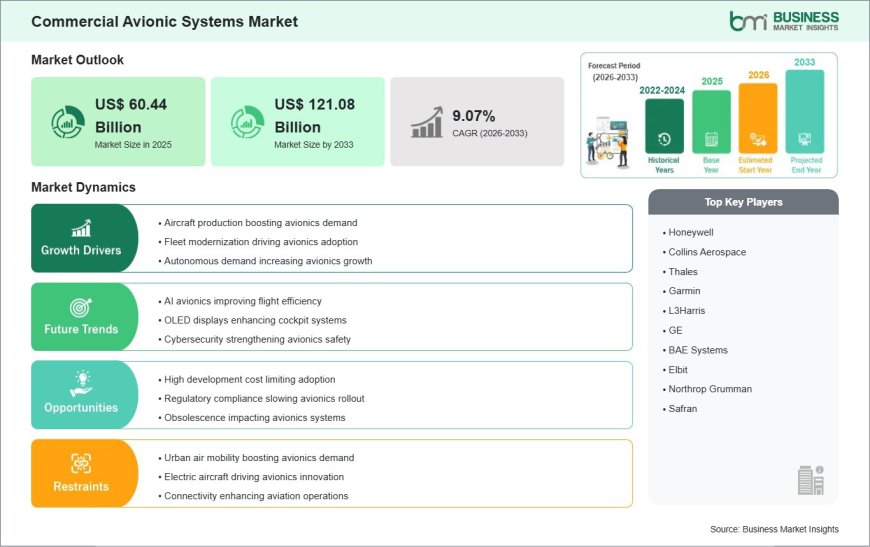
The Commercial Avionic Systems Industry is expanding rapidly as aircraft become more connected, digitally integrated, and performance-driven.
According to Business Market Insights, the global Commercial Avionic Systems Market size is expected to reach US$ 121.08 Billion by 2033 from US$ 60.44 Billion in 2025, registering a CAGR of 9.07% from 2026 to 2033.
Technological innovation is reshaping the Commercial Avionic Systems Market through connected aircraft architectures, digital communication systems, real-time weather reporting, satellite-based navigation, and intelligent flight management platforms. Airlines and aircraft manufacturers are increasingly adopting integrated avionics solutions to improve operational efficiency, enhance safety, reduce fuel consumption, and ensure compliance with evolving aviation regulations. These developments are creating strong opportunities for both OEM-installed systems and retrofit solutions across the global aviation ecosystem.
Download Sample Report : https://www.businessmarketinsights.com/sample/BMIPUB00035364
What Are Commercial Avionic Systems?
Commercial avionic systems are integrated electronic technologies used in aircraft to support safe, efficient, and reliable operation. These systems include navigation tools, communication networks, flight management systems, collision avoidance technologies, weather detection units, and power/data systems. Together, they form the digital backbone of modern aircraft and play a critical role in helping pilots, airlines, and air traffic control teams coordinate smooth flight operations.
These systems are used to improve situational awareness, automate key functions, and enhance aircraft performance under varying conditions. As aviation networks become more complex and connected, avionic systems are becoming increasingly essential for maintaining safety, performance, and regulatory compliance. Their importance continues to grow as airlines modernize fleets and embrace more digital flight operations.
Market Drivers
A major driver of the Commercial Avionic Systems Market is rising aircraft production worldwide. As new aircraft are manufactured and delivered to airlines, avionics are installed to meet safety requirements, improve operational reliability, and support digital flight capabilities. This growing production cycle is creating strong demand for line-fit avionics and advanced integrated systems that can be installed during manufacturing.
Another important growth factor is the modernization of air traffic and aircraft communication systems. Airlines increasingly require continuous, real-time connectivity between aircraft and ground control, making communication systems a core part of commercial operations. As satellite-based communication and connected aircraft technologies become more common, the need for robust and secure avionics continues to expand.
Urban air mobility is also creating new opportunities for the market. Emerging aircraft concepts such as electric vertical takeoff and landing vehicles require advanced navigation, communication, and collision avoidance technologies to operate safely in dense urban environments. These new aviation models are encouraging the development of compact, lightweight, and highly integrated avionics solutions.
Market Segmentation
By Systems
- Navigation: Satellite-based solutions that improve route precision and flight efficiency.
- Communication: Secure and reliable cockpit-ground connectivity for real-time operations.
- Flight Management: Automated systems that optimize performance monitoring and fuel use.
- Collision Avoidance: Integrated tools that reduce risk and improve flight safety.
- Weather Detection: Radar and sensing systems that support proactive route decisions.
- Power/Data: Core infrastructure that enables synchronized avionics performance and data flow.
By Platform
- Commercial Aviation: Airlines that rely on avionics for efficiency, safety, and regulatory compliance.
- Military Aviation: Defense programs that require secure and mission-specific avionics.
- General Aviation: Private and smaller operators focused on navigation and safety reliability.
- Special Mission: Custom systems used in surveillance, rescue, and specialized operations.
By Fit
- Line-fit: Factory-installed systems integrated during aircraft manufacturing.
- Retrofit: Upgrade solutions used to modernize existing aircraft fleets.
The communication segment accounted for a significant share of the market in 2025 due to the growing need for continuous and secure aircraft-ground connectivity. Commercial aviation dominated the platform segment because it represents the largest aircraft fleet and continues to see strong deliveries. The line-fit segment led the market by fit, supported by rising aircraft production and the preference for OEM-installed systems.
Regional Insights
- North America remains a major market due to regulatory incentives, a large commercial fleet base, and strong adoption of next-generation avionics.
- Asia-Pacific is expected to grow rapidly, supported by fleet expansion, rising air passenger traffic, and strong demand from China, India, and Japan.
- Europe continues to advance through mature aviation infrastructure, sustainability initiatives, and strong emphasis on compliance and interoperability.
- Latin America is gradually expanding as airlines modernize operations and improve digital flight systems.
- Middle East & Africa is also showing strong potential, supported by aviation growth, fleet upgrades, and regional connectivity investments.
Top Players in the Commercial Avionic Systems Market
The market is highly competitive, with leading companies focusing on product integration, safety, connectivity, and aircraft modernization to strengthen their market positions.
- Honeywell
- Collins Aerospace
- Thales
- Garmin
- L3Harris
- GE
- BAE Systems
- Elbit
- Northrop Grumman
- Safran
These companies are investing in avionics innovation, digital cockpit technologies, communication systems, and advanced integration capabilities to address the growing demands of commercial aircraft operators and manufacturers.
Technological Innovations
Technological innovation is transforming the Commercial Avionic Systems Market through smarter, more connected, and more automated aircraft systems. Modern avionics increasingly incorporate satellite navigation, real-time weather intelligence, and digital communication tools that support safer and more efficient flight operations. These innovations are helping airlines improve route planning, reduce delays, and optimize fuel usage.
Another important trend is the move toward connected aircraft ecosystems. By linking avionics systems with broader aircraft and ground-based digital networks, operators can improve data sharing, maintenance visibility, and operational decision-making. This shift is supporting the aviation industry’s transition to more intelligent and responsive fleet management.
The market is also benefiting from ongoing development in lightweight and compact avionics hardware. These systems are especially important for next-generation aircraft and urban air mobility platforms, where space, weight, and power efficiency are critical design requirements.
Future Market Outlook
The future outlook for the Commercial Avionic Systems Market remains highly positive. Rising aircraft production, fleet modernization, and digital aviation transformation are expected to sustain strong demand through 2033. As airlines and aircraft manufacturers continue investing in connected, efficient, and safety-focused technologies, avionics will remain a core part of aviation modernization.
Companies that focus on integration, compliance, reliability, and next-generation digital capabilities are likely to capture the strongest growth opportunities. With aviation moving toward a more connected and automated future, commercial avionic systems will continue to play a central role in improving performance and supporting global air transportation.
Frequently Asked Questions (FAQs)
What is the projected size of the Commercial Avionic Systems Market by 2033?
The market is projected to reach US$ 121.08 Billion by 2033, rising from US$ 60.44 Billion in 2025.
What is the CAGR for the Commercial Avionic Systems Market?
The market is expected to grow at a CAGR of 9.07% from 2026 to 2033.
Which systems segment dominated the market in 2025?
The communication segment held a significant share in 2025.
Which platform segment dominated the market in 2025?
Commercial aviation dominated the market in 2025.
Which fit segment led the market in 2025?
The line-fit segment led the market in 2025.
Browse More Reports:
https://www.businessmarketinsights.com/reports/africa-non-invasive-radiosurgery-robots-market
https://www.businessmarketinsights.com/reports/middle-east-non-invasive-radiosurgery-robots-market
About Us
Business Market Insights is a market research platform that provides subscription service for industry and company reports. Our research team has extensive professional expertise in domains such as Electronics & Semiconductor; Aerospace & Defense; Automotive & Transportation; Energy & Power; Healthcare; Manufacturing & Construction; Food & Beverages; Chemicals & Materials; and Technology, Media, & Telecommunications.
Contact Us
If you have any questions about this report or would like further information, please contact us:
Contact person: Ankit Mathur
Email: sales@businessmarketinsights.com
Phone: +16467917070