Continuous Carbon Fibre 3D Printing: The Lightweight Alternative to Machined Aluminium
 forgelabs
When engineers need parts that are both lightweight and exceptionally strong, traditional manufacturing often means CNC machining aluminium or steel. While these materials perform well, they also increase production time, cost, and weight.
Continuous Carbon Fibre (CCF) 3D printing is changing that equation.
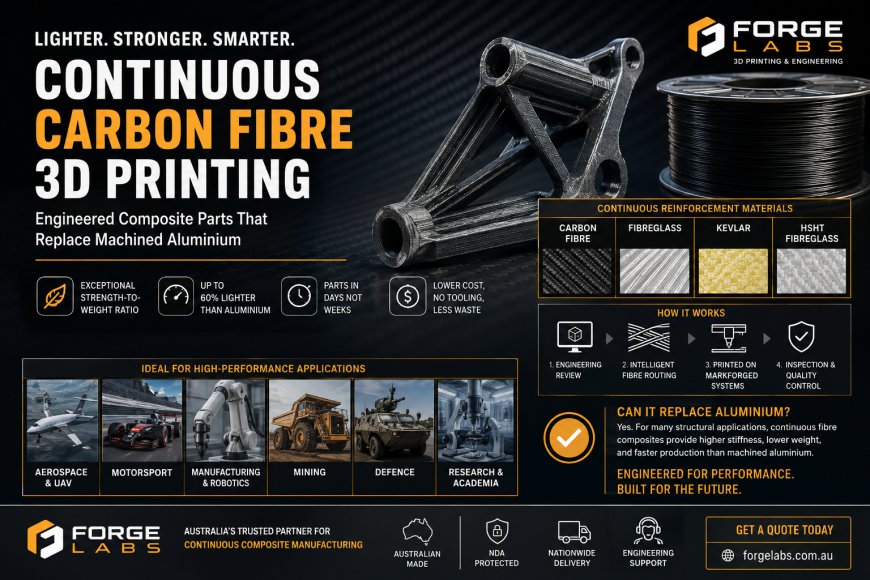
Using advanced composite manufacturing systems such as Markforged technology, Forge Labs produces structural components reinforced with continuous carbon fibre, fibreglass, Kevlar, and HSHT fibreglass. These engineered composite parts deliver outstanding strength-to-weight ratios, rapid production, and significant cost savings compared to conventional machining.
Whether you're developing aerospace components, manufacturing fixtures, robotics, motorsport parts, or industrial equipment, continuous fibre reinforcement enables production-ready parts in days instead of weeks.
What Is Continuous Carbon Fibre 3D Printing?
Unlike standard carbon fibre filaments, which contain tiny chopped fibres mixed throughout the plastic, continuous carbon fibre 3D printing embeds uninterrupted strands of aerospace-grade carbon fibre directly inside a printed nylon composite.
The process combines:
- Onyx (carbon-filled nylon) as the structural matrix
- Continuous reinforcement fibres placed exactly where strength is required
- Intelligent fibre routing based on engineering load cases
The result is not simply a stronger plastic part—it is an engineered composite structure designed specifically for mechanical performance.
Why Continuous Fibre Is Different
Traditional FDM printing relies entirely on thermoplastics for strength.
Continuous fibre technology reinforces those plastics with long, uninterrupted strands that carry tensile loads across the component.
This provides:
- Significantly higher stiffness
- Greater tensile strength
- Reduced deflection under load
- Improved fatigue resistance
- Excellent dimensional stability
Instead of increasing material everywhere, reinforcement is only added where stress occurs, creating highly efficient structural components.
How Forge Labs Engineers Every Part
Every continuous carbon fibre project begins with understanding how the part will actually be used.
1. Engineering Review
Customers provide:
- CAD files
- STEP or STL models
- Expected loading conditions
- Environmental requirements
Engineers determine where reinforcement is needed rather than simply printing a standard infill pattern.
2. Fibre Routing Design
Depending on the application, fibre may be placed using:
- Concentric reinforcement
- Isotropic reinforcement
- Unidirectional reinforcement
This creates the highest strength exactly where the component experiences load.
3. Printing on Markforged Systems
Forge Labs produces components using industrial Markforged composite printers including:
- Mark Two
- X7
- Onyx composite systems
Each layer combines carbon-filled nylon with continuous reinforcement to create an integrated composite structure.
4. Inspection and Quality Control
Finished components undergo:
- Dimensional verification
- Surface inspection
- Mechanical validation where required
- Fibre layup documentation
Every production part is checked before dispatch.
Key Benefits of Continuous Carbon Fibre 3D Printing
Outstanding Strength-to-Weight Ratio
One of the biggest advantages of continuous fibre reinforcement is exceptional structural efficiency.
Typical benefits include:
- Around 800 MPa tensile strength along fibre direction
- Approximately 60% of aluminium's weight
- Excellent stiffness
- High fatigue resistance
This makes it ideal where weight reduction directly improves performance.
Faster Manufacturing
Traditional CNC machining often requires:
- Material procurement
- Programming
- Machining
- Finishing
- Multiple setup operations
Continuous carbon fibre printing removes many of these steps.
Many functional prototypes can be delivered within 48 hours.
Lower Production Costs
Without expensive tooling or lengthy machining operations, businesses can manufacture:
- Single prototypes
- Engineering validation parts
- Custom fixtures
- Production tooling
- Low-volume manufacturing components
This significantly reduces project costs.
Design Freedom
Complex geometries become practical without additional machining expense.
Engineers can produce:
- Internal channels
- Lightweight lattice structures
- Organic load paths
- Integrated mounting features
- Custom reinforcement zones
These designs are often impossible or prohibitively expensive using conventional manufacturing.
Materials Available
Onyx (Carbon-Filled Nylon)
Onyx forms the structural base of every composite part.
It provides:
- Excellent dimensional stability
- Toughness
- Superior surface finish
- Better strength than standard ABS
Continuous Carbon Fibre
Ideal when maximum stiffness and minimum weight are priorities.
Applications include:
- Structural brackets
- Robotics
- UAV frames
- Motorsport components
Continuous Fibreglass
Offers:
- High tensile strength
- Greater flexibility than carbon fibre
- Cost-effective reinforcement
Suitable for many industrial applications.
Continuous Kevlar
Kevlar reinforcement excels where impact resistance matters.
It is commonly used for:
- Protective equipment
- Flexible fixtures
- Parts exposed to repeated impacts
HSHT Fibreglass
Designed for elevated temperature environments.
Ideal for:
- Heated tooling
- Under-bonnet automotive parts
- Manufacturing fixtures
Applications Across Australian Industry
Continuous carbon fibre printing is increasingly replacing machined metal components across multiple industries.
Aerospace and UAV
Lightweight structures improve flight efficiency while maintaining structural integrity.
Typical parts include:
- Drone frames
- Payload mounts
- Sensor brackets
- Airframe components
Motorsport
Every gram matters in competitive racing.
Composite components include:
- Air ducts
- Mounting brackets
- Electronics housings
- Cooling systems
Manufacturing
Factories use continuous fibre components for:
- Assembly fixtures
- Robot end-effectors
- Workholding systems
- Inspection jigs
These parts reduce weight while maintaining rigidity.
Mining
Mining operators often require replacement parts quickly.
Continuous fibre printing enables rapid production of:
- Equipment brackets
- Protective guards
- Maintenance fixtures
- Custom replacement components
Reducing equipment downtime can save thousands of dollars.
Defence
Many defence projects require:
- Rapid prototyping
- Secure manufacturing
- NDA-protected workflows
- High-strength structural components
Continuous fibre technology enables confidential development without lengthy machining lead times.
Research and Universities
Research organisations frequently require unique one-off components that cannot justify expensive tooling.
Continuous carbon fibre provides an ideal solution for:
- Laboratory rigs
- Sensor mounts
- Test fixtures
- Experimental equipment
Can Continuous Carbon Fibre Replace Aluminium?
For many applications, yes.
Continuous fibre composites can replace machined aluminium when the design prioritises:
- High stiffness
- Reduced weight
- Rapid production
- Lower manufacturing cost
- Moderate operating temperatures
Applications involving extreme heat, heavy wear surfaces, or complex multi-axis loads may still require traditional metals, but many brackets, fixtures, housings, and structural supports can successfully transition to composite manufacturing.
Engineering evaluation determines the most appropriate solution.
Why Australian Engineers Choose Forge Labs
Forge Labs combines industrial composite printing with practical engineering expertise.
Every project benefits from:
- Industrial Markforged composite printers
- Continuous carbon, Kevlar, fibreglass, and HSHT reinforcement
- Engineering-led fibre routing
- Fast Australian production
- NDA protection for confidential projects
- Rapid quoting and nationwide delivery
Rather than simply printing files, Forge Labs works with customers to optimise each component for strength, weight, and manufacturing efficiency.
The Future of Lightweight Manufacturing
As industries continue demanding lighter, stronger, and faster-to-produce components, continuous carbon fibre 3D printing is becoming an increasingly valuable manufacturing technology.
From aerospace and motorsport to mining, defence, robotics, and industrial automation, engineered composite parts are replacing traditionally machined aluminium in countless applications.
With intelligent fibre placement, rapid turnaround, and outstanding mechanical performance, continuous carbon fibre manufacturing allows businesses to move from concept to production significantly faster while reducing both cost and weight.
If your project requires structural performance without the delays of conventional machining, Forge Labs' continuous carbon fibre 3D printing service provides a modern manufacturing solution designed for Australia's most demanding engineering applications.