Dust collector manufacturer in Delhi | Shimi Research
Looking for reliable dust control solutions? Shimi Research offers industrial dust collectors, bag filters, cyclone systems, and air filtration equipment for factories.
 shimiresearch
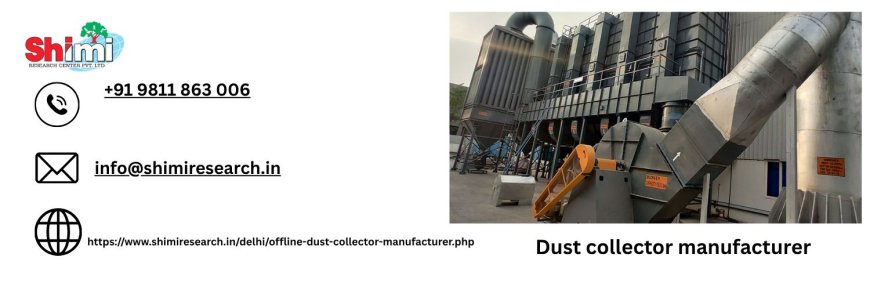
Dust is an everyday challenge in many factories and workshops. It can come from grinding cutting drilling polishing mixing crushing or even moving raw materials from one place to another. At first a little dust may not seem like a serious issue. But when machines keep running for several hours those small particles can quickly spread across the production area.
Dust can settle on machines floors tools and workstations. Fine particles can also remain suspended in the air. This is why industries need a practical way to collect dust instead of depending only on regular cleaning.
Shimi Research provides dust collection and air filtration solutions for different industrial applications. The company focuses on understanding the process first and then suggesting equipment according to factors such as dust type airflow production conditions and available space.
Why Does Dust Become a Problem in Industrial Areas?
Think about a workshop where grinding machines operate continuously. Every time a component is processed more dust is released. By the end of the day the same dust may be visible on nearby surfaces and equipment.
Without proper extraction particles can travel much farther than the point where they were originally generated. This can make the production floor harder to maintain and increase the need for frequent cleaning.
A suitable collection arrangement works at the source. Instead of allowing dust to move freely around the workplace it pulls dust-filled air toward a collection unit. This simple change can make dust management much more practical.
How Does an Industrial Dust Collector Work?
The working principle is easier to understand than it may sound. Dust-producing equipment is connected to an extraction arrangement. A fan creates the required airflow and draws dust-filled air through ducting toward the collector.
Inside the unit dust is separated from the air through filtration or mechanical separation. The collected material is then stored or discharged depending on the system design.
The final setup can look different from one industry to another. A system used for heavier particles may not be suitable for very fine dust. Similarly a small workshop may require a different airflow arrangement than a large production facility.
This is why the application should always be considered before selecting equipment.
Why Is Shimi Research a Practical Choice?
When businesses search for dust collection equipment they often focus only on machine capacity or price. These things matter but they are not the whole story. A collector needs to work properly with the machines ducting airflow and type of material used in the factory.
Shimi Research focuses on the actual industrial application. The company provides solutions that can be planned around the production process and available installation area.
Whether the requirement involves dust generated from machinery or a larger air management setup the aim is to provide a practical solution rather than a one-size-fits-all product.
The company also provides Pollution Control Equipment for industrial applications where controlling dust and airborne particles is an important part of the production environment.
What Are the Different Dust Collection Options?
Different industrial processes create different kinds of dust. Because of this there is no single collection method that works equally well everywhere.
Bag filtration is commonly considered for dry particulate applications. In this type of arrangement air passes through filter bags and dust is captured by the filtration surface.
A Cyclone Dust Collector works using centrifugal force. It separates heavier particles from the moving air and can be useful in applications where larger or heavier dust needs to be removed.
In some cases more than one technology can be used in the same system. For example heavier particles can be separated first followed by finer filtration. The appropriate combination depends on the process and filtration requirement.
How Can Dust Extraction Help During Daily Production?
One of the simplest ways to improve dust control is to collect it as close as possible to the source.
Suppose a grinding machine is producing dust. Instead of allowing that dust to spread across the workshop an extraction hood or suitable collection point can be positioned near the machine. The contaminated air is then pulled into the extraction system.
The same principle can be applied to cutting machines conveyors hoppers mixing equipment and other dust-producing processes.
A properly designed Dust Extraction System can therefore become part of the production setup rather than something added later as an afterthought.
It can also reduce the amount of dust that settles on equipment and surrounding surfaces making routine housekeeping easier.
Can One Dust Collector Be Used for Every Factory?
Not necessarily. This is one of the most important things to understand before buying a system.
A woodworking facility may generate sawdust and wood chips. A metalworking unit may produce fine metal particles. A powder-processing facility may deal with very fine material. These materials behave differently so the collection requirements can also be different.
The system may need to be planned around the type of dust particle size dust load number of collection points airflow temperature and operating hours.
This is where application-based planning becomes useful. Instead of asking only “Which machine should we buy?” businesses should first ask “What does our process actually require?”
What Should You Check Before Selecting Equipment?
Start by looking at the source of the dust. Identify which machines or activities are creating it and how frequently they operate.
Next consider the material itself. Is it heavy or lightweight? Coarse or fine? Dry or mixed with other substances? The answers can influence the type of collection and filtration technology required.
Airflow is another important consideration. The system needs to provide suitable air movement for effective capture. Ducting also matters because poorly planned duct routes can affect overall performance.
Installation space should not be ignored either. The equipment needs to fit comfortably within the factory while still allowing access for inspection and maintenance.
Finally consider how collected dust will be removed and handled. A system is easier to manage when its collection and discharge arrangement fits the daily workflow.
Why Choose an Industrial Dust Collector Manufacturer in Delhi?
Delhi and nearby industrial regions have a wide range of manufacturing and processing businesses. Fabrication units engineering workshops chemical plants food processing facilities and other industries may have different dust control requirements.
Working with an Industrial Dust Collector Manufacturer in Delhi can make communication and project planning easier for businesses in the region. Instead of relying only on standard specifications industries can discuss their process and understand what type of solution may be suitable.
Shimi Research works with industrial requirements and provides equipment for dust collection filtration and air management applications.
How Does Better Air Filtration Support a Factory?
Air quality is not just about what can be seen. Fine particles may remain in the surrounding air even when the floor and machines look clean.
A suitable Industrial Air Filtration arrangement helps remove unwanted particles from process air. When extraction and filtration are planned properly dust can be captured before it spreads through the production area.
This can also support cleaner machinery and workspaces. For industries that operate continuously having a reliable filtration setup can make daily maintenance more manageable.
What Other Solutions May Be Needed?
Dust collection is often one part of a larger industrial air management plan. Depending on the process a factory may also need ventilation systems additional filtration stages or other pollution control arrangements.
Shimi Research provides solutions for different industrial air management requirements. Its equipment can be selected according to the application operating conditions and desired level of particle control.
This allows businesses to look at the complete air management requirement instead of treating dust collection as an isolated machine.
Conclusion
Industrial dust is not always something that can be completely avoided but it can be managed with the right approach. The most useful system is one that fits the actual production process and captures dust as close to its source as possible.
From selecting the right filtration method to planning airflow ducting collection points and maintenance access every part of the setup matters.
Shimi Research provides practical dust collection and filtration solutions for industrial applications. Businesses looking for an Industrial Dust Collector Manufacturer in Delhi can consider their process dust characteristics airflow requirements and available space before choosing equipment.
With the right system in place dust management becomes less of a daily headache and more of a properly planned part of the production process.